
Jim Simons, Math Genius Who Conquered Wall Street, Dies at 86
Jonathan Kandell in the New York Times:
 Mr. Simons equipped his colleagues with advanced computers to process torrents of data filtered through mathematical models, and turned the four investment funds in his new firm, Renaissance Technologies, into virtual money printing machines.
Medallion, the largest of these funds, earned more than $100 billion in trading profits in the 30 years following its inception in 1988. It generated an unheard-of 66 percent average annual return during that period.
That was a far better long-term performance than famed investors like Warren Buffett and George Soros achieved.
More here. Also see this, “RIP to the man who beat the efficient market hypothesis” by Eric Hoel.
Gabor Maté and Yanis Varoufakis: How to heal from this toxic culture
Tuesday Poem
Dominion
God separated the light from the darkness,
but I have a light switch.
Once there was morning and evening,
but now someone has torn the heart out of a mountain,
and they’re burning it for me.
God gave every green and growing thing,
every seed and every fruiting tree,
to all the beasts and birds for food,
but my desire sets the market price.
The patents are in my name.
If Noah had known what I know
about ventilated barns and gestation crates
he could have fit more than two of every animal in that ark.
He could have made them forget
they were animals at all.
I surveyed creation. I saw that it was profitable.
My ads fall from satellites like doves.
You’d be surprised what I can turn into a weapon.
You’d be surprised how many people
will wave my flag as they die.
God divided the light from the darkness,
but I have a light switch, a patent, a nation, a bomb,
I have mountains to burn and rivers to dye red and gray.
The old world has passed away. This is my new heaven and new earth.
Let all the people say “Amen.”
by Claire Hermann
from Split This Rock
Monday, May 13, 2024
Israel, Gaza, and Robert McNamara’s Lessons for War and Peace
by Ashutosh Jogalekar
 Once again the world faces death and destruction, and once again it asks questions. The horrific assaults by Hamas on October 7 last year and the widespread bombing by the Israeli government in Gaza raise old questions of morality, law, history and national identity. We have been here before, and if history is any sad reminder, we will undoubtedly be here again. That is all the more reason to grapple with these questions.
For me, a particularly instructive guide to doing this is Errol Morris’s brilliant 2003 film, “The Fog of War”, that focuses on former Secretary of Defense Robert McNamara’s “eleven lessons” drawn from failures of the United States in the Vietnam War. Probably my favorite documentary of all time, I find both the film and the man fascinating and the lessons timeless. McNamara at 85 is sharp as a tack and appears haunted with the weight of history and his central role in sending 58,000 American soldiers to their deaths in a small, impoverished country far away which was being bombed back into the stone age. Throughout the film he fixes the viewer with an unblinking stare, eyes often tearing up and conviction coming across. McNamara happens to be the only senior government official from any major U.S. war who has taken responsibility for his actions and – what is much more important than offering a simple mea culpa and moving on – gone into great details into the mistakes he and his colleagues made and what future generations can learn from them (in stark contrast, Morris’s similar film about Donald Rumsfeld is infuriating because unlike McNamara, Rumsfeld appears completely self-deluded and totally incapable of introspection).
For me McNamara’s lessons which are drawn from both World War 2 and Vietnam are uncannily applicable to the Israel-Palestine conflict, not so much for any answers they provide but for the soul-searching questions which must be asked. Here are the eleven lessons, and while all are important I will focus on a select few because I believe they are particularly relevant to the present war. Read more »
The Hidden World of Gauss and His Periods
by Jonathan Kujawa

One of the great pleasures in life is learning about something today that you couldn’t have imagined yesterday. The infinite richness of mathematics means I get to have this experience regularly. However much I think I know, it is a drop in the ocean of things yet to be learned.
And even if lots of people already know something, it doesn’t matter when it’s new to you. As is often the case, xkcd made this point already. Even the most ordinary facts are amazing and new for the 10,000 or so people learning it today:
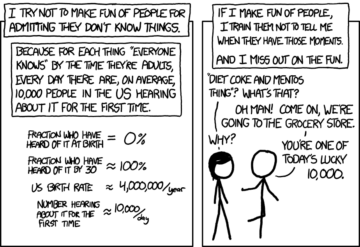
A few weeks ago I once again had the joy of learning about a previously hidden corner of the mathematical world: Gaussian Periods. Samantha Platt, a graduate student working with Ellen Eischen at the University of Oregon, gave a fantastic talk about Gaussian Periods in one of our seminars. Since a close second to learning something new is the fun of explaining it to someone else, I thought I’d take this opportunity to share Gaussian Periods with you. Read more »
Has Science Discovered Animal Consciousness?
by Tim Sommers
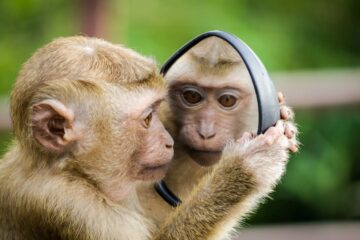
Here’s the gist of it. I think a recent declaration on animal consciousness, being signed by a growing number of philosophers and scientists, is largely correct about nonhuman animals possessing consciousness, but misleading. It insinuates that animal consciousness is a recent discovery – made in the last five to ten years – based on new experimental work. As exciting and revelatory as recent work on the minds of nonhuman animals is, animal consciousness is hardly a new discovery. In fact, I am not sure the declaration is really a scientific manifesto so much as a moral one. We ought to be treating nonhuman animals better because many seem to have some level of consciousness, but implying we should do so because of new “scientific evidence” may be a mistake.
NBC recently reported that “discoveries…in the last five years” show that a “surprising range of creatures” exhibit “evidence of conscious thought or experience, including insects, fish and some crustaceans.”
“That has prompted a group of top researchers on animal cognition to publish a new pronouncement that they hope will transform how scientists and society view — and care — for animals.”
“Nearly 40 researchers signed The New York Declaration on Animal Consciousness, which was first presented at a conference at New York University.” Many more have signed the Declaration since then, and many more are likely to sign it in the near future.
Here is The New York Declaration on Animal Consciousness in its entirety.
“Which animals have the capacity for conscious experience? While much uncertainty remains, some points of wide agreement have emerged.
First, there is strong scientific support for attributions of conscious experience to other mammals and to birds.
Second, the empirical evidence indicates at least a realistic possibility of conscious experience in all vertebrates (including reptiles, amphibians, and fishes) and many invertebrates (including, at minimum, cephalopod mollusks, decapod crustaceans, and insects).
Third, when there is a realistic possibility of conscious experience in an animal, it is irresponsible to ignore that possibility in decisions affecting that animal. We should consider welfare risks and use the evidence to inform our responses to these risks.”
When I read this my first reaction was “I can’t believe it, they’ve solved the ‘other minds’ problem!” A leading problem in philosophy, after all, has been ‘How do we even know other humans have consciousness?’ – much less nonhuman animals. In fact, one of the signatories to the declaration, leading philosopher of mind David Chalmers, is well-known for arguing that there might be beings (“philosophical zombies”) that look and behave just as we do, but have no consciousness. In other words, recognizing there is a philosophical problem about how we can be justified in attributing consciousness to others. Read more »
Perceptions
 Sughra Raza. Light Play in The Living Room, November 2023.
Digital photograph.
Shipping Muse: The Accidental Aesthetics Of Disaster
by Brooks Riley
 One of nature’s most endearing parlor tricks is the ripple effect. Drop a pebble into a lake and little waves will move out in concentric circles from the point of entry. It’s fun to watch, and lovely too, delivering a tiny aesthetic punch every time we see it. It’s also the well-worn metaphor for a certain kind of cause-and-effect, in which the effect part just keeps going and going. This metaphor is a perfect fit for one of the worst allisions in US maritime history, leading to the collapse of Baltimore’s Francis Scott Key Bridge after it was hit by the container ship MV Dali on the morning of March 26, 2024.
At that hour, long before dawn, it was too dark for the resulting ripple effect to be seen. But it was most certainly a hefty version of the pebble drop, with waves fanning out all the way to the harbor berth from which the Dali had just departed. At daybreak, when images of the disaster began to appear everywhere, the ripples were no longer visible. But given the catastrophic consequences of this event, and the tragic loss of life, they were, and still are, fanning out across the globe.
Am I the only one who can’t stop looking at images of this disaster? Am I the only one who sees an awful beauty in them? Or is it a beautiful awfulness? The frenzy of angles, the implosive intensity of the damage, the jolly Lego-like containers in Bauhaus colors still neatly stacked atop the ship in defiance of the tangled metal of the bridge’s cold steel mesh structure lying over the ship’s forecastle where it fell. Add to that the murky, shifting colors of the water, lending the disaster a visual context like a fluid frame—a calming contrast to the frozen pandemonium it encircles. Read more »
“I wear the chain I forged in life”
by Jerry Cayford
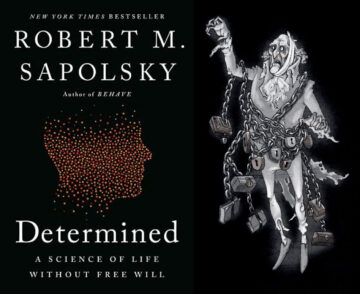
Robert Sapolsky claims there is no free will. Jacob Marley begs to differ. Let us consider their dispute. Sapolsky presents his case in Determined: A Science of Life Without Free Will: everything has a cause, so all our actions are produced by the long causal chain of prior events—never freely willed—and no action warrants moral praise or blame. He supports this position with a great deal of science that was not available back when Marley was alive, though “alive” seems an awkward way to put it, since Marley is a fictional ghost, possibly even a dreamed fictional ghost (depending on your interpretation of A Christmas Carol), dreamed by fictional Ebenezer Scrooge. Marley’s standing to bring objections against Sapolsky seems pretty tenuous.
Nevertheless, Marley forthrightly rejects Sapolsky’s thesis: “‘I wear the chain I forged in life,’ replied the Ghost. ‘I made it link by link, and yard by yard; I girded it on of my own free will, and of my own free will I wore it.’” That there is a real dispute here is proven by Scrooge presenting a very Sapolskian argument against Marley’s right to bring a case at all: “You may be an undigested bit of beef, a blot of mustard, a crumb of cheese, a fragment of an underdone potato.” That is, only a chain of physico-chemical causes makes me, Scrooge, see you at all, let alone give any credence to your arguments about morality. If this rebuttal seems sophisticated for a fictional Victorian businessman, it at least reminds us that Sapolsky’s philosophical position is quite old and well known.
Unlike Scrooge, Sapolsky does not inhabit the same fictional realm as Marley’s ghost. He cannot argue that Marley’s sins were caused by prior conditions and events, because Marley’s sins and choices don’t really exist, not in the causal universe in which Sapolsky makes his argument. As he so emphatically puts it: “But—and this is the incredibly important point—put all the scientific results together, from all the relevant scientific disciplines, and there’s no room for free will.…Crucially, all these disciplines collectively negate free will because they are all interlinked, constituting the same ultimate body of knowledge” (8-9). Marley’s ghost, though, is not of that body—an “incredibly important point” indeed—and that’s precisely the reason to choose him as our spokes-“person.” Read more »
Catspeak
by Brooks Riley

Making a Deal with Memory
by Nils Peterson
Charles Simic says, “[I] suspect that a richer and less predictable account of our lives would eschew chronology and any attempt to fit a lifetime into a coherent narrative and instead be made up of a series of fragments, spur-of-the-moment reminiscences occasioned by whatever gets our imagination working.”
I was reading an article yesterday on translation of Proust and the author mentions Proust’s decision to build “a whole long novel on an involuntary memory.” You’ll remember the moment. He has a madeleine cookie with his tea and all of a sudden “An exquisite pleasure had invaded my senses, something isolated, detached, with no suggestion of its origin…. Whence did it come? What did it mean? How could I seize and apprehend it? … And suddenly the memory revealed itself. The taste was that of the little piece of madeleine which on Sunday mornings at Combray.” He is transported back to his childhood.
I got caught up in the idea of an involuntary memory. Michael Wood, the author of the Proust article, goes on to explain ‘Involuntary here means not only unintended but barred from the realm of intention. Whatever it is, it won’t happen if you try to make it happen.” A philosopher of language would have a ball playing with what is going on in those last two sentences, but I’m not interested this morning in going down that road because I had on Tuesday an involuntary memory. I saw the floor of the bedroom my brother and I shared in the chauffeur’s apartment above the garage in the late 30’s. I think I was eight the last time I saw that floor. It was covered in linoleum and the linoleum was divided into squares and each square had a nursery rhyme with an illustration. Mind settles for a moment on Miss Muffet and her tuffet. Part of my learning to read may have come from hearing my mother recite the rhyme and my finding it on the floor and understanding and parsing out the words. This last is a forced memory and it may not even be a true one. How different a making from the involuntary appearance in my memory of the linoleum.
There was a path to there. I was walking back from poetry salon I lead here at my old people’s home. People bring poems they want to read. Tuesday we got everything from Casey at the Bat to some lovely Robert Frost. When a person comes who didn’t know he or she was supposed to bring a poem to share, I ask for a song lyric or nursery rhyme and usually they can come up with something. The younger they are, the less likely they are to come up with a nursery rhyme. I think they’re on the endangered species list.
The subject of Memory interests me and I have written a couple of attempts to understand it. Here’s one. Read more »
Word Cabinet: On Chess and Literature
by Ed Simon
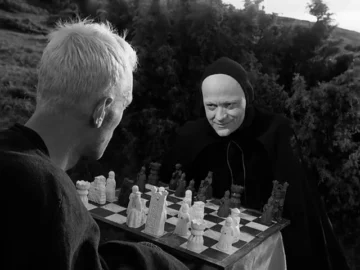
In Renaissance Europe, a Wunderkammer was literally a “Wonder Cabinet,” that is a collection of fascinating objects, be they rare gems and minerals, resplendent feathers, ancient artifacts, exquisite fossils. Forerunners to the modern museum, a Wunderkammer didn’t claim comprehensiveness, but it rather served to suggest the multiplicity of our existence on this earth, the nature of possibility. Wunderkammers developed alongside that literary form which Michelle de Montaigne called “essays,” literally an “attempt.” Essays, like Wunderkammers, at their most potent are also not comprehensive; rather their purposes is to experiment, to riff, to play. In that spirt, half of my columns at 3QuarksDaily will be dedicated to what I call a “Word Cabinet,” a room dedicated to literature, neither as theory nor even as reading, but to do what both wonder cabinets and essays do, and that is to hopefully provide intimations of possibility. All essays will take the form of “On X and Literature,” where the algebraic cipher indicates some broad, general subject (fire and labyrinths, trees and infinity, etc.). As always, feel free to suggest topics.
* * *
Behind the gleaming, modernist, smooth sandstone façade of Edinburgh’s National Museum of Scotland, a temple to all things Hibernian from the Covenanters to the Jacobite Rebellion, the Highland Clearances to James Watt’s steam-engine, there is a small thirteenth-century walrus tusk ivory carving of a Medieval Nordic soldier. Discovered in a simple stone ossuary buried in a sand dune on the foggy, rain-lashed Bay of Uig on the Outer Hebridean Isle of Lewis in 1831, the little sculpture is just a bit over an inch tall, yet it’s easy to make out the distinctive Scandinavian designs on his pointed helmet, his comical bulging eyes, and his teeth over the top of the shield that he clutches and bites. His is clearly a pose of frenzied, martial wrath. A berserker – the feared caste of Viking warriors who in an enraged fugue state (possibly aided by hallucinogens) terrorized people from Novgorod to Newfoundland, including the Scotts who lived on Lewis where this small figurine would be entombed for six centuries, alongside ninety two other pieces. Not just berserkers, but a mitered bishop of the recently converted Norseman; a tired looking queen with her eyes wide, resting her face upon her balm; a bearded, wise old king.
The berserker isn’t just a tiny statue of a Norse combatant, he’s a warder; what is more commonly known as a rook. This tiny berserker was a chess piece, who even nine centuries ago had the responsibility of charting that distinctive L-shaped course across checkered boards. From India into Persia, than the Arabic world into Europe, chess had already been played for half-a-millennia by the time whatever Norse craftsman took chisel and scorper to a walrus tusk. The rules would be recognizable to contemporary players, though the sterling craftsmanship of the Isle of Lewis chessman – with enough pieces to constitute three complete sets – is rather different than the boring black-and-white pieces used by players today, whether the prodigies competing against paying tourists in view of Washington Square Park’s triumphal arch or the celebrated 1972 match in Reykjavik between Fischer and Spassky. Read more »
Monday Photo
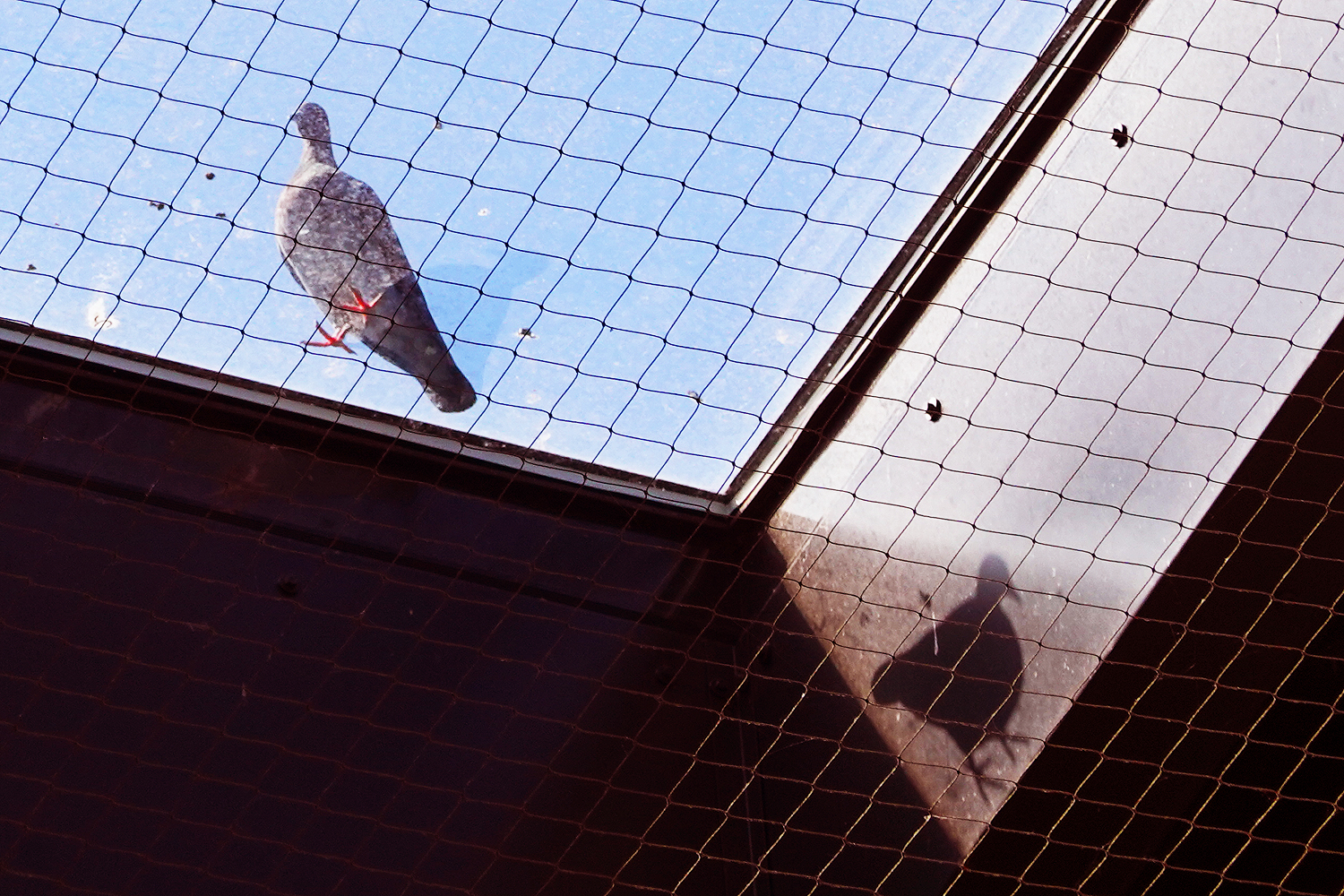
Pigeon sitting on a skylight at the Berlin airport. And its shadow.
The Road to Freedom: The Fate of the Oligarchs in Ukraine
by Olivier Del Fabbro
 No matter where you go, Aristotle believes, the rich will be few and the poor many. Yet, to be an oligarch means more than to simply be part of the few, it means to govern as rich. Oligarchs claim political power precisely because of their wealth.
Rightfully then, we associate oligarchy with the few individuals, who enrich themselves in Eastern Europe after the downfall of the Soviet Union, in order to take part in political governance. Alexander Smolensky, Yuri Lushkov, Anatoly Chubais, Boris Berezovsky, Vladimir Gusinsky, and most famously Mikhail Khodorkovsky, are the protagonists of David E. Hoffman’s The Oligarchs, who are right on the spot, when the Soviet planned economy turns into a wild privatization of profitable industries and resources.
But the economic situation in the 1990’s in Eastern Europe is by no means comparable to the market economy of a liberal democracy. What is missing, according to Timothy Snyder in The Road to Unfreedom, is the rule of law. In other words: oligarchs wish to manage Russian “democracy” in favor of their own interests.
Later on, when Vladimir Putin succeeds Boris Yeltsin, oligarchy in Russia continues. Putin keeps those he likes in his inner circle and gets rid of others, who are critical or not playing along: e.g. the case of Khodorkovsky. It is time for Putin’s KGB friends to come to power, as Catherine Belton shows in her book, Putin’s People. Yet, Putin’s Russia becomes at the same time, as Mark Galeotti highlights in his podcast In Moscow’s Shadows, more and more an authoritarian regime, in which many different types of individuals desire a piece of the cake: mega-oligarchs, mini-oligarchs, corrupt politicians and officials, warlords, generals and what not. Russia has never been democratic – not under the Tsars, the Soviet Union, Yeltsin nor Putin. Its path is one from imperialism to communism to oligarchy to authoritarianism – not to freedom.
Ukraine, similarly to Russia, falls under the grip of its very own oligarchs after the Soviet Union vanishes from the world map. Read more »
Unconscious Freedom
by Christopher Horner
Become That which You Are —Nietzsche.
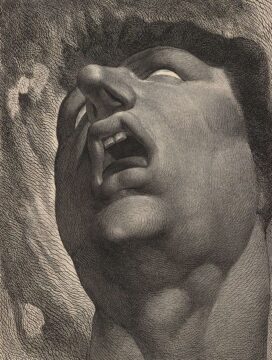
What is it to lead a free life? Perhaps it is doing what we want with the minimum of external constraints, so we can follow our desires. Also to be free from anything within us that would prevent us from choosing wisely and acting effectively. I don’t want to bungle an action, I don’t want to get things wrong that might lead me to misread a situation, and I don’t want to be knocked off track by some outburst of the irrational, blind anger or a neurotic compulsion that reaches me from my past. The ideal of a free life includes in it the notion that I can to identify with my actions as my own, to stand by them, as it were.
We picture the rational self that wills, as somehow brightly lit in the conscious mind: I know, I choose, I act, and I say: I did that. The darkness is in the unconscious, and we need the light to choose freely. However, this image of the free self is at best incomplete. [1] We know that we are being pushed in all sorts of ways, even – perhaps especially – when we think we are making a free choice. I choose A over B: to marry or not; to go on holiday here and not there; to go for a walk; to buy that laptop. Are these free, independent choices? How did I come to have just these desires, here and now? My desire for A over B was conditioned by who I came to to be, and my goals are embedded in my biology and in my place and time in history. Since desires aren’t simple and basic can I say I am free when I act on them? If not it would appear that responsibility, and the praise or blame that goes with it, are just empty words.
‘Ought implies can’
The phrase comes from is Immanuel Kant, who was much exercised by the question, as he saw that morality implies freedom. Since my reasons for doing something are also causes, and are the outcomes of the push and pull of social life, it looks like my inclinations are anything but free, if we imagine that to mean that I could have chosen to do something else. We may feel free, but that isn’t proof that we are free. Read more »
Sunday, May 12, 2024
The kitsch we need
Morgan Meis in The Easel:
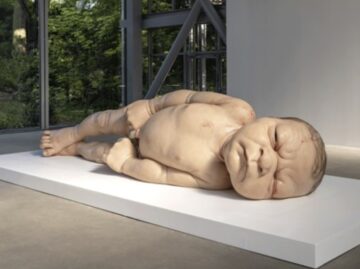
It’s a baby lying on the floor. The eyes and squishy forehead are particularly impressive. There’s a gooey-ness and rawness to the flesh that is particular to newborn babies. I happen to like knobby knees and this baby’s knees are nice and knobby. The new skin on baby knees looks like it could also be old skin. It is startling, the way that tiny infants can resemble elderly people. There is a shared vulnerability to bodies just coming into the world and bodies soon to make their way back out again.
The sculpture, A Girl, is also quite large. Much larger than an adult human being. The scale is affecting, though it is hard to put one’s finger on exactly why. Maybe it’s that the giant size actually increases the viewer’s experience of fragility. Everything that makes a newborn baby new is magnified.
More here.
Illuminating ‘the ugly side of science’: fresh incentives for reporting negative results
Rachel Brazil in Nature:
 Editor-in-chief Sarahanne Field describes herself and her team at the Journal of Trial & Error as wanting to highlight the “ugly side of science — the parts of the process that have gone wrong”.
She clarifies that the editorial board of the journal, which launched in 2020, isn’t interested in papers in which “you did a shitty study and you found nothing. We’re interested in stuff that was done methodologically soundly, but still yielded a result that was unexpected.” These types of result — which do not prove a hypothesis or could yield unexplained outcomes — often simply go unpublished, explains Field, who is also an open-science researcher at the University of Groningen in the Netherlands. Along with Stefan Gaillard, one of the journal’s founders, she hopes to change that.
Calls for researchers to publish failed studies are not new. The ‘file-drawer problem’ — the stacks of unpublished, negative results that most researchers accumulate — was first described in 1979 by psychologist Robert Rosenthal. He argued that this leads to publication bias in the scientific record: the gap of missing unsuccessful results leads to overemphasis on the positive results that do get published.
More here.
South Africa’s Enduring Unfreedom: An interview with S’bu Zikode, leader of the shack dwellers’ movement, 30 years after apartheid’s end
S’bu Zikode and Richard Pithouse in the Boston Review:
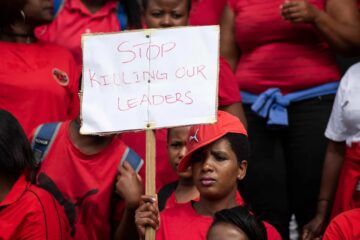 Richard Pithouse: Mandela was released from prison on February 11, 1990, suddenly opening up the field of political possibility after a long and exhausting stalemate between the progressive forces, which were largely organized in two groups: the United Democratic Front (UDF) and the trade unions, and the apartheid state. What did Mandela’s release mean to you?
S’bu Zikode: I was fourteen years old, and in school. At that time, we were divided. It was the time of the war between [the right-wing Zulu nationalist organization] Inkatha and the UDF. People could easily draw the line between the two sides along a river or a road. Everyone on one side was Inkatha; everyone on the other side was UDF. A lot of people were killed or had their homes burnt down just because they were living on this or that side of the line.
Some people had guns; we young people had sticks. If you turned back from a battle you would be shot. You had to face bullets from the front and the back. Terrible things happened, very painful things. We don’t talk about it.
More here.
Before Palmer Penmanship
Katrina Gulliver in JSTOR Daily:
 In the years following American independence, many questions would be asked, in different spheres, of what it meant to be a citizen, and what it meant to be an American. New England schoolmaster John Jenkins focused on penmanship as the key to building a strong American middle class, creating his own book of instruction for handwriting.
“Writing in the shadow of the American Revolution, Jenkins recognized that subtle changes in everyday cultural practices like handwriting could have significant effects on the character of the new nation,” explains historian Richard S. Christen.
Literacy on both sides of the Atlantic had increased during the sixteenth and seventeenth centuries, but a fine hand tended to be the mark of the well born and well educated.
More here.