by Rafaël Newman

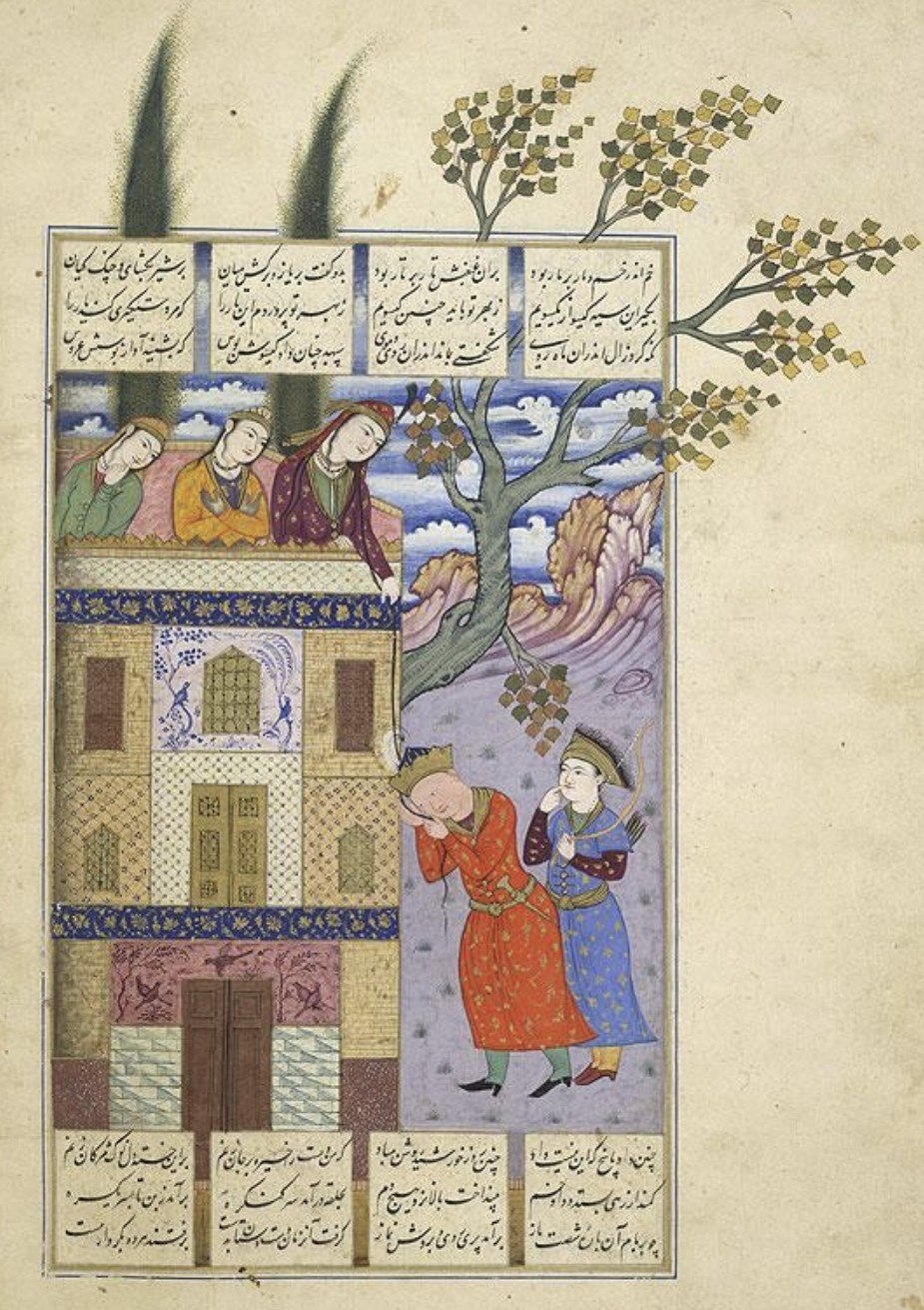
Herta Müller, winner of the Nobel Prize for Literature in 2009, was born and raised in a traditionally German-speaking region of Romania. When she moved to what was then the German Federal Republic in 1987, she was eagerly asked by strangers hearing a Latinate inflection in her German whether she was French. When she told them that she was in fact Romanian, she recounts, she would watch as the expectant glow faded from their eyes.
There is a similar case of mistaken identity in Greta, a new film by Neil Jordan, in which the phenomenon is a deliberate plot point: apparent French nationality masks a lowlier, positively sinister Eastern European provenance. Jordan also made The Crying Game in 1992, a film notorious for a certain gasp-provoking reveal, whereby gender ambiguity and assumed identity serve as an allegory of the Anglo-Irish relations that are on the political periphery of what is otherwise a picaresque romantic comedy. In Greta, an assumed French identity is merely one of several burlesque symptoms of mental illness, as the film out-camps serial-killer forebears like Psycho and The Vanishing to produce a solid genre flick. But the certainty with which Jordan deploys presumed Frenchness as a lure and a lull to an Occidental sensibility on guard against the Iron-Curtained Orient is a reminder of the role France and French culture have long played in the Western imaginary: that of a reliable signifier of elegance, glamour, and sophistication, and an apotropaic talisman wielded against the less presentable elements of the Europe family.
This last propensity of Frenchness was a source of confusion for me when, a prepubescent visiting Paris in the early 1970s, I attempted to assimilate the evident grandeur of the métropole, and the globally intimidating power of its culture, with the French world I had been familiar with to date, namely the Montreal of my birth: a city divided on linguistic lines, whose francophone majority seemed to me edentulous and impoverished, quietly wracked with resentment at anglophone overlords who had long since forfeited bragging rights won two centuries earlier on the Plains of Abraham and were in the process of being outnumbered by an ascendant starving class still practicing a “revanche des berceaux”, or revenge of the cradle, initiated in the 18th century. Read more »
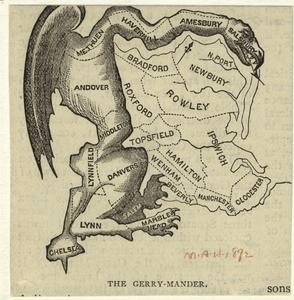 The Supreme Court doesn’t play politics.
 Several co-workers, all of whom have Ph.D.s. An old friend who’s a physicist. Scads of family members of both blue and white collar variety. Numerous neighbors. And of course the well dressed, kindly old women who occasionally show up at my door uninvited, pamphlets in hand.




 Johnny spoke softly in a voice just past the threshold of manhood. His smile, mistaken for charm, was longing. I could see the pentimento of the child still in him.

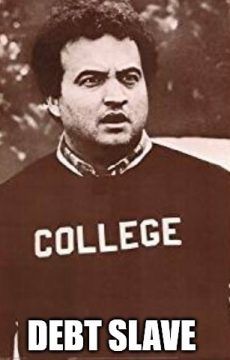 It does not take long for history to repeat itself. It was only a little over a decade ago that overzealous lending, lax underwriting standards, unrealistic collateral valuations, borrowers not understanding loan terms, an exploding derivative securities market–and a dozen or so other factors–led to a massive crash in the housing market. Today in the United States we have outstanding student loan debt of $1.5
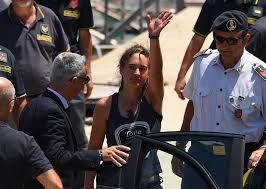 While Trump’s immigration politics makes international headlines almost every day, the disaster of the European immigration policies rarely becomes international news. A recent exception is the case of Captain Carola Rackete, and it is a telling one. With all the potential for a good story, Rackete’s journey is both standing for and at the same time distracting from the actual complex mess of European immigration politics.
 When the flight delay is announced, we ask what it is we have done wrong. From airlines and the world at large, the answer is rarely forthcoming, so we must look inward instead.