
by David Greer
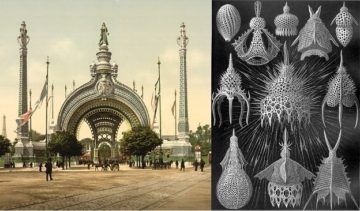
The 1900 Paris Exposition was a grand event, a world’s fair intended to honor the great achievements of the century just completed while heralding those of the century about to begin. In this spirit, architect René Binet designed a daring, futuristic entrance gate unlike anything ever seen before. It was as if he had had a prophetic vision, sixty years into the future, of a rocket launching into space. Binet’s concept, bizarre as it seemed, was far from imaginary. It was modelled after one of the most common creatures on Earth, though not one ever seen by anyone without a microscope. The animal that inspired the design of Binet’s Porte
Monumentale was a radiolarian, a form of zooplankton found in oceans everywhere.
The image of the radiolarian that so entranced Binet had been drawn by the German scientist Ernst Haeckel, a contemporary and admirer of Charles Darwin. Fascinated by the diversity of species and especially of the minute sea creatures seen through his microscope, Haeckel obsessively drew their forms in painstakingly detailed images. Reproduced in book form as Kunstformen der Natur (Art Forms in Nature), Haeckel’s images caught the attention of architects and designers and became an inspiration for the Art Nouveau movement, of which Binet’s radiolarian gate was an early example.
 Being in Berkeley for more than four decades I have met and encountered many leftists and several of them are/were radical in their politics, though in recent years the radical fervor has been somewhat on the decline even in Berkeley. I remember some time back reading one east-coast journalist describing Berkeley, with a pinch of exaggeration, as moving from being the Left capital of the US to being its gourmet capital—this transition is, of course, most well-known in the case of Alice Waters who, a Berkeley activist in the 1960’s, started her iconic restaurant Chez Panisse in the next decade, though she herself considers the novel approach to food embodied in that restaurant—insistence on fresh ingredients and cooperative relations with local farmers– as growing out of the same counter-culture movement. (This transition was, of course, much more agreeable than some of the militant Black Panther leaders of 1960’s Oakland turning to Christian evangelism).



 Sughra Raza. Self Portrait in The November Sun, 2020.

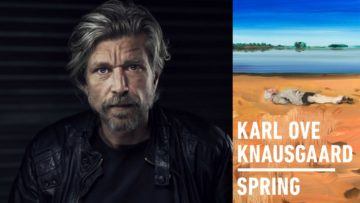 Going back and reading one’s favorite authors is like seeing an old friend after a long absence: things fall into place, you remember why it is you get along with and like the other person, and their idiosyncrasies and unique character reappear and interact with your own, making old patterns reemerge and lighting up parts of you that have long been dormant.
 The perfect, so the saying goes, is the enemy of the good. Don’t deny yourself real progress by refusing to compromise. Be realistic. Pragmatic. Patient. Don’t waste resources and energy on lofty but ultimately unobtainable goals, no matter how noble they might be; that will only lead to frustration, and worse, hold us all back from the smaller victories we can actually achieve.