
by David Greer
I used to visit our airport on Vancouver Island not to catch a flight but to hear the skylarks. I stood in the parking lot and looked up. The stares from passengers arriving and departing seemed a small price to pay for the reward of listening to the endless birdsong spilling from the sky above the terminal.

The Eurasian skylarks were all but invisible, hovering two or three hundred feet above me, but I was familiar with their routine. Male skylarks begin their song flight with a rapid ascendance to hovering altitude, where they deliver their unbroken melodious stream, lasting up to 20 minutes. The longer and more complicated the song, the greater the likelihood of impressing a potential mate. The grassy fields around the runways provided ideal nesting sites for one of the last remaining skylark populations in North America. Fortunately, whenever I visited, the airport sky seemed always to overflow with skylark song, albeit to an intermittent accompaniment of airplane engines.
Eurasian skylarks were introduced to several American states in the nineteenth century by European immigrants nostalgic for the birds of home. A further introduction to Vancouver Island in 1903 was sufficiently successful that the local skylark population had grown to more than a thousand by the early 1960s.
Although only the male skylarks engage in the aerial opera, the long-standing belief that courtship songs are primarily the province of male birds has been well and truly shattered. That theory likely arose from the fact that early naturalists primarily made their observations in temperate zones where male birds play a larger role in birdsong. But the majority of songbird species are tropical (unsurprising, given that birds evolved in the general vicinity of Australia), and a 2014 study of almost all songbird families demonstrated that female song not only occurs in more than two-thirds of those species but also may be just as long and complex as male song. Read more »

 A new study has revealed a troubling development in the state of Maryland: while murder rates fluctuated between 2005 and 2017—first trending downward, then increasing for a few years—the homicides recorded during that period have grown steadily more violent the entire time.
 Consider again the wooden desk. It was once part of a tree, like the ones outside your window. It became a bit of furniture though a long process of growth, cutting, shaping buying and selling until it got to you. You sit before it as it has a use – a use value – but it was made, not to give you a platform for your coffee or laptop, but in order to make a profit: it has an exchange value, and so had a price. It is a commodity, the product of an entire economic system, capitalism, that got it to you. Someone laboured to make it and someone else, probably, profited by its sale. It has a history, a backstory.
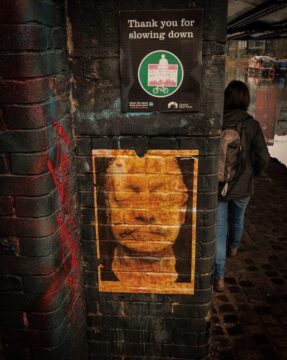 All of this is the case, but none of it simply appears to the senses. Capitalism itself isn’t a thing, but that doesn’t make it less real. The idea that all that there really is amounts to things you can bump into or drop on your foot is the ‘common sense’ that operates as the ideology of everyday life: “this is your world and these are the facts”. But really, nothing is like that: there are no isolated facts, but rather a complex, twisted web of mediations: connections and negations that transform over time.

 Is there such a thing as tasting expertise that, if mastered, would help us enjoy a dish or a meal? It isn’t obvious such expertise has been identified.
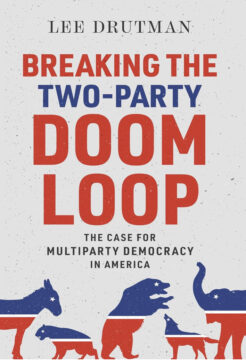 It’s a book about how our political system fell into this downward spiral—a doom loop of toxic politics. It’s a story that requires thinking big—about the nature of political conflict, about broad changes in American society over many decades, and, most of all, about the failures of our political institutions. (2)
 I’m writing this 37,000 feet above Vestmannaeyjar, a chain of islands off Iceland’s south coast. Or so the screen tells me – I can’t see the view because I’m wedged into 38E, a middle seat at the back near the loos.
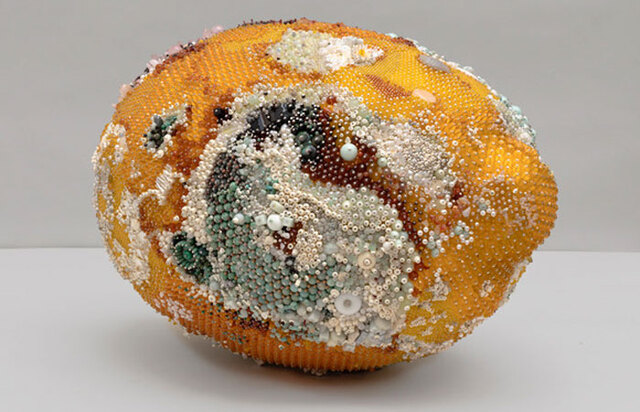 Kathleen Ryan. Bad Lemon (Creep), 2019.



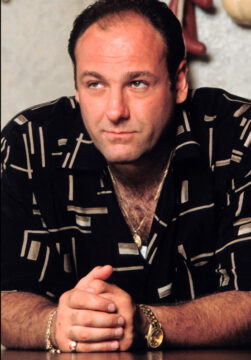 In an attempt to understand my relationship to the Italian-American identity, I recently began watching episodes of The Sopranos, which I avoided when it first aired twenty-five years ago. I was on a nine-month stay in New York at the time, living in a loft on the Brooklyn waterfront, and I remember the ads in the subways—the actors’ grim demeanors; the letter r in the name “Sopranos” drawn as a downwards-pointing gun. I’ve always been bored by the mobster clichés, by the romanticization of organized crime: as an entertainment genre, it’s relentlessly repetitive, relies on a repertoire of predictable tropes, and it has cemented the image of Italian Americans we all, to one degree or another, carry around with us. But the charisma of Tony Soprano, played by James Gandolfini, exerts an irresistible pull: I jettison my critical abilities and find myself binge-watching several seasons, regressing for weeks at a time, losing touch with what I was hoping to find.