by Richard Farr
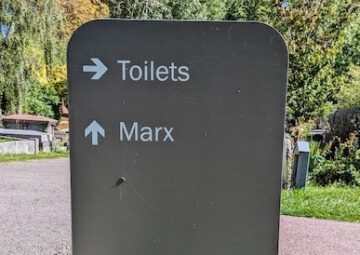 Even if you are sympathetic to Marx — even if, at any rate, you see him not as an ogre but as an original thinker worth taking seriously — you might be forgiven for feeling that the sign at the East entrance to Highgate Cemetery reflects an excessively narrow view of the political options facing us.
For years I had planned to come here, to his final resting place, and pay my genuine if heavily qualified respects. In the end the visit was almost accidental. My wife and I were walking off vast quantities of melted cheese sandwich that had accosted us in Camden Market, our destination was Hampstead Heath, and Google Maps suggested to us that the detour was slight.
The six quid you pay to get in helps the Cemetery Trust keep most of this beautiful sanctuary neat and trim, with broad main avenues and benches spaced at convenient intervals for rest and contemplation. But much of its appeal lies in a strange duality of character. Large sections are so crowded, so ivied, so root-heaved and broken that I was put in mind of Mayan temples in the Yucatan, reduced to fragments and being digested by the rainforest. Stones pristine and sundered. Inscriptions legible and illegible. Some Victorian pillars standing proud and straight but others leaning against one another like end-of-day commuters slumped shoulder to shoulder on the Northern Line.
Hopeful sentiment is engraved here over and over: Never Forgotten; Always in our Thoughts. But you look at relentless climbing nature and wonder how long any of this remembering can really last. Two generations? Three? A bit more, for the famous — but the truth is that they too will “fly forgotten as a dream,” as Isaac Watts has it. Even at George Eliot’s grave, tended lovingly by a woman with gloves and garden tools, the name itself has all but evaporated. Read more »





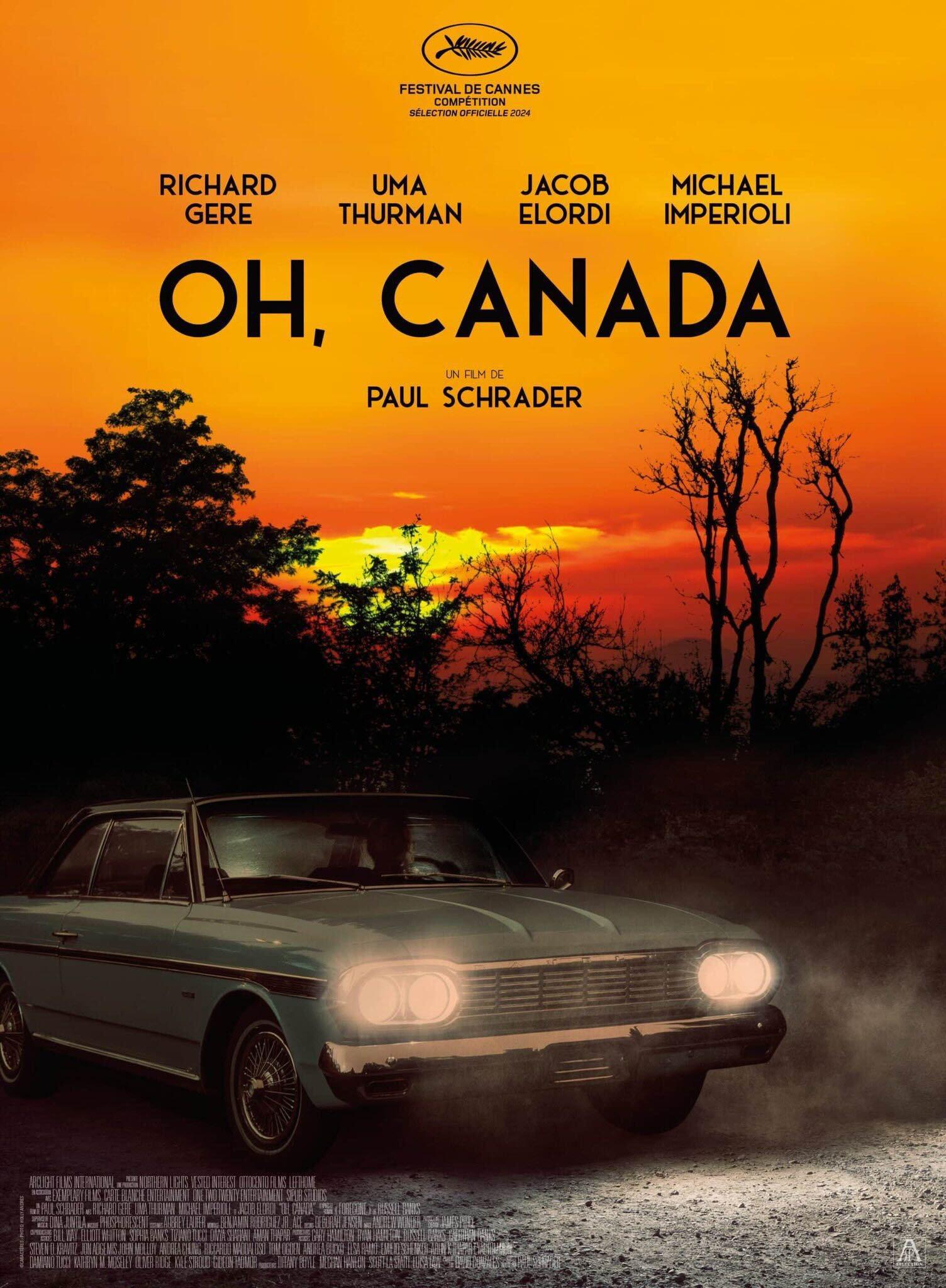 I was in Toronto the other day to see Paul Schrader’s newest film, Oh, Canada, which was screening at the Toronto International Film Festival (TIFF). This was my first time seeing a movie at a festival, and the experience was quite different from seeing a movie at a cinema: we had to line up in advance, the location was not a cinema but a theatre (in this case, the Princess of Wales Theater, a beautiful venue with orchestra seating, a balcony, and plush red carpeting), and there was a buzz in the air, as everyone in attendance had made a special effort to see a movie they wouldn’t be able to see elsewhere. As I stood in line with the other ticket holders, I noticed that there was a clear difference between the type of person in my line, for those with advance tickets, and the rush line, for those without tickets and who would be allowed in only in the case of no shows: in my line, the attendees were older, often in couples, and had the air of Money and Culture about them; in the rush line, the hopeful attendees were younger, often male, and solitary. In other words, those in the rush line, the ones who couldn’t get their shit together to buy a ticket in time, could have been typical Schrader protagonists: a man in a room, trying, yet frequently failing, to live a meaningful life, to keep it together, to be the type of person who buys a ticket in advance, and invites his wife, too. Yet there I was, in the advance ticket line: a man, relatively young, and someone who spends a good deal of time by himself. I’d invited my partner of 10 years, but she didn’t come because she doesn’t like Paul Schrader films, and who can blame her? They’re not for everyone. Perhaps my presence in the advance ticket line, but my understanding of and identification with those in the other line, helps explain my deep attraction to Schrader’s films: I know his characters, and in the right circumstances, I could become one of his characters.