
by Adele A. Wilby
 With its pristine rainforest, complex ecosystems and rich wildlife, Ecuador has been home to one of the most biodiverse countries on Earth. For thousands of years indigenous peoples have also lived harmoniously in this rainforest on their ancestral land. All that has now changed. Since the 1960s, oil companies, gold miners, loggers and the enabling infrastructural workers have all played their part in the systematic deforestation and destruction of this complex eco-system. Human rights abuses, health issues, deleterious effects on the people’s cultures and the displacement of people have all become part of the indigenous people’s lives. But wherever and whenever oppression, exploitation and social injustice raises its ugly head, resistance will eventually emerge, and so it is with the indigenous Waorani people of the Ecuadorian rainforest, under the leadership of Nemonte Nenquimo.
Nenquimo’s recent autobiographical memoir, We Will Not Be Saved, is a detailed narration of her life as an indigenous Waorani woman living in the rainforest and the consequences of the extractive industrial practices on their way of life and the rainforest they live amongst. With the assistance of her husband Mitch Anderson listening, translating and rendering Nenquimo’s voice, she provides us with authentic, deep insight into the exceptional culture and world view of her people; it makes an important contribution to our knowledge of indigenous people’s lives and the devastating impact of the oil industry on those lives.
There are two parts to this book. Part One spans her childhood years in her village of Toñampare and ends with her flight from the missionary couple with whom she lived when in her teens. Nenquimo writes emotively and insightfully about those years of her life and her community’s intimate and harmonious connection to the natural environment; of her mother’s pregnancies and her twelve brothers and sisters living in a smoked filled oko; of how she makes the sweetest manioc mixture of chicha; of hunting with her father and learning to identify the footprints belonging to the diverse forms of animal life; of how she learns of the spirit that lives within the jaguar and of the power of the shamans.
The book is also significant for the way it highlights the stark contrasts between two ways of life and world views, that of the ‘cowori’, ‘outsiders’ as the white people are known in Wao Tededo, the language of the Waorani, and the life of indigenous people in the Ecuadorian rainforest. As a small child Nenquimo runs excitedly to the landing site when she hears the humming sound of an ebo, a plane, bringing the cowori, including missionaries, to her village. She could never have imagined then that one day she would find herself not running towards but running away from the Christian missionaries the plane delivered to her village. Read more »

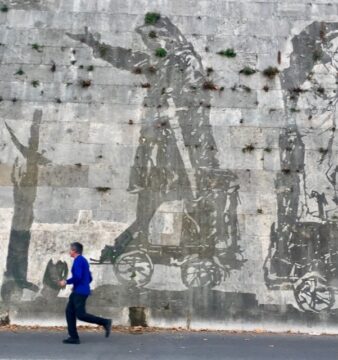



 It doesn’t take a lot of effort to be a bootlicker. Find a boss or someone with the personality of a petty tyrant, sidle up to them, subjugate yourself, and find something flattering to say. Tell them they’re handsome or pretty, strong or smart, and make sweet noises when they trot out their ideas. Literature and history are riddled with bootlickers: Thomas Cromwell, the advisor to Henry VIII, Polonius in Hamlet, Mr. Collins in Pride and Predjudice, and of course Uriah Heep in David Copperfield.
 There is something repulsive about lickspittles, especially when all the licking is being done for political purposes. It’s repulsive when we see it in others and it’s repulsive when we see it in ourselves It has to do with the lack of sincerity and the self-abasement required to really butter someone up. In the animal world, it’s rolling onto your back and exposing the vulnerable stomach and throat—saying I am not a threat.


 Risham Syed. The Heavy Weights, 2008.
 Despite the fact that Newcomb’s paradox was discovered in 1960, I’ve been prompted to discuss it now for three reasons, the first being its inherent interest and counterintuitive conclusions. The two other factors are topical. One is a scheme put forth by Elon Musk in which he offered a small prize to people who publicly approved of the free speech and gun rights clauses in the Constitution. Doing so, he announced, would register them and make them eligible for a daily giveaway of a million dollars provided by him (an almost homeopathic fraction of his 400 billion dollar fortune). The other topic is the rapid rise in AI’s abilities, especially in AGI (Artificial General Intelligence). Soon enough it will be able, somewhat reliably, to predict our behaviors, at least in some contexts.


 My 2024 ends with a ceremony of sorts. On December 31st, I’m sitting in a hotel in Salt Lake City an hour before midnight. I’m looking at my phone and I have it opened to Tinder.
  I read the opening of Peter Handke’s A Sorrow Beyond Dreams and immediately thought of Camus’ The Stranger. Here is how Handke begins: