by Alizah Holstein
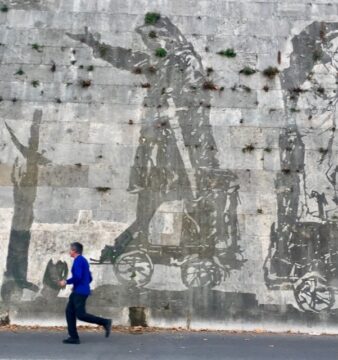
A pandemic has swept the land, talk of apocalypse abounds. A charismatic political figure with a penchant for opulence and known for captivating the populace with speeches about reviving the old empire is embarking upon his second stint in power. In his crosshairs is the political establishment, and under his rule the social order shows signs of fissure.
The story rings familiar, but is it? The year is 1354. The place, Rome.
When we swoop in for a closer look, other details begin to emerge. The apocalypse as it was imagined in late medieval Italy looks different from today’s. Less water, more fire. Though maybe this is my own personal apocalypse speaking, rooted in the southern New England landscapes I know best; where I see only downpours and rising sea levels, Californians might well look into the future and envision a fireball. Four horsemen featured prominently in the medieval imagination, and alongside the extinction of mankind on earth, they would also usher in a new age, one in which justice and peace prevailed in the heavenly city, the New Jerusalem.
The political figure who wants to Make Rome Great Again is Cola di Rienzo, and if you’d lived in Europe before the twentieth century, chances are you’d have known who he was. Machiavelli praised him, and Napoleon retreated from Moscow with his story tucked in his carriage. Byron eulogized him as a radiant figure, Hitler found his charisma inspiring, and Mussolini was warned he’d end up assassinated and strung upside down by an angry mob just like Cola, and lo and behold, he did. Opera fans will recognize Cola as the revolutionary “tribune of the Roman people, “a young man clad in velvet tights whose heroic stand against the depredations of an unchecked elite class was the subject of Rienzi, Richard Wagner’s first opera to hit the charts. Late in life, the composer came to feel ashamed of his youthful score. It was too “Italian”—a descriptor Cola would have eschewed for himself in favor of the more local “Roman.” Neither adjective was revolutionary, but taking the title “tribune” really was, because no one had done it for nearly a thousand years. It recalled the ancient office of the tribune of the plebs, devised to check the power of senators and leading magistrates. Read more »



 It doesn’t take a lot of effort to be a bootlicker. Find a boss or someone with the personality of a petty tyrant, sidle up to them, subjugate yourself, and find something flattering to say. Tell them they’re handsome or pretty, strong or smart, and make sweet noises when they trot out their ideas. Literature and history are riddled with bootlickers: Thomas Cromwell, the advisor to Henry VIII, Polonius in Hamlet, Mr. Collins in Pride and Predjudice, and of course Uriah Heep in David Copperfield.
 There is something repulsive about lickspittles, especially when all the licking is being done for political purposes. It’s repulsive when we see it in others and it’s repulsive when we see it in ourselves It has to do with the lack of sincerity and the self-abasement required to really butter someone up. In the animal world, it’s rolling onto your back and exposing the vulnerable stomach and throat—saying I am not a threat.


 Risham Syed. The Heavy Weights, 2008.
 Despite the fact that Newcomb’s paradox was discovered in 1960, I’ve been prompted to discuss it now for three reasons, the first being its inherent interest and counterintuitive conclusions. The two other factors are topical. One is a scheme put forth by Elon Musk in which he offered a small prize to people who publicly approved of the free speech and gun rights clauses in the Constitution. Doing so, he announced, would register them and make them eligible for a daily giveaway of a million dollars provided by him (an almost homeopathic fraction of his 400 billion dollar fortune). The other topic is the rapid rise in AI’s abilities, especially in AGI (Artificial General Intelligence). Soon enough it will be able, somewhat reliably, to predict our behaviors, at least in some contexts.


 My 2024 ends with a ceremony of sorts. On December 31st, I’m sitting in a hotel in Salt Lake City an hour before midnight. I’m looking at my phone and I have it opened to Tinder.
  I read the opening of Peter Handke’s A Sorrow Beyond Dreams and immediately thought of Camus’ The Stranger. Here is how Handke begins: