
by Michael Liss
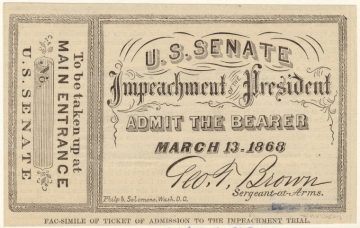 I have an awful confession to make. I haven’t made up my mind about whether President Trump should be convicted and removed from office.
I know that sounds deranged. I am “troubled” by what Trump apparently did. “Disturbed” by the scorched-earth defense strategy put together by the Trump team. “Deeply concerned” about the continuous violations of norms and the virtual certainty they will continue.
All of these things are true, and I’m not even a moderate Republican trying to show my independence to the folks back home before voting to acquit. I’m a Democrat, and every day of the Trump Regime is an excruciating day. Nothing would make me happier than a landslide repudiation of Trump by a thoroughly repulsed electorate. I want him out, and I believe that, applying a probable cause standard, the House voted appropriately to Impeach and send it to the Senate. Nonetheless, I’m not sure that, if I were a Senator, I would vote to convict.
I need evidence. Old fashioned, I admit, but I need it anyway. I need a credible process with witnesses being called and a case being presented in a formal way. I need a sense that the system actually works, as opposed to just being a two-party rumble where few seem to care about facts, and fewer about process.
Three simple questions: What did the President do? Did he have the authority to do it? And, if so, did he abuse that authority beyond the breaking point? Read more »
 When Bob Dylan was awarded the Nobel Prize in Literature in 2016, the poet Nora Gomringer expressed her satisfaction at the recognition thus afforded not only poetry, but in particular songwriting, which she identified as the very wellspring and guarantee of literature, citing in her appraisal such classical forebears as Sappho and Homer. In an article published in the Neue Zürcher Zeitung, Gomringer mocked the conventional Western view of letters, a canon founded on prose and the novel, and now challenged by the award to Bob Dylan: “Literature is serious, it is beautiful, it is a vehicle for the noble and the grand; poetry is for what is light, for the aesthetically beautiful, it can be hermetic or tender, it can tell its story in a ballad and, if especially well made, can invite composers to set it to music…”. But “such categories”, she went on to suggest, “are stumbling blocks and increasingly unsatisfying, since they have ceased to function”, in part because of the Academy’s willingness to step outside its comfort zone and award the prize to a popular “singer/songwriter”.
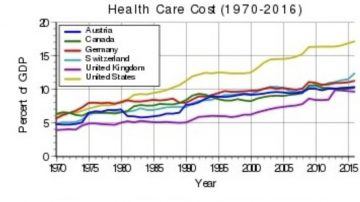 Fifty years ago, when healthcare expenditures were a mere 6% of US GDP, Martin Feldstein was afraid that the seemingly imminent adoption of some form of national health insurance would cause health care spending to grow unchecked.

 Back in 2014 I circled the country. It was a very long trip. From late August to early November I drove over 9,000 miles, all of it by myself. For many people, perhaps most, that kind of marathon driving day after day, particularly without someone to talk to, is only made bearable by listening to music. And given my own background, which has includes stints as a radio DJ, music critic, and rankly amateur musician, most everyone I know assumes I fall into that camp. Which is why they’re often shocked to find out that I don’t.
 As I sit here marveling at the inexorability of deadlines, even in the midst of holiday cheer, I consider that I should, in the absence of time for research ventures, write about “what I know.” Isn’t that the default advice for people who don’t know what to write about and don’t want to come across as false? Well, I spend at least half of my time, and most of my psychic energy, on tasks stemming from being a mother. But do I “know” anything about it? For example, how do you get your child to become a good person, and by that I don’t mean compliant or obedient, but ethical? I spend a lot of time fretting about it, but I don’t know if I have any answers.

 In 1885 Mary Terhune, a mother and published childcare adviser, ended her instructions on how to give baby a bath with this observation:
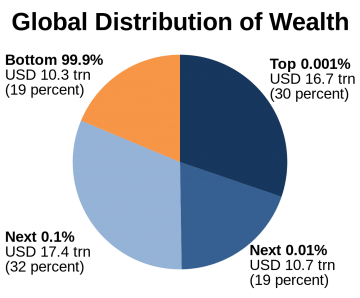 A 2011 survey by Michael Norton and Dan Ariely, of Harvard’s Business School, found that the average American thinks the richest 25% of Americans own 59% of the wealth, while the bottom fifth owns 9%. In fact, the richest 20% own 84% of the wealth, and the bottom 40% controls only 0.3%. An avalanche of studies has since confirmed these basic facts: Americans radically underestimate the amount of wealth inequality that exists – and the level of inequality they think is fair is lower than actual inequality in America probably has ever been. As journalist Chrystia Freeland put it, “Americans actually live in Russia, although they think they live in Sweden. And they would like to live on a kibbutz.”
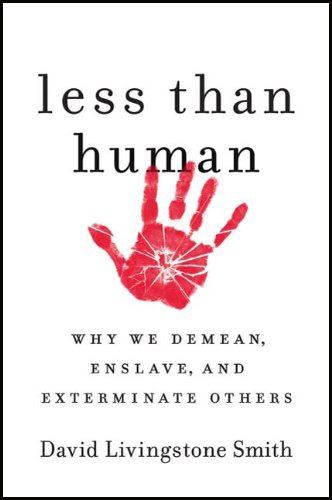 We are all aware that from amongst the vast diversity of life forms that inhabit the earth, human beings are exceptional. But while human beings are capable of inexhaustible creativity and goodness, they also have the potential to commit the most heinous acts and demeaning of fellow human beings. Accounting for such a phenomenon in the human condition and the committing of abominable acts towards their own species, is an issue that perplexes many. Perhaps the answer to such a question can be found by studying the genes or analysing the brain functioning of the perpetrators, but that could involve investigating entire populations who knowingly condone or participate in such acts. A simpler answer could be that human beings have yet to evolve into a species that is incapable of acts of inhumanity. David Livingstone Smith’s book Less than Human: Why We Demean, Enslave, and Exterminate Others offers us insight into the processes that lead to the designating of fellow human beings as ‘subhuman’ and makes possible the potential for human beings to perpetrate acts that can only be considered as evil.