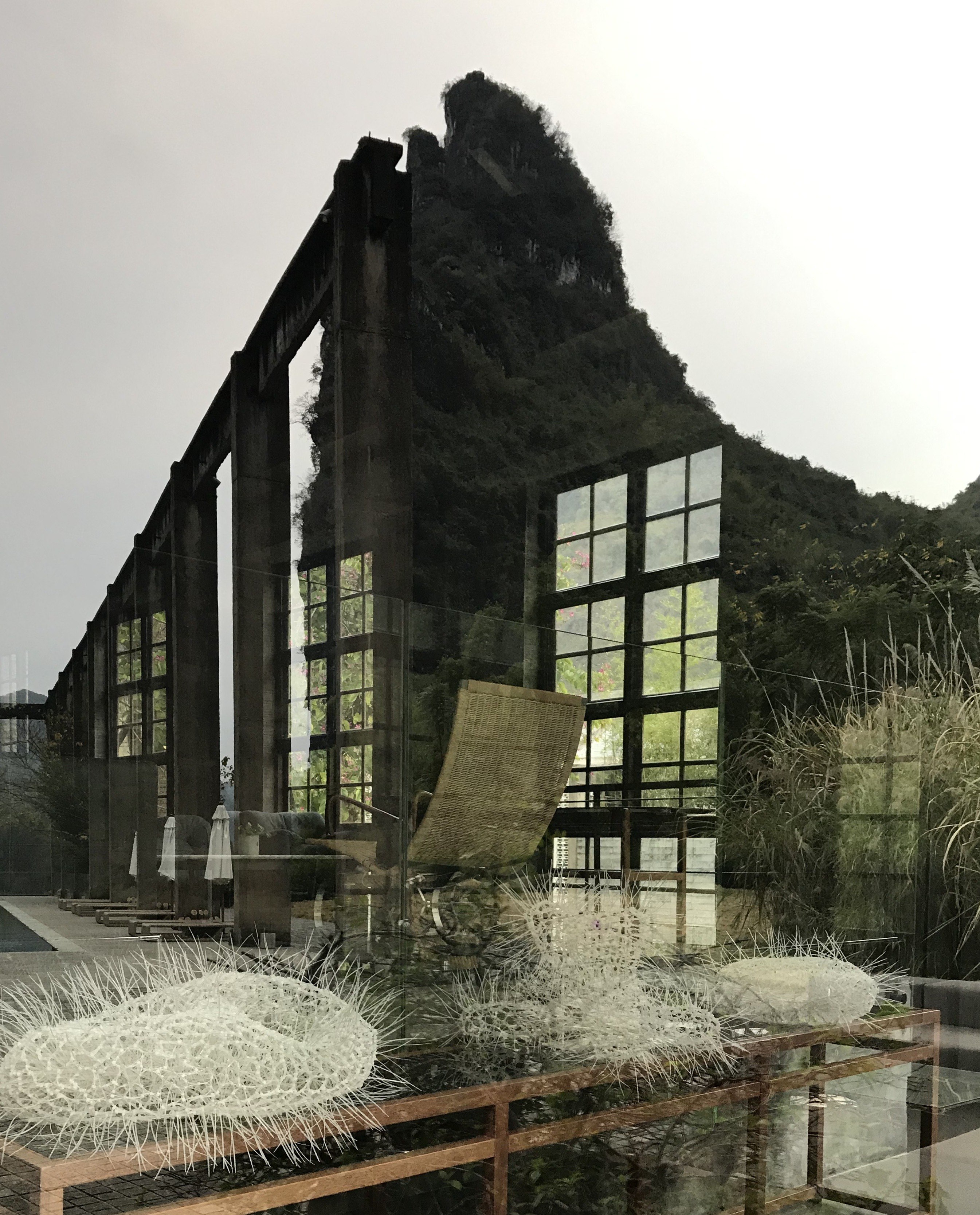
Last Night I Dreamt I Was in Kashmir Again
“May our Chinar last a thousand years,”
Grandfather said, clenching a cigar.
“Chi means What, Nar: Fire: What fire!”
Rustling boughs reigned above the tin roof
of our home where I was born a Scorpio
at midnight. It’s Fall. Each leaf burst into
a flower. We gathered the remains of dyes
to create fuel for winter, sprinkling water
on burning leaves, palms brushed ashes
together, packing cinders in a clay pot
matted in bright wicker, his kangri.
“Symbol of our culture,” he said,
cloaking it between his knees under
a loose mantle, his phiran, three yards
of brown houndstooth made by Salama,
the beloved tailor at Polo View, solely
for Grandfather who said the embers
warmed his bones. “We are all bones
under the houndstooth,” my father said.
He’s sun-withered, pouring morning tea
from a samovar alone beside an amputated
trunk. What’s father doing in Kashmir,
have they annulled the Partition?
But he still parts his hair in the center.
A Himalayan glacier ruptured its bank.
Signal towers sunk, our tin roof as well.
My valley was again a lake it used to be.
I was a shikara. I was a crewel curtain
embroidering the shikara I once was.
Barrenness had become a thousand things.
By Rafiq Kathwari / @brownpundit
 During my late 1970s New York City childhood, repeats of Star Trek aired every weeknight on channel 11, WPIX. The original 79 episodes ran about three times per year, which means that, allowing for the occasional miss, I’d seen each episode about 10 – 12 times before reaching high school.
 For the last three years, I have struggled with a dilemma: As a reasonable, quite liberal person, what should I think of my 60 million fellow Americans who voted for Donald Trump in 2016, and the vast majority of whom continue to support him today? Normally, a personal dilemma is a private thing, not a topic for public airing, but I feel that this particular problem is one the vexes many others – perhaps even a majority of Americans, as more of us voted for Hillary Clinton and many did not vote at all. Since that bleak day in November 2016, an unspoken – and sometimes loudly spoken – question hangs in the air: What kind of “
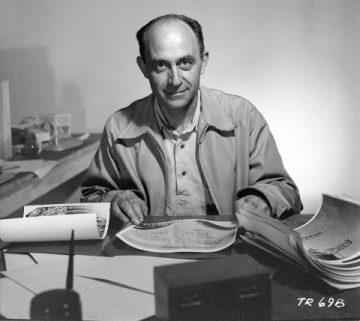 In November 1918, a 17-year-student from Rome sat for the entrance examination of the Scuola Normale Superiore in Pisa, Italy’s most prestigious science institution. Students applying to the institute had to write an essay on a topic that the examiners picked. The topics were usually quite general, so the students had considerable leeway. Most students wrote about well-known subjects that they had already learnt about in high school. But this student was different. The title of the topic he had been given was “Characteristics of Sound”, and instead of stating basic facts about sound, he “set forth the partial differential equation of a vibrating rod and solved it using Fourier analysis, finding the eigenvalues and eigenfrequencies. The entire essay continued on this level which would have been creditable for a doctoral examination.” The man writing these words was the 17-year-old’s future student, friend and Nobel laureate, Emilio Segre. The student was Enrico Fermi. The examiner was so startled by the originality and sophistication of Fermi’s analysis that he broke precedent and invited the boy to meet him in his office, partly to make sure that the essay had not been plagiarized. After convincing himself that Enrico had done the work himself, the examiner congratulated him and predicted that he would become an important scientist.
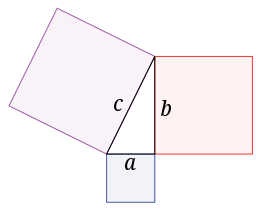 I have some very simple New Year’s resolutions, and some that require an entire column to spell out. One example of the latter is that I want to make a subtle but meaningful change in how I talk to my (middle and high school) math students about proofs.

 We find ourselves always in the middle of an experience. But it’s what we do next – how we characterize the experience – that lays down a host of important and almost subterranean conditions. Am I sitting in a chair, gazing out the dusty window into a world of sunlight, trees, and snow? Am I meditating on the nature of experience? Am I praying? Am I simply spacing out? Depending on which way I parse whatever the hell I’m up to, my experience shifts from something ineffable (or at any rate, not currently effed) to something meaningful and determinate, festooned with many other conversational hooks and openings: “enjoying nature”, “introspecting”, “conversing with God”, “resting”, “procrastinating”, and so on. Putting the experience into words tells me what to do with it next.
 Forever is a long time.
 Lili Marleen is one of the best known songs of the twentieth century. A plaintive expression of a soldier’s desire to be with his girlfriend, it is indelibly associated with World War II, in part because it was popular with soldiers on both sides. It was
 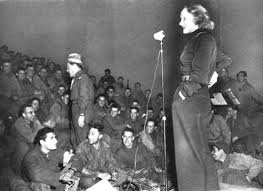 Marlene Dietrich, who worked tirelessly during world war two entertaining allied troops, also recorded both a