by Ali Minai
 But Och! I backward cast my e’e,
On prospects drear!
An’ forward tho’ I canna see,
I guess an’ fear!
—Robert Burns, “To a Mouse”
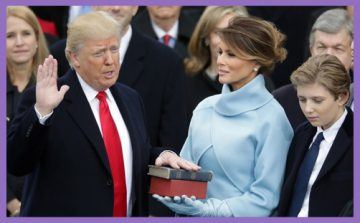
On January 24, 2017 – four days after Donald Trump was sworn in as the 45th President of the United States – I sat down at my computer and wrote out an 8-point plan by which I feared he and his party could change forever the nature of American democracy. Now, as we approach another presidential election, it is interesting to look back and take stock.
Here was the plan – reproduced verbatim without any change except a small typo correction:
Step 1: Delegitimize all authoritative sources of information – mainstream media, scientists, economists, historians, other experts.
Step 2: Use control of government resources to foment conspiracy theories and generate fake information (including fake data) to delegitimize popular predecessor.
Step 3. Use the judiciary and the legislature to criminalize criticism and dissent.
Step 4 Stop keeping track of data that would quantify inconvenient facts about climate change, economic inequality, social problems, civil rights problems, gun violence, police brutality, corporate greed, foreign wars, etc.
Step 5: Use control of government institutions to revise previous data and generate new false data to shape perceptions of prior dysfunction and current progress.
Step 6: Divide the opposition by tangling them in internal feuds on issues such as trade, race, political correctness, Israel, etc.
Step 7: Pack the bureaucracy and judiciary as far as possible with compliant functionaries who support the program.
Step 8: Use government institutions to ensure single-party electoral dominance for the foreseeable future, thus removing all fear of public accountability.
I would now like to pose two questions:
- Was all this possible in January 2017?
- Did it come to pass, and if not, why not?
To answer the first question, yes, it was certainly possible. The mechanisms were all there. Trump had come in with Republican majorities in both houses of Congress. The party dominated governorships and state legislatures across the country. The judiciary had already been packed well by previous Republican administrations, and the reversal of this packing stymied by Republican obstruction during the Obama years. The Right-Wing propaganda machine, led by Fox News and Talk Radio, was humming on all cylinders. Read more »


 Now that a deranged president’s toxic presence will finally—finally!—begin to occupy increasingly smaller tracts of our inner lives, these new days might offer an ideal occasion to celebrate songs that sing of the singular mental spaces hidden inside us all—songs that can help re-acquaint us with ourselves.
 Put a small child in a room with a single marshmallow. Tell him that, if he can wait for five minutes, he gets a second one. Leave the room, and see what he does. Can he sit there, staring at that scrumptious-if-a-tad-rubbery mound of goo and powdered sugar and just fight off the urge to grab it, tear it to bits, and, like the Cheshire Cat, leave nothing but a smile?
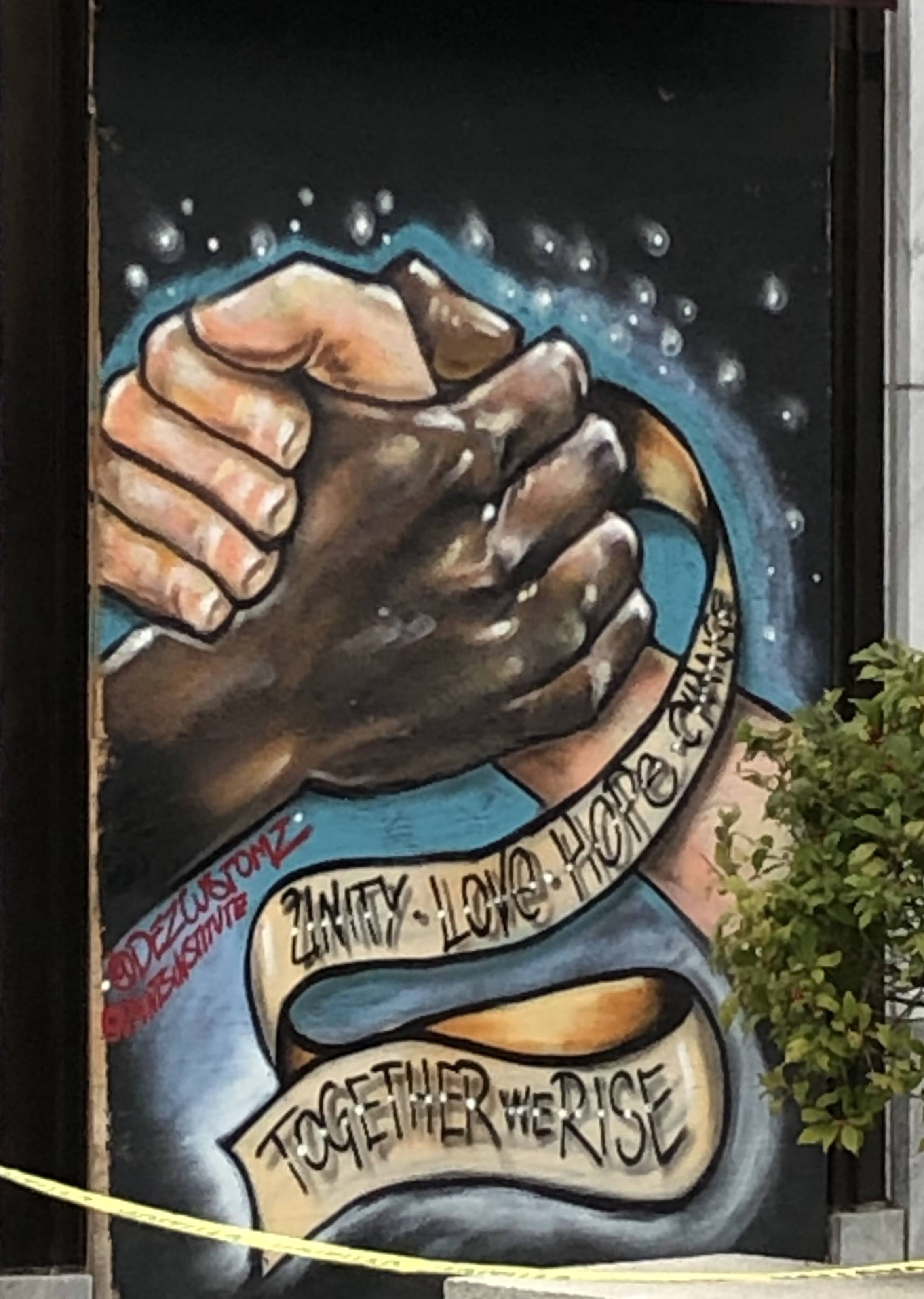 When we are done rhyming words of hope and history to audacity we will need to wake up. When the much needed elation and good cheer wears off, of getting job one done, defeating Trump then the reality will set in.
 think about that. Though others may have one, I lack an analytic framework. The best I can do is to offer some things I’ve been thinking about.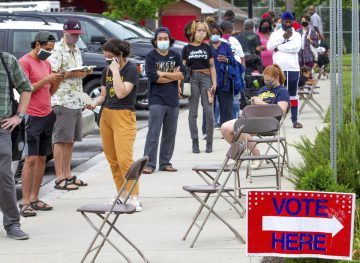
 I’ve been airborne since
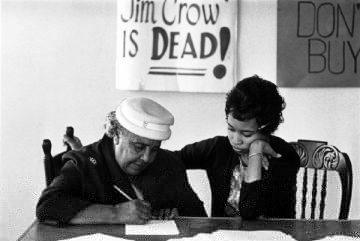 In the presidential election of 2016, around 45% of adult eligible to vote in the USA did not vote. It isn’t disputed that voter suppression, disproportionately affecting people of colour, was one of the causes. Another seems to be a cynicism, or apathy about the process itself. And there may be other reasons. But however you look at it, a situation in which nearly half of the eligible population doesn’t vote in an election for the highest office in the land ought to be causing a good deal of alarm, and not just for those political actors who reckon to be most damaged by this blank statistic. But then, ‘democracy’ has always been rather more of an unfulfilled promise than an accomplished fact, even in the Land of the Free (as well as in the land that boasts the ‘Mother of Parliaments’, where I live).

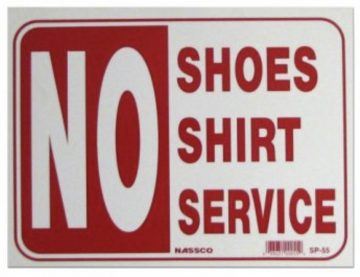 When I was a kid, I used to see this little sign everywhere (still see it occasionally): “No shoes. No shirt. No service.” It was on the door of every store, including the store down at the gas station. It used to make me laugh for some reason. Maybe, just the image of this shoeless, shirtless madman storming the store for more toilet paper.