by Marie Snyder
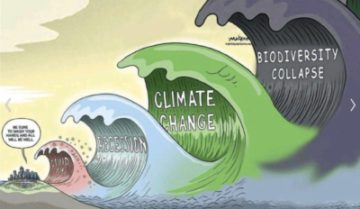 Climate change and covid are revealing an ongoing inability for our society to make wise decisions in the face of calamity, which may be leading us to a collapse of our civilization. Perhaps if we accept (or just believe) that we’re nearing the end, we can shift our priorities enough to usher in a more peaceful and equitable denouement.
Some recent climate change articles are painting a bleak picture. At the Paris Agreement in 2015, countries around the world signed on to reduce greenhouse gases (GHGs) in order to cap warming at 1.5°C above pre-industrial levels by 2030. It’s become clear that we won’t be able to make it.
Current pledges for action by 2030, if delivered in full, would mean a rise in global heating of about 2.5°C and catastrophic extreme weather around the world. . . . Global emissions must fall by almost 50% by that date to keep the 1.5°C target alive. . . . We had our chance to make incremental changes, but that time is over.
The climate crisis has been a test of our ability to put long term collective needs over individual desires, and we failed miserably. It’s no wonder we’re not sufficiently mitigating SARS-CoV-2. Despite all our knowledge and technology and ability, we just don’t want to be inconvenienced. This attitude dates at least as far back as Plato’s Protagoras, as Socrates argues that “our salvation would lie in the art of measurement,” specifically the ability to measure long term benefits against short term when measuring pleasures and pains. It appears that no amount of ingenuity can foist us out of our short-sightedness. We’re horrible at measuring current pleasures against distant pains, but even if we could, we also enjoy doing wrong too much for knowledge alone to lead us down the right path. Thousands of years after it was explained in writing, we still value unfettered lives that lead to unspeakable tragedies over some measure of restraint in current inconveniences could lead to greater pleasures later. Read more »
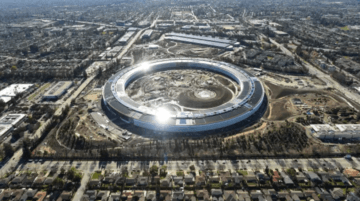


 Now there is a
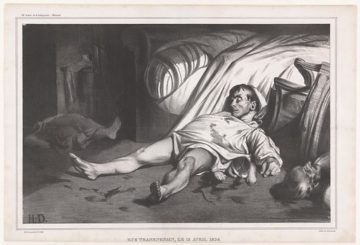 “Mankind was first taught to stammer the proposition of equality” – “Everyone is equal to everyone else” – “In a religious context, and only later was it made into morality,” Nietzsche wrote. Elsewhere, he called “human equality,” or “moral equality,” a specifically “Christian concept, no less crazy [than the soul],” moral equality “has passed even more deeply into the tissue of modernity…[it] furnishes the prototype of all theories of equal rights.”
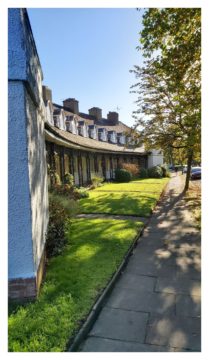 Port Sunlight was a model village constricted in the Wirral, in the Liverpool area, by the Lever brothers, and especially under the inspiration of William Lever, later lord Leverhulme. Their fortune was based on the manufacture of soap, and the village was built next to the factory in the Victorian/Edwardian era, for the employees and their families. It’s certainly a remarkable place, with different houses designed by various architects, parks, allotments, everything an Edwardian working class person might want. An enlightened employer, Lever was still a paternalist: he claimed his village was a an exercise in profit sharing, because “It would not do you much good if you send it down your throats in the form of bottles of whisky, bags of sweets, or fat geese at Christmas. On the other hand, if you leave the money with me, I shall use it to provide for you everything that makes life pleasant – nice houses, comfortable homes, and healthy recreation.” Overseers had the right to visit any house at any time to check for ‘cleanliness’ and that the rules about who could live in which house were observed (men and women could only share accommodation if they were in the same family). Still, by the stands of the day it was quite progressive – schools, art gallery, recreation of all sorts for the employees were important.
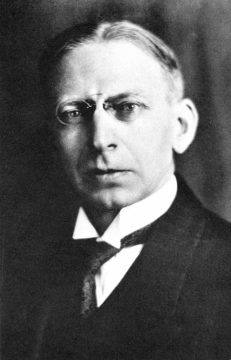 In 1930, the German anthropologist Berthold Laufer published a monograph on the phenomenon of people eating dirt.
 My grandmother’s bird of choice is the rooster. She was raised in rural Kentucky and now lives in rural Wisconsin. She collects all sorts of roosters (and, by extension, some hens): wall art, printed dish towels, ceramic statues as small as a pinky and as large as a lamp, coin bowls and blankets and something nostalgic in each one.