by Tim Sommers

“Happiness is that which all things aim at” according to Aristotle. All virtues – arete (ἀρετή) or “excellences” – are the mean between two extremes. We should choose courage over cowardice, sure, but also over being too bold. Stick to the tame middle.
Epicureans and Stoics counsel against risk and in favor of moderation and in cultivating simple tastes in all things.
Confucius was strongly against reckless behavior. The Daoist counseled, “He who knows when to stop does not find himself in danger.”
But it is Jeremy Bentham, the father of Utilitarianism, that I think about when I think about philosophy’s historical distaste for thrill-seeking. According to Bentham the only human good is happiness. Happiness is just pleasure minus pain. Just as we are morally obligated to seek, above all, the greatest happiness for the greatest number, for ourselves we should also want only happiness. Nietzsche retorted, “Man does not strive for happiness; only the Englishman does that.”
Unfair. John Stuart Mill took Bentham’s view of happiness a step further, unintentionally, providing a rare and beautiful thing: an actual argument for thrill-seeking. Read more »


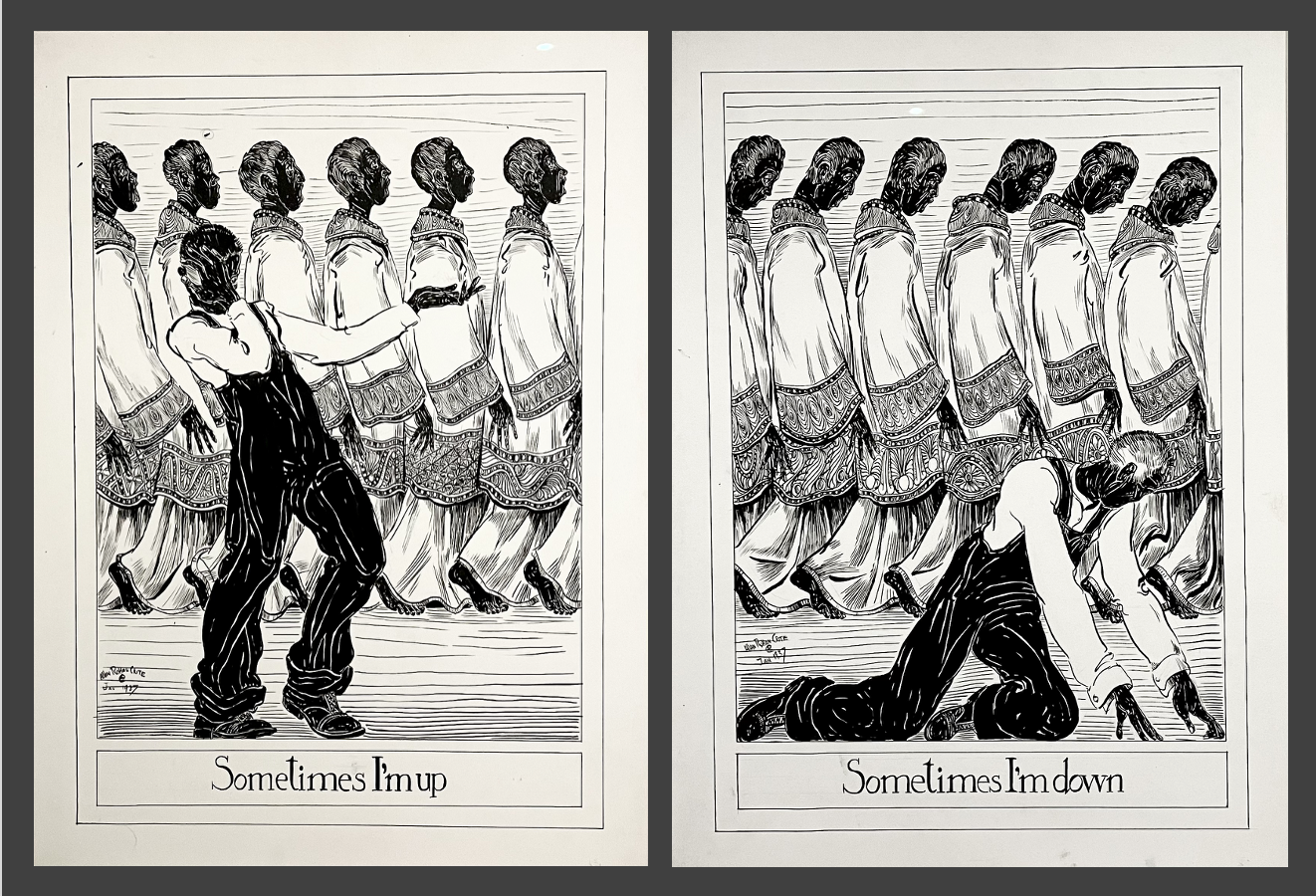 Allan Rohan Crite. Sometimes I’m Up, Sometimes I’m Down. Illustration for Three Spirituals from Earth to Heaven (Cambridge, Mass., 1948),” 1937.
  Dear Reader,



 We sometimes say that someone is living in the past, but it seems to me that the past lives in us. It lives in our houses; it lies all around us. As I write this, I’m sitting on the couch under two blankets crocheted by my grandmother, who was born around the turn of the 20th century. The laptop sits on a folded blanket that came from Mexico via a friend years ago. And that’s just the surface layer. My closets and file cabinets are also full of the past.