
Category: Recommended Reading
What Cold War Liberalism Can Teach Us Today
Jan-Werner Müller in the New York Review of Books:
Liberalism is in crisis, we’re told, assailed on left and right by rising populists and authoritarians. The center cannot hold, they say. But if liberal democracy itself is under threat of collapse because of this weakened center, why are the great defenders of the “open society” such as Isaiah Berlin, Arthur Schlesinger Jr., Karl Popper, and Raymond Aron so little invoked? One would think that liberals today would be pressing back into service these robust thinkers of cold-war liberalism. But while not forgotten, their names are barely cited in contemporary political debates. One curious exception—that almost proves the rule, given its eccentric grounds—was when, last year, an Irish finance minister lauded Berlin for helping him deal with “the demands of corporation tax policy.” That is hardly using Berlin as a buttress against populism.
There remains much to be recovered from cold war liberalism for our historical moment. These thinkers had already learned the hard way that progress in the direction of a more liberal world is not inevitable. In a self-critical vein, they took seriously some of the charges that had been leveled against capitalist democracies in the 1920s and 1930s. But what Schlesinger outlined in an influential 1949 book called The Vital Center was not a matter of mere pragmatism, let alone triangulation between extreme left and right.
More here.
Meena Alexander, Poet Who Wrote of Dislocation, Dies at 67
Neil Genzlinger in the New York Times:
 Meena Alexander, a poet and scholar whose writings reflected the search for identity that came with a peripatetic life, including time in India, Africa, Europe and the United States, died on Wednesday in Manhattan. She was 67.
Her husband, David Lelyveld, said the cause was endometrial serous cancer.
In both prose and poetry Ms. Alexander, a longtime professor at Hunter College and the CUNY Graduate Center, explored themes of feminism, post-colonialism, dislocation, memory and more. She published numerous volumes of poetry, two novels and a memoir, “Fault Lines” (1993). Her writings were themselves the subject of a book, “Passage to Manhattan: Critical Essays on Meena Alexander” (2005).
In their introduction, the editors of that volume, Lopamudra Basu and Cynthia Leenerts, credit Ms. Alexander with creating “a new hybrid poetic form, which fuses the Western Romantic lyric tradition with non-Western ones of Bhakti and Sufi poetry,” which came out of India. In one essay in the book, Jacqueline Wigfall describes “Fault Lines” as “a production of sound, color and texture that exceeds the function of autobiography, social history and political memoir.”
More here.
We Need to Destroy the Blurbing Industrial Complex
Marie Myung-Ok Lee at The Millions:
 Blurbs, the quoted testimonials of a book’s virtues by other authors, are now so ubiquitous, readers expect them, first-time authors stress about getting them, booksellers base orders on them. A blank back cover today would probably look like a production mistake. But while readers heft books in their hands and scrutinize the praise, it should be noted that blurbs are not ad copy written by some copywriter; they are ad copy written by a fellow author. “Ad copy” might be a bit harsh, but maybe not. The “flap copy,” the wordage on the inside flap of the cover of a hard cover, is written by the publishers, to tell potential readers what the book is about but also, of course, to spur a purchase. Blurbs are also there for promotional purposes only, their bias similarly implicit. “Why is this even a book?” I saw in a book review for a tepid memoir that I read in galleys and enthusiastically thought the same thing about. But such an honest negative assessment is not going to make it as a blurb, nor does an author’s effusive praise guarantee that the book has been read. Random people I interviewed for this piece didn’t know what blurbs were—when I asked about their persuasiveness/necessity, most said they thought they were necessary, but then I realized they were referring to the “flap copy” on the inside cover. Most readers I spoke to casually, including my niece, a college student who can’t leave a bookstore without at least 50 pounds of books, seemed pretty agnostic-to-meh about blurbs and mostly ignored them while browsing.
more here.
Populism Without the People
Thea Riofrancos at n+1:
 Consistent with Mouffe’s other writings, For a Left Populism draws on the work of two interwar intellectuals: Carl Schmitt and Antonio Gramsci. It might seem strange to place the thought of “the crown jurist of the Third Reich” alongside that of a leader of the Italian Communist Party who was imprisoned by Mussolini’s government, but Mouffe finds in both figures conceptual resources for what she calls an anti-essentialist leftism. From Gramsci, Mouffe takes the concept of hegemony; from Schmitt, the concept of the political. Hegemony names the form of power that cannot be reduced to brute repression alone. Rather, a dominant social group attains hegemony when subaltern groups voluntarily submit to its rule, not under the barrel of a gun but through the force of “common sense” and affective attachments to the existing order. As a corollary, any counter-hegemonic movement from below must contest the prevailing order and the class interests it serves by engaging not only the state but also civil society. Churches, schools, trade unions, sports teams, and all manner of voluntary associations are the battlegrounds of hegemonic struggle.
more here.
Wednesday Poem
morning song of a fan
a flock of black birds bursts across
the gray sky above a late fall dawn, then
splits in two like a pair of receivers
heading for opposite sidelines.
.
I’m not much of a defender this morning.
let everything score – let the last roses kick
field goals, let the tall, wide-shouldered deodars
plunge over the horizon again and again.
watch how in the far pits the sturdy clouds
hunker down against the blitzing light
while perky pyracanthas strut their orangey stuff.
.
already there is traffic noise as some fans
have left the game before it’s over, yet nobody loses.
it’s like that moment at a great stadium when
you’re going off to the john or to get a beer
and you pause on the cold gritty concrete to hear
the vast, informing silence that coaches everything.
.
by Nils Peterson
the vast, informing silence that coaches everything.
.
by Nils Peterson
Apex Predators and Elena Ferrante
G’Ra Asim in Baffler:
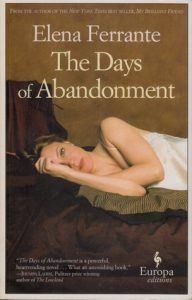 In her 2002 novel The Days of Abandonment, Elena Ferrante deftly dissects just the kind of seemingly vestigial social and historical baggage that remains central to contemporary gender identity. It’s an audacious, unflinching look at the things that are still important to women and why. Reeling in the wake of her husband’s unexpected abandonment of her for another woman, thirty-eight-year-old Olga is vexed by the realization that her sense of self is tethered so tightly to her social roles as mother and wife. The novel’s title is fitting not only for its reference to the sudden dissolution of a marriage, but for Olga’s dereliction of the duties that have come to define her. Bills still pile up, the dog her husband left behind still requires care, and ants threaten to overtake the house when Olga neglects her once undeviating house-cleaning routine.
…I’m skeptical that a total understanding of another’s experience is ever the necessary threshold for thoughtful coexistence, but great literature provides insight into the experiences of others that might be otherwise inaccessible, and can be a vehicle for the kind of empathy that foments social progress. The Days of Abandonment is richer and more nuanced than a merely schematic handbook for post-sexist masculinity, but Ferrante does detail the perils that attend treating relationships as a zero-sum game in which a man willfully waxes at a woman’s wane.
More here.
Tuesday, November 27, 2018
Ancient or modern? The perplexing case of indigenous art
Morgan Meis in The Easel:
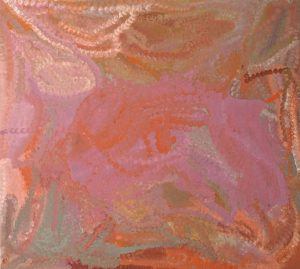 There’s an unexpectedly amusing passage in the great German philosopher Immanuel Kant’s Critique of Judgment. Kant is deliberating upon lofty issues like how and why we consider something beautiful. In the course of his complicated philosophical maneuverings he pauses to mention, by way of example, a number of pleasing designs to be found in nature. And then, in a twist, he muses briefly on how the eye and mind delight in the incredible shapes and forms of… wallpaper. Yes, wallpaper.
Kant likes wallpaper, and thinks the rest of us like it too, because the shapes to be found on a well-designed piece “mean nothing on their own, they represent nothing … and are free beauties.” That’s to say, we delight in the beautiful forms and shapes of wallpaper precisely because we don’t relate them to anything else. The very fact that the mind doesn’t really know what to do with the shapes or how to categorize them means that we can appreciate them on their own terms.
To me, this is one of the crucial moments in the history of modern art.
More here.
Sean Carroll’s Mindscape Podcast: Kip Thorne on Gravitational Waves, Time Travel, and Interstellar
Sean Carroll in Preposterous Universe:
 I remember vividly hosting a colloquium speaker, about fifteen years ago, who talked about the LIGO gravitational-wave observatory, which had just started taking data. Comparing where they were to where they needed to get to in terms of sensitivity, the mumblings in the audience after the talk were clear: “They’ll never make it.” Of course we now know that they did, and the 2016 announcement of the detection of gravitational waves led to a 2017 Nobel Prize for Rainer Weiss, Kip Thorne, and Barry Barish. So it’s a great pleasure to have Kip Thorne himself as a guest on the podcast. Kip tells us a bit about he LIGO story, and offers some strong opinions about the Nobel Prize. But he’s had a long and colorful career, so we also talk about whether it’s possible to travel backward in time through a wormhole, and what his future movie plans are in the wake of the success of Interstellar.
More here.
Setting the record straight on the Journal of Controversial Ideas
Jeff McMahan, Francesca Minerva, and Peter Singer in The Guardian:
 We are the editors of the Journal of Controversial Ideas, which was criticised by Nesrine Malik (Now we have a journal to host provocateurs. Not a good idea, 14 November). We would like to correct her misrepresentations of our project.
At present there is no Journal of Controversial Ideas. There are only our plans and intentions, and a group of about 40 academics who have agreed to be on our editorial board. These are the only facts there are about the journal. Malik could have learned about them had she contacted one of us. Instead she attributed to us a set of aims of her own invention, principal among which is to create a “safe space” in which, by “deliberately branding ideas as controversial”, our authors can “provoke, recoil at the response, abhor it as overreaction”. Because our “thin-skinned, elitist, coddled” authors “will be anonymous”, they can publish “without responsibility” and with complete “freedom from consequence”. Malik even endows us with an unidentified source of funding who will ensure the journal will be governed by “market forces”.
Our aim in establishing the journal is only to enable academics – particularly younger, untenured, or otherwise vulnerable academics – to have the option of publishing under a pseudonym when they might otherwise be deterred from publishing by fear of death threats (which two of us have received in response to our writings), threats to their families, or threats to their careers. Pseudonymity is optional, not required. Our intention is to publish only articles that give carefully developed reasons, arguments and evidence in support of conclusions that some may find offensive or pernicious. We will not publish work that is polemical, intentionally inflammatory or ad hominem. These aims and constraints have consistently guided our own writing.
More here.
Daniel Dennett on the Future of Biology
Punch-Drunk Critics in The Era of Peak TV
Kyle Paoletta at The Baffler:
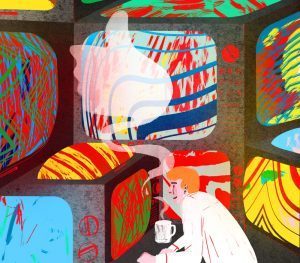 If a decline in quality writ large is indeed evident on the networks and streaming services, one could hardly guess it from the continuing tone of TV coverage. This summer, Sepinwall—recently ensconced at Rolling Stone, long Hollywood’s most reliable cheerleader outside of the trade rags—proclaimed The Americans “one of the great TV dramas of this era,” named Atlanta’s debut season “one of the best and boldest in recent memory,” and labeled Barry “the blackest of black comic stories.”
This counts as reserved praise from Sepinwall. And there’s a reason: in his esteemed opinion, 2018 “has not, by recent standards, been a particularly great year for television.” At least, not compared to 2017, when he groused upon the publication of his year-end best-of list that “narrowing things down even to twenty is tough in Peak TV.” Though one can scarcely imagine a civilian having the time or inclination to follow even twenty programs, to Sepinwall’s mind “there was no real gap in quality between my sixth-place show and about ten or fifteen series that didn’t even make this list.”
more here.
Thoughts on Art
Hank Willis Thomas at Artforum:
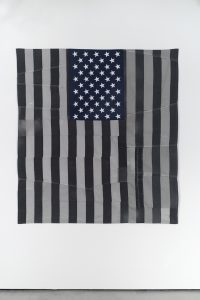 All of my work is about framing and context. Where you stand affects what you see. Your notion of reality is completely shaped by your perspective and what you bring to what you’re looking at. You can have multiple people looking at or talking about the same thing, but having different experiences when it comes to what they’re seeing and what they’re actually talking about.
I’ve always loved modern art, especially Minimalism and Conceptual art. However, I’ve often struggled with interpreting its meaning and even interpreting its value, and at some point I thought that I could engage with it more closely by working with optical ideas that artists such as Frank Stella, Daniel Buren, and Ellsworth Kelly were wrestling with. I was really interested in Buren’s stripes because they are seen as so mundane and apolitical, and I realized that in the United States stripes play a critical role in our iconography as a country (the stars and stripes) but, of course, that we also imprison more people in the land of the free than anywhere else in the world and that prison stripes also have a meaning, a potency. There’s the idea of bars that are meant to represent liberty but are also meant to represent people being confined.
more here.
Handel’s Saint Cecilia Ode
Sudip Bose at the American Scholar:
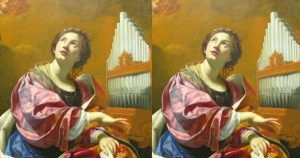 If music is the agent of creation, it remains, for those on earth, a reminder of the divine. It is at once a celestial gift and a personification of human emotions. For both Dryden and Handel, music can be blissful and serene, as in the “What passion cannot music raise and quell!”—a movement that also features two extended, heartfelt solos, the soprano dovetailing beautifully with the cello. It can inspire us to war—“The trumpet’s loud clangor / Excites us to arms / With shrill notes of anger. / And mortal alarms”—the trumpet and tenor sounding the battle cry, and the martial roll of the timpani (corresponding to “The double double double beat / Of the thund’ring drum …”) truly bringing our blood to the boil. Music can reflect our jealousy, our pain, our anger, our desperation. And in quieter moments, it can mirror feelings of deep melancholy. In the movement commencing with “The soft complaining flute,” Handel contrasts the sad desolation of the solo flute and lute continuo (the timbres becoming magical with the addition of the soprano’s voice) with some spectacular coloratura on the word warbling in “Whose dirge is whisper’d by the warbling lute.” More passages of impressive coloratura come later, though in Handel’s hands, this writing never amounts to mere showing off, to virtuosity for its own sake. Rather, the florid embellishments always seem to enhance meaning, aligning text and music to the greatest effect.
more here.
NASA lander survives harrowing descent to surface of Mars
Paul Voosen in Science:
 Update: NASA’s InSight spacecraft survived its descent through the thin atmosphere of Mars and successfully landed on the planet’s surface today. Although hurdles remain to achieve operating status, the lander is well positioned to begin to take Mars’s heartbeat in the next few months. “It was intense, and you could feel the emotion,” says NASA Administrator Jim Bridenstine in Washington, D.C. NASA was able to quickly confirm the landing thanks to a flawless performance by two tiny satellites that accompanied the lander. These CubeSats caught and relayed InSight’s signal to Earth, along with a bonus: a first picture of the terrain where the lander will place its two instruments. Although the picture is obscured by motes of dust on the camera, the terrain looks promising, says Rob Manning, chief engineer at the Jet Propulsion Laboratory (JPL) here. “It looks like there’s not a lot of rocks in the field of view.” A confirming “beep” of health, sent directly from InSight followed, soon after the CubeSat relay. Now, the agency must wait 5 hours for confirmation that the lander’s solar panels have been deployed. Here is our story from earlier today:
PASADENA, CALIFORNIA—A boring spot on Mars is about to get real interesting. Later today, at 11:54 a.m. PST, NASA’s $814 million InSight spacecraft will attempt to land on a flat lava plain near the martian equator. The mission will be NASA’s first landing on the Red Planet since the Curiosity rover in 2012. “I’m really confident, personally, that we’re going to land safely,” says Bruce Banerdt, the mission’s principal investigator here at JPL. “Doesn’t mean I’m not nervous.” The size of an SUV, InSight is designed to explore the martian interior by sensing “marsquakes.” It has spent the past 6 months uneventfully cruising through space, making occasional tweaks to its trajectory. That calm will break at 11:41 a.m., when the spacecraft pivots and presents its heat shield to the atmosphere. At 11:47 a.m., the spacecraft will begin its screaming plunge toward the surface; friction will send temperatures on the heat shield soaring to 1500°C.
More here.
Genome-edited baby claim provokes international outcry
David Cyranosky and Heidi Ledford in Nature:
 A Chinese scientist claims to have helped make the world’s first genome-edited babies — twin girls, who were born this month. The announcement has provoked shock and outrage among scientists around the world. He Jiankui, a genome-editing researcher at the Southern University of Science and Technology of China in Shenzhen, says that he impregnated a woman with embryos that had been edited to disable the genetic pathway HIV uses to infect cells. In a video posted to YouTube, He says the girls are healthy and now at home with their parents. Sequencing of the babies’ DNA has shown that the editing worked, and altered only the target gene, he says. The scientist’s claims have not been verified through independent genome testing, nor published in a peer-reviewed journal. But, if true, the twins’ birth would represent a significant — and controversial — leap in the use of genome editing. Until now, the use of these tools in embryos has been limited to research, often to investigate the benefit of using the technology to eliminate disease-causing mutations from the human germ line. But some studies have reported off-target effects, raising significant safety concerns.
HIV’s entry point
Documents posted on China’s clinical-trial registry show that He used the popular CRISPR–Cas9 genome-editing tool to disable a gene called CCR5, which encodes a protein that allows HIV to enter a cell. Genome-editing scientist Fyodor Urnov was asked to review documents that described DNA sequence analysis of human embryos and fetuses edited at the CCR5 locus for an article in MIT Technology Review. “The data I reviewed are consistent with the fact that the editing has, in fact, taken place,” says Urnov, who is based at the Altius Institute for Biomedical Sciences in Seattle, Washington. But he adds that the only way to tell whether the children’s genomes have been edited is to independently test their DNA.
More here.
Tuesday Poem
Self Portrait with NeoNazi Demonstration
— Leipzig, Germany 4/20/15
Just like that the day is black
and blue, bruised with hate.
Just like that my skin, black
as fine leather stretches so tight
I might tear into bright black
ribbons. See the flag– spent
and flaccid– the windless black,
red and gold clutched in a fist
that I fear will name my black
face dirt, and land. And so, just
like that plans fade to black—
a sunlit walk home folds flat
into a taxi’s steel skin, the black
seat holding my body upright.
See the street draped in black
uniforms, the shrill blue shout
of sirens, the march of black-
draped demonstrators, faces set
toward the sun in rows of black
sunglasses. I want to shoot
something, to become a black
grizzly and claw someone’s throat:
what I mean is I want to be black
and brave, but today, I am not.
Just like that.
By Lauren K. Alleyne
from Split This Rock
Monday, November 26, 2018
Russia’s Dead Souls: A Tale of Two Movies
by Pranab Bardhan
 Ever since my childhood I have been excited, even electrified, by movies. In my college days in Calcutta, in search of alternate experience beyond Indian and Hollywood movies, I used to frequent the local Film Society events, showing some commercially unavailable European fare. Short of funds these Film Society outfits mainly went for movies they could procure at low cost. The East European consulates in the city were particularly generous in making available films from their countries.
Most of them involved grim, but occasionally gripping, stories of life struggles under Nazi occupation and oppression, laced with heart-warming episodes of small triumphs or tragic acts of heroism. It was only much later that I realized that some of these stories were also muffled and indirect protests of the directors against the then Soviet domination in their countries. This was the case, for example, in some of the films of the great Polish director, Andrzej Wajda (whose early films like Kanal and Ashes and Diamonds I had seen several times in Calcutta). His father was among the thousands of Polish officers killed in Katyn forest by Stalin’s secret police in 1940. (Wajda finally made a film about the Katyn massacre much later in his life, when he was in his 80s).
After Calcutta, when I went to Cambridge, England, as a student, for the first time I was exposed to what can be called an ‘abundanza’ of European art films. To borrow the words of the Irish writer John Banville, for me it was an “opulent pleasure garden where I sipped and sucked, dazed as a bumblebee in full-blown summer” (Banville had used these words to describe his ecstatic exploration of his lover’s female body). A couple of movie halls in Cambridge used to specialize in arranging retrospectives of these art films. Read more »
Shades of Life
by Adele A Wilby
 Many decades ago, I packed my bags and left the shores of Australia and headed to the United Kingdom (UK). My secondary years of education had taught me to believe that my journey to the UK would amount to a ‘return’ to the ‘motherland’. A ‘return to the motherland’? Really? That says more about the education system I was exposed to, than just how naïve I was. However, having learned after my arrival that the UK was not, in fact, my ‘motherland’, I did discern that it had more to offer in terms of being ‘in’ the world than the distant shores of Australia, and I decided to stay. Thus, after many years resident in the UK, I considered myself as someone familiar with the country, until, that is, a change in my life circumstances provided me the opportunity to know the UK, or more specifically, England, in a totally different way.
Acting on the advice of a friend concerned with what he considered to be my solitary life following the death of my husband, I joined the Ramblers’ Association in the UK. Involvement with activities of the Ramblers didn’t last too long; group walking was not my thing. I did learn however, that walking was something I relished; it literally, put a spring in my step. The more regularly I walked the more the country opened up to me, an England loaded with complexity, diversity, mystery, and an alluring, limitless beauty: the English countryside.
In many ways, the countryside is how England can be: cold and aloof, requiring time to get to know; a place where one can feel a sojourner in its midst; a place where its nuances and secrets take time to understand. But it is too a place that tolerates your presence, and, as long as you remain respectful, it will allow you to saunter and relish the attributes that it has to offer, undisturbed and secure. That, to me, is fair enough; I don’t ask for more. I have no wish to disturb its existence, or indeed, undermine any aspect of its life.
The UK is exceptional for its network of public footways and bridleways; walking routes where ramblers are permitted to cross farmers’ property, to pass through private driveways and gardens and around farm buildings, if that is where the public right of way takes its direction. Read more »
Verb Tenses
by Gabrielle C. Durham
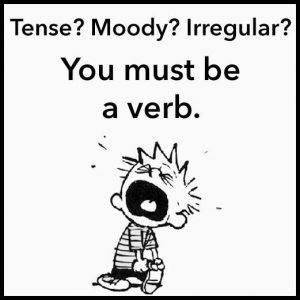 We can agree that a verb in the present tense means that action is occurring now. What about the present progressive, which I used in the previous statement? That apparently confounds non-native English speakers because it means that an action is in the middle of happening. Friends have asked me, “What is the difference between I am playing tennis and I play tennis?” That example is actually a softball because the present progressive indicates that the first person is in the middle of playing a game and the simple present indicates the playing of the sport in general.
This feeling of verbal instability perhaps approaches the bewilderment I still feel with some verbs in Russian when deciding whether to use perfect versus imperfect (honestly, not that common an occurrence, put play along with me, please). I understand when Misha went by train to Novgorod yesterday, no sweat. It’s when he ate a 3-day feast beforehand that I start getting itchy palms. Yes, the verb is in the perfect, or completed, past tense, but that piggish boy just kept engaging in the activity for 72 hours. Would you use the perfect or imperfect past? You could make a persuasive argument for either. According to the Oxford Dictionary, we can break this use of tense down to aspect, which would be either continuous or perfect.
So what does tense tell us? Verb tense refers to when a subject performed an activity (the verb). Easy, peasy, right? Not really if you start talking about other things that happened in relation to that time. That’s where pluperfects and subjunctives, among other infernal entities, come into play. Read more »