by Denis Robinson
Some philosophers I know seem to be engaging in a “this is what I work on in no long words” meme game. I’m retired and I don’t think I could have done it anyway. But in 2005 there was a wee game of that ilk, in which the aim was just to write some philosophy in words of one syllable. I wrote some thoughts I had had: short words but a long piece. I’ve taken this opportunity to make a couple of improvements I’ve long thought of. Here is the whole thing:
Some say it’s all just text and what it means must be as may be, no neat or sharp thoughts or claims which mean just what they say, no grand tales we can know to be true, just a mix of words which shift as we look at them or speak them or hear them some way or not, say “yes” or “no” to them, or play our word games with them just as we play our life games, fight our word wars with them as we fight our life wars, and so on and on and all this and that. If it takes text to say what text means, and then yet more text to say what that text means, and so on, how can it end but in text? At least in France.
But I say this. You can think of words as like tools.
So let’s think of tools for a bit. Stone age folks had a few rough tools, which would do a few rough jobs – split a rock, or a tree, or a skull, crush a nut, spear or skin a fish or a deer, store an egg or some seeds, light a fire, but all no more than fair for what few things they had to do. You might think a lot of rough tools could just make more rough tools at best. Not so. We now have lots of good fine sharp tools, which cut and draw and rule straight and true, we can make a neat screw bolt with a nut to fit tight on it, we can weigh a small wee bit of an ounce or a gram, we can build a plane or a ship or a great big house or mall or hall or bridge, we can see things much too small for the eye to see on its own, we can make small hard drives which store gigs and gigs of stuff, we can surf the net and phone some place on the far side of the world while still on line. We have tools which each do their own jobs well, just as we wish them to, more or less, and each new lot of tools lets us make the next lot yet more fine and use them for yet more things.
I say, so it went with words. It may be that once we had just rough blunt words as tools to speak our speech and think our thoughts. It may be that back then our thoughts, or at least our words and what they meant, were vague, not clear, a mix, like things seen in dreams. Our words would not add all that much to our ways of life, just help us share a bit, work a bit, play a bit, each with each, but all vague, each like a broad dim patch, not a bright spot or dot in the great field of things we might think or mean. But just as you can start with blunt tools and make tools that are sharp, you can start with dim thoughts and make thoughts that are clear, start with vague words and make words that mean things sharp and true, words that do well to state just what you mean and such that each one who knows those words knows what you mean when you say them. Read more »

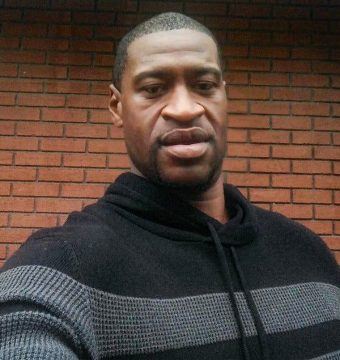 It feels impossible this week not to talk about George Floyd, and yet it feels as if talk has become egregiously cheap, less a mechanism for change than a means of resting in paralyses of complacency, disbelief, or comfort. When rage, grief, frustration, and loss take over communities, states, and entire countries as they have this week, words feel at once like our most important tool and a frantic means of filling what could otherwise be a devastating silence. How do we address a racism so deeply ingrained in society that it feels woven into every fiber of our country’s foundation—and, indeed, was there at the United States’ genesis, when black bodies bolstered a white economy at the expense of their lives, health, and humanity, and in the process built what we so misguidedly call the land of the free, the world’s first great democracy?
 My father had an immensely fat friend whom I often glimpsed filling a plate alone at the buffet table of the King Eddie’s restaurant as I walked past that grand hotel. This man himself had a father even then in those days a nonagenarian, whom he saw daily, devotedly, taking him to the pool for a swim. It turned out that, obesity or no obesity, the friend would outlive my own father by twenty years. Because I liked the man very much, his longevity does not strike me as an injustice. He had a snuffling voice, small but piercing eyes, a gigantic nose and a fund of forgiving affection, the kind dispensed even in the awareness that what was being forgiven might have been awful. He preferred not to know, though his ignorance was (if I may venture a paradox) well informed. My mother played matchmaker for decades in his behalf, possibly because she found him appealing. Her stratagems did not avail. His marvellous acquitting heart remained unpaired.

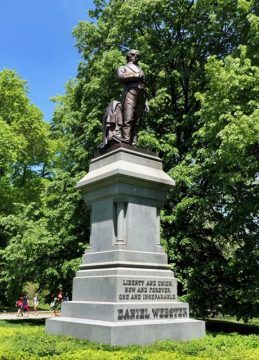 There is a statue of Daniel Webster in Central Park. It is tucked in at the intersection of West and Bethesda Drives, massive and unmoving, implacable and forbidding. Despite its size, it goes largely unnoticed, except as a meeting point.
 I’ve taught shittily these last two months. That’s nothing a teacher ever wants to admit and normally has no excuse for, but these are not normal times.


 Two months ago, COVID lockdown was still new; in the US it was horrific that
  Today will mark the death of at least one hundred thousand Americans because of COVID. The science was clear. Lockdown. Stop movement. Distance. This would have stopped large numbers of people dying. In short, stopping the virus from becoming a pandemic meant pausing the profit principle.
 Jon Hassell is one of America’s musical treasures, and I’ve been listening to his music for forty years, so when I heard he needed help for his medical care, I decided to make a mix of his music. This mix actually grew into two mixes, so look for another one next month. This one features Jon playing with other musicians, and part two will feature other musicians whom Jon has influenced (and a bit more from Jon himself).