by Chris Horner
The general terms ‘true’ and ‘good’ or ‘wisdom’ and ‘virtue’, with which stoicism is stuck, are on the whole undeniably uplifting, but because they cannot in fact end up in any kind of expansion of content, they quickly start to become tiresome. —Hegel [1]

Stoicism seems to be everywhere at the moment, on Tiktok, Instagram, YouTube (‘The Daily Stoic’) and in plenty of best selling books on how to be a Stoic. But why would a philosophy from the Ancient world be found so appealing to so many, right now? I think I can at least give a partial answer to that. And I also want to raise some of the problems of this Neostoicism. In what follows I will be less concerned with the details of the philosophy as it was taught in ancient times, the developments it went through or the logic and metaphysics it involved, than with the way it has been received in the 21st century. Stoicism is a symptom of a malaise, a problem in the modern world, rather than any kind of solution to its ills. But first – what is, or was, Stoicism? [2]
Originally associated with Zeno of Citium in the 3rd century BCE, It is a philosophy focused on developing self-control, fortitude, and reason as a way to overcome destructive emotions and to achieve inner peace, and resilience, by focusing on what is within one’s control, (one’s own feelings, thoughts) while letting go what is outside one’s control. External events and other people’s actions should not disturb one’s inner tranquility. Rather, one cultivates an attitude of calm and detachment from external events. Stoics believed in the importance of reason, logic and self-discipline as essential for leading a fulfilling life, based on following Nature, which has a logos, an order with which we must harmonise our thoughts, feelings and actions.
It was a philosophy that developed and changed during the ancient world, but these main points can be held to be true to the philosophies of such famous Stoics as Seneca, Epictetus, and Marcus Aurelius. Read more »
 I think of Pearl S. Buck and end up thinking of William F. Buckley. I think of
  In late March the United Nations adopted a landmark
 The term “gastronomy” has no agreed-upon, definitive meaning. Its common meaning, captured in dictionary definitions, is that gastronomy is the art and science of good eating. But the term is often expanded to include food history, nutrition, and the ecological, political, and social ramifications of food production and consumption. For my purposes, I want to focus on the conventional meaning of gastronomy for which that dictionary definition will suffice.

 One of the most interesting debates within the larger discussion around large language models (LLMs) such as GPT-4 is whether they are just mindless generators of plausible text derived from their training – sometimes termed “

 Misha Japanwala. Breastplate, ca. 2018.
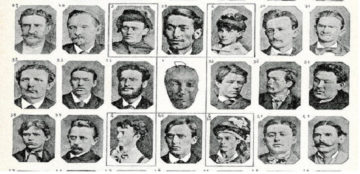 When they arrived in the U.S., Southern Italians brought with them the sense that they’d been branded as underdogs, that they belonged and would forever belong to a lower class, but the birth of the Italian-American gangster was rooted in attitudes toward the Mezzogiorno that dated back far earlier. After Italy was unified under Vittorio Emanuele II in 1861, a new national government imposed Piedmont’s centralized administrative system on the South, which led to violent rebellion against State authority. Politicians and intellectuals took pains to deflect responsibility for what they saw as the “barbarism” of the Mezzogiorno, and were particularly receptive to theories that placed the blame for the South’s many problems on Southern Italians’ own inborn brutishness. The decades following Unification saw the nascent fields of criminal anthropology and psychiatry establish themselves in the universities of Northern Italy; implementing the pseudosciences of phrenology and anthropometry in their search for evolutionary remnants of an arrested stage of human development manifested in the people of the Mezzogiorno, they used various instruments to measure human skulls, ears, foreheads, jaws, arms, and other body parts, catalogued these, and correlated them with undesirable behavioral characteristics, inventing in the process a Southern Italian race entirely separate from and unrelated to a superior Northern race and officially confirming the biological origins of Southern “savagery.”