by David Introcaso
 In late March the United Nations adopted a landmark resolution requesting an advisory opinion from the International Court of Justice “on the obligations of States in respect of climate change.” Specifically, the resolution seeks an opinion regarding legal consequences under international law states may face for acts or omissions that have caused significant damage to the climate that in turn harm other states. The US opposed the resolution arguing disingenuously diplomatic efforts constitute the best approach to addressing the climate crisis. Disingenuous in that the US, for example, is the only country not to sign the UN’s 1992 Convention on Biological Diversity. Also in late March the European Court of Human Rights heard two lawsuits brought by French and Swiss citizens who argued their governments had violated their human rights by failing to address the climate crisis. In the fall the European Court will hear a related case brought by Portuguese citizens that names all 27 European Union and five other nations as defendants.
Because annual global greenhouse gas emissions (GHG) continue to increase and because there is no credible pathway to limiting global warming to an average of 1.5C, not surprisingly the number of climate crisis-related lawsuits have rapidly increased since 2020. Of the 2,000 globally 500 are in the US. The most noted US lawsuit is Juliana v the US, a case that has been termed the most important in history largely because the US is responsible for 40% of excess global GHG emissions. In 2015, 21 youth plaintiffs, moreover minorities as young as eight, filed a lawsuit against President Obama and seven executive departments including Agriculture, Commerce, Energy and the Department of Defense, the world’s largest institutional GHG polluter. The Department of Health and Human Services (HHS) was not named despite the fact the healthcare industry, extensively regulated and almost entirely financed or subsidized by the federal government, emits four times more GHG emissions than the US defense department. The plaintiffs allege the federal government has violated, in part, their constitutional due process rights by supporting the use of fossil fuels for over fifty years. The government does this, the plaintiffs argue, despite knowing resulting GHG emissions endanger the climate’s stability thereby compromising the plaintiffs’ health and the health of all future Americans. The plaintiffs requested the court to order the government to implement a plan to phase out fossil fuel use and draw down excess atmospheric GHG emissions. Read more »

 The term “gastronomy” has no agreed-upon, definitive meaning. Its common meaning, captured in dictionary definitions, is that gastronomy is the art and science of good eating. But the term is often expanded to include food history, nutrition, and the ecological, political, and social ramifications of food production and consumption. For my purposes, I want to focus on the conventional meaning of gastronomy for which that dictionary definition will suffice.

 One of the most interesting debates within the larger discussion around large language models (LLMs) such as GPT-4 is whether they are just mindless generators of plausible text derived from their training – sometimes termed “


 Misha Japanwala. Breastplate, ca. 2018.
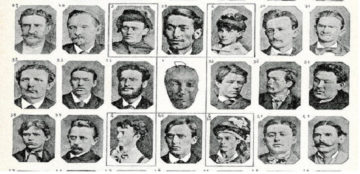 When they arrived in the U.S., Southern Italians brought with them the sense that they’d been branded as underdogs, that they belonged and would forever belong to a lower class, but the birth of the Italian-American gangster was rooted in attitudes toward the Mezzogiorno that dated back far earlier. After Italy was unified under Vittorio Emanuele II in 1861, a new national government imposed Piedmont’s centralized administrative system on the South, which led to violent rebellion against State authority. Politicians and intellectuals took pains to deflect responsibility for what they saw as the “barbarism” of the Mezzogiorno, and were particularly receptive to theories that placed the blame for the South’s many problems on Southern Italians’ own inborn brutishness. The decades following Unification saw the nascent fields of criminal anthropology and psychiatry establish themselves in the universities of Northern Italy; implementing the pseudosciences of phrenology and anthropometry in their search for evolutionary remnants of an arrested stage of human development manifested in the people of the Mezzogiorno, they used various instruments to measure human skulls, ears, foreheads, jaws, arms, and other body parts, catalogued these, and correlated them with undesirable behavioral characteristics, inventing in the process a Southern Italian race entirely separate from and unrelated to a superior Northern race and officially confirming the biological origins of Southern “savagery.”