by John Allen Paulos
 Despite many people’s apocalyptic response to ChatGPT, a great deal of caution and skepticism is in order. Some of it is philosophical, some of it practical and social. Let me begin with the former.
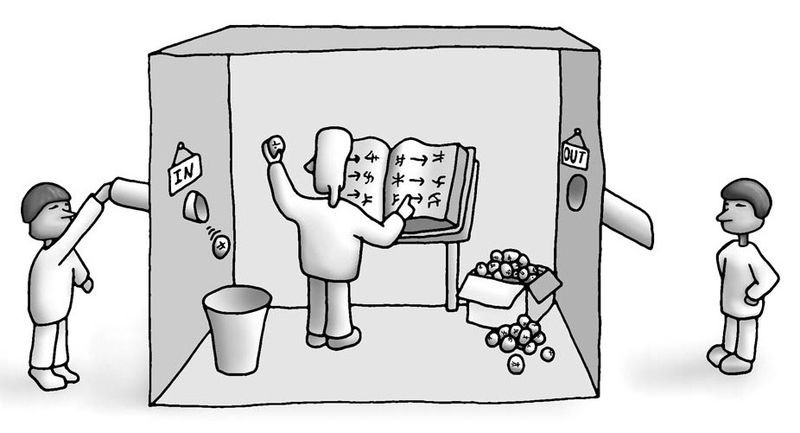
Whatever its usefulness, we naturally wonder whether CharGPT and its near relatives understand language and, more generally, whether they demonstrate real intelligence. The Chinese Room thought experiment, a classic argument put forward by philosopher John Searle in 1980, somewhat controversially maintains that the answer is No. It is a refinement of arguments of this sort that go back to Leibniz.
In his presentation of the argument (very roughly sketched here), Searle first assumes that research in artificial intelligence has, contrary to fact, already managed to design a computer program that seems to understand Chinese. Specifically, the computer responds to inputs of Chinese characters by following the program’s humongous set of detailed instructions to generate outputs of other Chinese characters. It’s assumed that the program is so good at producing appropriate responses that even Chinese speakers find it to be indistinguishable from a human Chinese speaker. In other words, the computer program passes the so-called Turing test, but does even it really understand Chinese?
The next step in Searle’s argument asks us to imagine a man completely innocent of the Chinese language in a closed room, perhaps sitting behind a large desk in it. He is supplied with an English language version of the same elaborate set of rules and protocols the computer program itself uses for correctly manipulating Chinese characters to answer questions put to it. Moreover, the man is directed to use these rules and protocols to respond to questions written in Chinese that are submitted to him through a mail slot in in the wall of the room. Someone outside the room would likely be quite impressed with the man’s responses to the questions posed to him and what seems to be the man’s understanding of Chinese. Yet all the man is doing is blindly following the same rules that govern the way the sequences of symbols in the questions should be responded to in order to yield answers. Clearly the man could process the Chinese questions and produce answers to them without any understanding any of the Chinese writing. Finally, Searle drops the mic by maintaining that both the man and the computer itself have no knowledge or understanding of Chinese. Read more »




 How intelligent is ChatGPT? That question has loomed large ever since
 Environmentalists are always complaining that governments are obsessed with GDP and economic growth, and that this is a bad thing because economic growth is bad for the environment. They are partly right but mostly wrong. First, while governments talk about GDP a lot, that does not mean that they actually prioritise economic growth. Second, properly understood economic growth is a great and wonderful thing that we should want more of.
 Sughra Raza. Untitled. April 1, 2023.



 According to my father, David Mamet once said that his scripts are about “men in confined space.” I have been unable to verify this quote, but if you look on the internet, there’s an awful lot of writing about Mamet and “confined space.” In particular, I suspect the origin of this apocryphal statement may be