
I’m stumped. I’ve hit a wall. More than one most likely.
I don’t know how to think about artificial intelligence. Well, that’s a rather broad statement. After all, I’ve done quite a bit of thinking about it. Six of my most recent articles here at 3QD about been about it, and who know how many blog posts, working papers, and formal academic papers going back for decades. I’ve thought a lot about it. And yet I’ve hit a wall.
First I should say that it’s only relatively recently that I’ve given a great deal of focal attention to artificial intelligence as such. What I’ve been interested in all these years has been the human mind, which I’ve often approached from a computational point of view, as I explained in From “Kubla Khan” through GPT and beyond. In pursuing that interest I read widely in the cognitive sciences, including A.I. My objective was always to understand the human mind and never to create an artificial human being.
It’s the prospect creating of an artificial human being that has me stumped. Of course, an artificial intelligence isn’t necessarily an artificial human being. Computer systems that plays chess or Jeopardy at a championship level are artificial intelligences, but they certainly aren’t artificial human beings. ChatGPT or any of recent large language models (LLMs) are artificial intelligences, but they aren’t artificial human beings.
But the capability of these recent systems, certainly the LLMs, but other systems as well, are so startling that, it seems to me, that they have changed the valence, for lack of a better word, of inquiry into the computational view of the human mind. What do I mean by that, by valence? My dictionary links the term with chemistry and with linguistics. In both contexts the term is about capacity for combination, the ability of one element to join with others in forming chemical compounds, the ability of a word to combine with others in a sentence. Something like that. Read more »
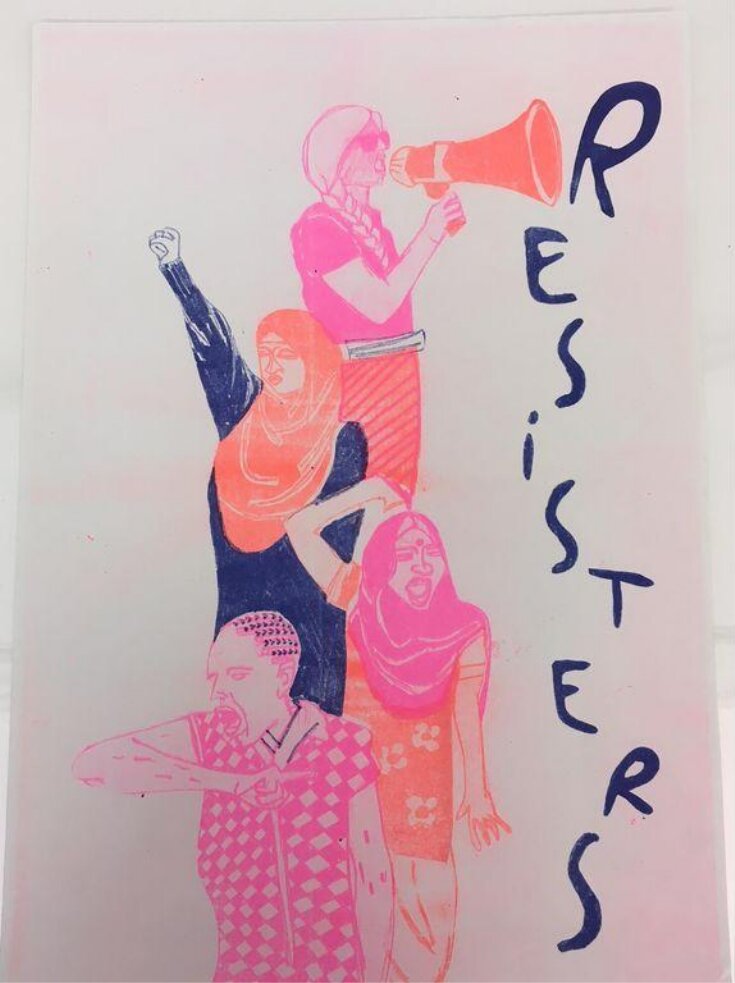 Aqui Thami. Resisters, 2018.
 I can’t sing. Or so I always thought. A notorious karaoke warbler, I would sometimes pick a country tune, preferably Hank Williams, so that when my voice cracked, I could pretend I was yodeling. Then one night, I stepped up to the bar’s microphone and sang a Gordon Lightfoot song.
 My father’s mother—Annie Newman, my grandmother or Bubbi—was born Hannah Dubin in a shtetl in what is now Ukraine a few years before the Great War. One of her earliest recollections—in addition to the image of her own grandmother hiding in a baby carriage to escape marauding Cossacks—was of being able to see troop movements from the roof of her house, presumably during the Russian Imperial Army’s advance against Austria-Hungary, an engagement that occurred in Galicia, farther to the west, in 1914. Much later, in the aftermath of the nuclear accident in Chernobyl in 1986, when that obscure place was suddenly on everyone’s lips, she began recalling that her village, which she called Priut, in a region she referred to by its Russian name as Екатеринославская губернія, or Yekaterinoslavskaya guberniya—the Yekaterinoslav Governorate, a province of the Russian Empire—was not far from that site, which had now become infamous for a catastrophic meltdown.
 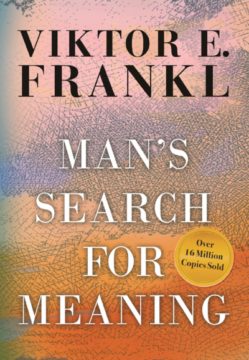 A dear friend of mine recently passed away unexpectedly. He had recommended I read Viktor Frankl’s
 In the typical American city where we live, the average commute time is 78 minutes a day and 97.5% of
  The
The 
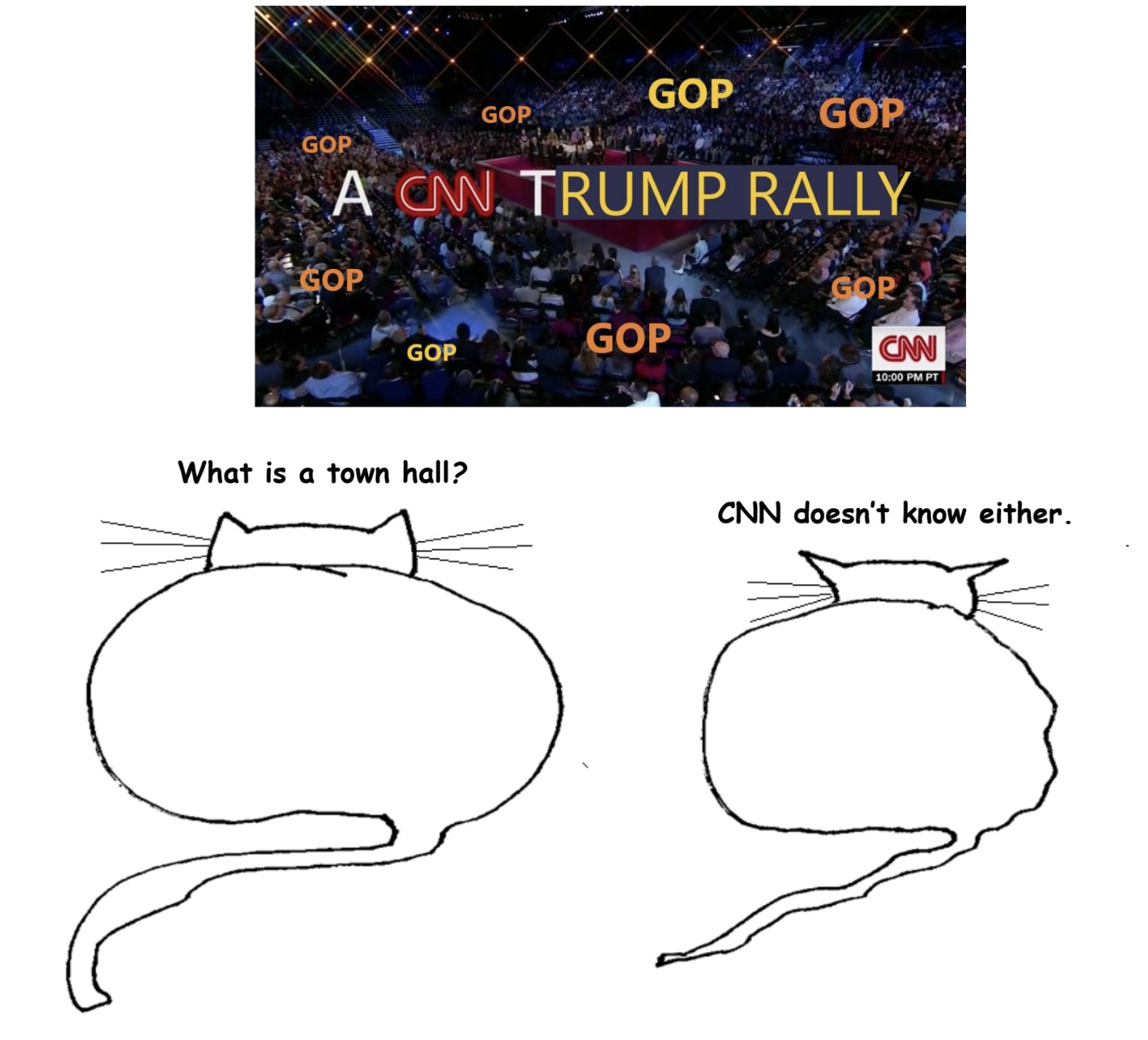
 Every generation, when it reaches a certain age, makes two proclamations: Saturday Night Live used to be funnier, and “kids these days” are lazy and stupid.
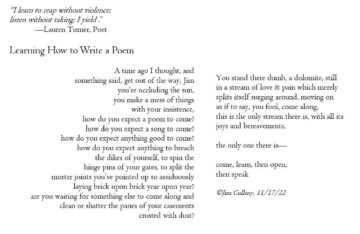
 I think of Pearl S. Buck and end up thinking of William F. Buckley. I think of
  In late March the United Nations adopted a landmark
 The term “gastronomy” has no agreed-upon, definitive meaning. Its common meaning, captured in dictionary definitions, is that gastronomy is the art and science of good eating. But the term is often expanded to include food history, nutrition, and the ecological, political, and social ramifications of food production and consumption. For my purposes, I want to focus on the conventional meaning of gastronomy for which that dictionary definition will suffice.