by Rafaël Newman
 “D — — , I presume, is not altogether a fool, and, if not, must have anticipated these waylayings, as a matter of course.”
“Not altogether a fool,” said G., “but then he is a poet, which I take to be only one remove from a fool.”
“True,” said Dupin, after a long and thoughtful whiff from his meerschaum, “although I have been guilty of certain doggerel myself.”
—Edgar Allan Poe, “The Purloined Letter”
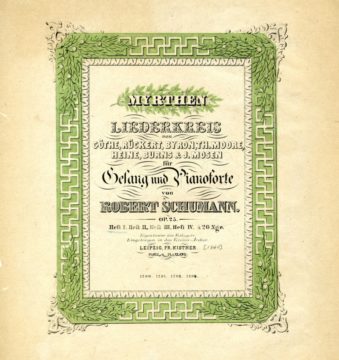
On the eve of their wedding day, on September 12, 1840, Robert Schumann presented Clara Wieck with a collection of 26 songs of his own composition, settings of poems by Goethe, Byron, Heine, Burns, and others. Arranged in four fascicles, the songs foreground literary works in which the speaking voice seems by turns male and female, at least by conventional codification. The poems’ themes range widely, including typical romantic topoi, such as flowers, the Scottish Highlands, and forbidden love affairs, but also drinking songs, ribaldry, and mock rhetorical argument. The very diversity of the selections suggests some definite, if eclectic and highly personal organizing principle had ordained them. And indeed, Schumann’s Myrthen opus 25, although named innocently enough for the myrtles traditionally carried by brides in the 19th century, was more than simply a Brautgeschenk or “bridal gift,” more than merely a pretty, arbitrarily assembled anthology (a term whose etymological roots are similarly floral), since it also celebrates the couple’s triumph over odds both familial and legal—Clara’s father had been resolutely opposed to the marriage, and she had had to win the right to marry Robert at court—as well as the union of two gifted and epochal musical artists.
Now, there is indeed a possible structural determinant of the selections for the cycle, one that tantalizingly suggests a secret code: for the number of its songs—twenty-six—is of course also the number of letters in the Roman alphabet; and musicologists have undertaken various ingenious attempts to discern an alphanumeric key or cypher in their distribution. Does the third song, for instance, “Der Nussbaum” (The Walnut Tree), in which a young woman dreams of a bridegroom, have some particular significance to the addressee, herself presumably about to see her own dream fulfilled, and whose name—Clara—begins with the third letter of the alphabet? Read more »

 1.
1.

 He received the Order of Canada, profoundly helped many people with addiction on the streets of Vancouver, and is much loved and admired, but some of Dr. Gabor Maté’s claims feel like they don’t hold water. And some claims might actually be dangerous if blindly accepted.

 Boomer-bashing is everywhere. Maybe it’s warranted, but a reality check is in order, because the bashing starts from an easy and false idea about how power has moved in American society. The recent change in House Democratic leadership is almost too perfect an example. As a “new generation” takes power in the top three offices, we quietly ignore the most interesting generational story. We griped about the old guard clinging to power, and we cheer for our new young leaders, but we don’t mention that political power skipped a generation: it passed from the pre-Baby Boom generation to the post-Baby Boom generation. The Boomers themselves were shut out of power. As usual.
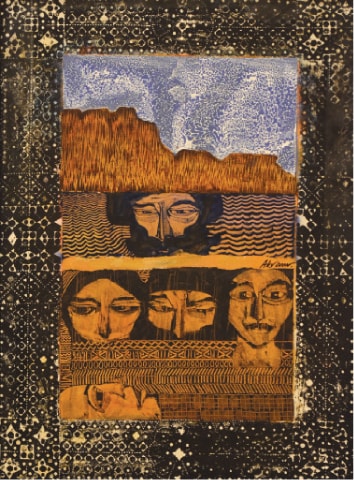 Akram Dost Baloch. From the exhibition “Identities”, 2020.
 There may be no concept so alluring in all of science fiction than that of time travel. We are undoubtedly drawn to alien species and places in space—moons to colonize, asteroids to mine. But even freakish beings and far-off worlds, however remote, have always smacked a little too much of our own reality. I’m fully capable, after all, of walking from my apartment to the park. I can sit on a bench and read
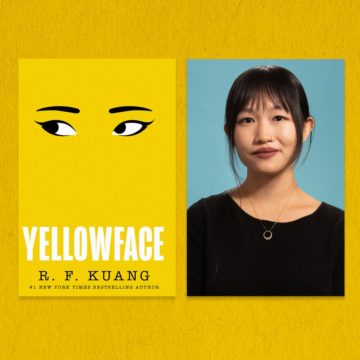
 Rebecca F. Kuang
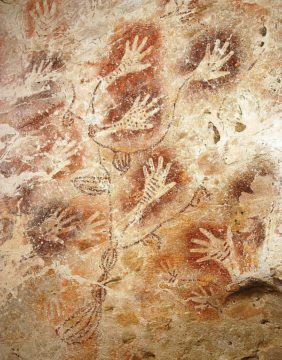 First mixing the grounds of red and yellow ocher with water so as to make a viscus, sticky gum which she puts between her cheek and whatever teeth she may have had, the woman placed her rough, calloused, weather-beaten, sun-chapped hand against the nubbly surface of the limestone cave’s wall, and then perhaps using a hollow-reed picked from the silty banks of the Rammang-rammang River she would blow that inky substance through her straw, leaving the shadow of a perfect outline. This happened around forty thousand years ago and her hand is still there. A little over two dozen of these tracings in white and red are all over the cave wall. What she looked like, where she was born, whether she had a partner or children, what gods she prayed to and what she requested will forever be unknown, but her fingers are slim and tapered and impossible to distinguish from those of any modern human. “It may seem something of a gamble to try to get close to the thought processes that guided these people,” writes archeologist Jean Clottes in What is Paleolithic Art?: Cave Paintings and the Dawn of Human Creativity. “They are so remote from us.” Today a ladder must be pushed against the surface of the cave’s exterior, which appears as if a dark mouth over the humid, muddy Indonesian rice fields of South Sulawesi Island, so as to climb inside and examine her compositions, but during the Neolithic perhaps they simply cleaved alongside the rock face with their hands and feet. Several other paintings are in the complex; among the earliest figurative compositions ever rendered, some of the sleek, aquiline, red hog deer, others of chimerical therianthropes that are part human and part animal. Beautiful, obviously, and evocative, enigmatic, enchanting, but those handprints are mysterious and moving in a different way, a tangible statement of identity, of a woman who despite the enormity of all of that which we can never understand about her, still made this piece forty millennia ago that let us know she was here, that she lived.