
by Ed Simon

Alternating with my close reading column, every even numbered month will feature some of the novels that I’ve most recently read, including upcoming titles.
I’m a sucker for a certain type of European novel, or if not actually European, something that trades in all of those connotations of that continent, of that word. Specifically central European and eastern European settings, perhaps because of some deep ancestral affinity for that borderland between the occident and orient, a place of beets, carraway seeds, and sour-cream, of gnarled primeval forests and grey rivers, of craggy ominous mountains or lonely sunflower covered steppes, massive brutalist apartment blocks and picturesque little Medieval hamlets of onion domed churches and red-tiled roofed homes. For that reason, this past year I’ve continually drifted towards either novels from folks originally from the Balkans, Poland, Russia, or I’ve read American imaginings of that broad inchoate land bordered by the Adriatic and the Bosphorus, the Black Sea and the Baltic, along the banks of the Danube or the Volga.
Daniel Mason’s 2018 The Winter Soldier was a particular type of eastern European story, an epic war account from the perspective of introverted Austro-Hungarian medical student Lucius, a scion of Viennese society from noble Polish stock who is unfortunately sent as a medic to the homeland of his forefathers on the eve of the Brusilov Offensive. My introduction to Mason was this past summer, when I read Northwoods, his brilliant, polyvocal, magical realist, slightly gothic, maximalist account of American history from the colonial era through to the near future all as focalized through a single western Massachusetts house in the woods, a character its own right. The Winter Soldier, in an envious display of Mason’s tremendous talent, is a profoundly different book.
Effectively a realist novel in the vein of a Boris Pasternak more than the Thomas Pynchon on display in Northwoods, Mason’s earlier attempt is a novel of the Great War, with accounts of charging Cossacks and rationing in Vienna, of railroad stations filled with fleeing refugees and of cruel Hussar officers. There is, of course, a love story (and a mystery) as well, Lucius inevitably falling for the nun who works alongside him as a nurse, but it is heartbreakingly depicted, with sentimentality but no schmaltz. Beyond that, however, Mason has written an indelibly effecting account of medicine, as Lucius is forced to develop from a shaky student in the distant cosmopolitan capital into a frontline emergency physician treating soldiers whose minds and bodies have been blown apart. Read more »
 In recent public debates it has been argued that the implementation of Artificial Intelligence in weapons systems is changing the nature of war, or the character of war, or both. In what follows, my intention is to clarify these two concepts of nature of war and character. It will show that AI is a powerful technology, but it is currently neither changing the character nor the nature of war.
 Orwell has surely been safe for ages – through just two famous books, neither of which is Keep the Aspidistra Flying. His essays seem alive too. Ideology plays a role here: he was saying things in Animal Farm and 1984 that influential people wanted disseminated. You couldn’t get through school in Britain without being made to read him. I persist in thinking him overrated. Will he fade without the Cold War? There’s no sign of it yet.

 When I think of New York City, the first image that rises to the surface isn’t its vaunted skyline, those defiant towers scraping at the heavens. It isn’t the classical grandeur of the Metropolitan Museum where civilizations whisper through marble and canvas, nor the razzle-dazzle of Broadway where melodies unfurl amidst a fever of lights and applause. No, of all the things I could remember, the image that lingers most is one of angst—dense, unrelenting and amorphous, like yellowing seepage on the walls of an old house, eating it from the inside out.
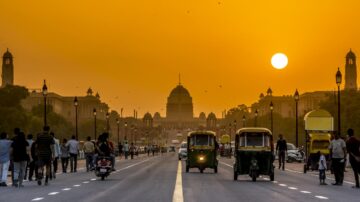 Meanwhile, in New Delhi, the capital city of India to which I’ve just returned, I’ve been startled to find a different rhythm altogether – slower, steadier, and far from the edge of a precipice. Here, the streets hum with chaos, the air is thick with dust and petrol, and the disparities between wealth and poverty gape wide. And yet, amidst this, I see people who seem—dare I say it?—happier. Their circumstances, when measured against any global standard of “quality of life,” are objectively harsher than those of the stressed and striving New Yorkers I left behind. But their faces, their words, their mannerisms suggest something else entirely.


 Sughra Raza. Self Portrait At Home. December 2024.
 After many years as a practicing lawyer, I remain proud of what I do. Putting aside lawyer jokes, stale references to ambulance chasing and analogies with other professions that charge by the hour, I have enjoyed doing what lawyers do and I am unapologetic about it.


 With its pristine rainforest, complex ecosystems and rich wildlife, Ecuador has been home to one of the most biodiverse countries on Earth. For thousands of years indigenous peoples have also lived harmoniously in this rainforest on their ancestral land. All that has now changed. Since the 1960s, oil companies, gold miners, loggers and the enabling infrastructural workers have all played their part in the systematic deforestation and destruction of this complex eco-system. Human rights abuses, health issues, deleterious effects on the people’s cultures and the displacement of people have all become part of the indigenous people’s lives. But wherever and whenever oppression, exploitation and social injustice raises its ugly head, resistance will eventually emerge, and so it is with the indigenous Waorani people of the Ecuadorian rainforest, under the leadership of Nemonte Nenquimo.