by Tasneem Zehra Husain
The development of [my] thought-world is in a certain sense a continuous flight from wonder.
—Albert Einstein
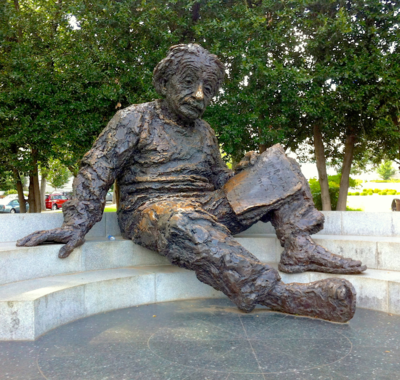
We are marked in large part by our celebrations: what we celebrate, and how we choose to do so, says a lot about who we are. As a global society, we seem to be increasingly fascinated with genius, and almost sixty years after his death, Einstein continues to be emblematic of this phenomenon. Over time, he has become larger than life – more myth than man.
In the annals of physics, Einstein's footprints are everywhere; his contributions as various and scattered as if they too, were subject to the brownian motion he elucidated. Along most paths he trod, he left staggering achievements in his wake. Einstein made crucial contributions to a nascent quantum theory, his incisive explanation of the photoelectric effect was so brilliant, it won him the Nobel Prize, and yet, most physicists, if asked to name Einstein's definitive work, would unblinkingly pick general relativity. The theory celebrates its hundredth birthday in a couple of weeks, and festivities are underway across the globe.
Over four successive Thursdays in November 1915, Einstein presented his (still developing) theory to the Prussian Academy of Sciences in Berlin. He laid down The Formal Foundations on 4 November 1915, and worked feverishly every day, polishing and honing the theory, coaxing out some of the gems that lay hidden within, until finally, on 25 November he unveiled the spectacular Field Equations of Gravitation.
“Hardly anyone who truly understands it will be able to escape the charm of this theory,” wrote Einstein in this final paper, and his remark has stood the test of time, just as well as his equations have. The General Theory of Relativity is a work of unparalleled beauty; in fact, it exemplifies what it means for a physical theory to be beautiful, and is often quoted as the canonical example of such.
There is an air of inevitability about general relativity, which Nobel Laureate Steven Weinberg equates with beauty. “In listening to a piece of music or hearing a sonnet one sometimes feels an intense aesthetic pleasure at the sense that nothing in the work could be changed, that there is not one note or one word that you would want to have different,” he writes. It is so with general relativity. No idea or symbol seems extraneous or out of place.