by Muhammad Aurangzeb Ahmad

In the previous article of this series I started with the exploration of the concept that every civilization eventually arrives at the edge of its own knowing. It was not meant to be exhaustive or a critique but rather exploration of certain themes in Western thinking. Based on the feedback I have decided to dive into Buddhist thinking to clarify the scope of this exploration. How Buddhist thought approached the limits of its thinking is very different from the West. For Buddhist thought, and dharmic thought in general, the problem of limits of knowledge was not that knowledge had limits. The problem was that we had mistaken our concepts for reality itself. What might appear as an impassable boundary was, on closer inspection, an illusion created by the mind’s need to divide the world into knower and known.
From its earliest philosophical formulations, Buddhism did not ask how far knowledge could reach. It asked instead whether the question itself was coherent. In the Pali cannon there are fourteen questions that Buddha is said to have described as being unanswerable. The task of thought was not to extend reason to its horizon, but to dissolve the horizon altogether. The literature that emerged from this tradition does not always accumulate answers. It erodes the ground on which answering stands, the most well known examples being from Zen Buddhism. In contrast to Western thinking, the Buddhist literature of limits offers neither mastery nor despair, but release. This is way of seeing in which the limits dissolve precisely because the self that sought it gives way. This way of thinking can be epitomized by the most radical thinker of Buddhist philosophy, Nagarjuna sought to dismantle the very conditions that make limits intelligible. In the Mulamadhyamakakarika, he applies relentless logic to every fundamental concept whether it is cause, substance, self, or time. The goal is to show that each of these collapses under analysis. Things do not exist independently, nor do they fail to exist. According to Nagarjuna, they arise only in dependence, empty of fixed essence.
From here, we move to the limits of language. Read more »





 Like many other video gamers (nearly eight million, in fact), I have spent no small portion of recent weeks in the robot-infested, post-diluvian wastes of late-22nd-Century Italy, looting remnants of a collapsed civilization while hoping that a fellow gamer won’t sneak up and murder me for the scraps in my pockets. This has been much more fun than the preceding description might lead you to believe, if you are not a fan of such grim fantasy playgrounds. It has also, interestingly, afforded rather heart-warming displays of the better side of human nature, despite the occasional predatory ambush or perfidious betrayal. It helps somewhat that nobody really dies in this game; they just get “downed” and then “knocked out” if not revived in time, leaving behind whatever gear they were carrying (except for what they were able to hide in their “safe pocket”, the technical and anatomical details of which are left to the player’s imagination).
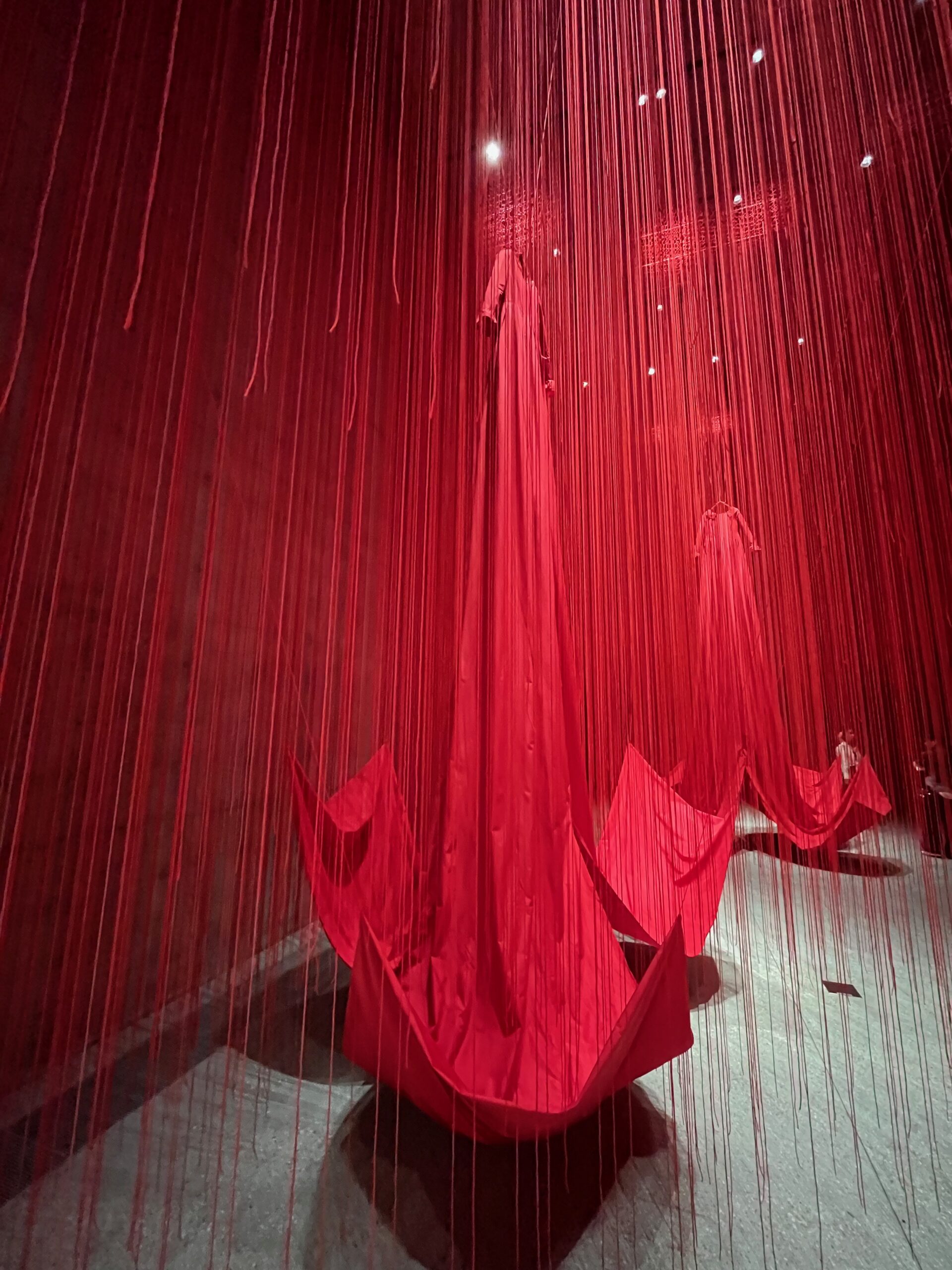 Chiharu Shiota. Infinite Memory, 2025.
 S. Abbas Raza: You may have heard of

 Preparing a worksheet with negative-number calculations where all the digits are sixes and sevens. Telling myself it’s meant to take the fun out of it for them – like a sex ed teacher having their students say ‘penis’ one hundred times before starting the unit. Definitely not the whole story, but plausible: as a middle school math teacher I am more than justified in trying to tame the phenomenon. In fact, I have drawn a firm line; just seeing a 6 anywhere in an exercise is decidedly not an appropriate reason for doing the meme. Really, we need to get on with the lesson now; I will count to five.
 Antonio Gramsci’s theory of hegemony helps explain how the power structure of modern liberal-democratic societies maintains authority without relying on overt force. Many definitions of hegemony point out that it creates “common sense,” the assumptions a society accepts as natural and right.