
The Literature of Limits IV: Hinduism, Forms, and the Infinite

by Muhammad Aurangzeb Ahmad
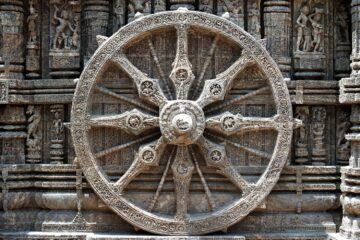
Image by Photo by Chaithanya Krishnan Creative Commons License

This is the last part of our discussion on the culture of limits (Part I, Part II, and Part III). In Hindu thought limits that define finitude and infinity were never opposed in a simple or antagonistic way. Instead, they were understood as mutually implicated. One could even say that they were woven together through cycles of manifestation and withdrawal, form and formlessness, appearance and return. The infinite was not something to be reached beyond the world, it was something already present within it. It was always unfolding rhythmically through time, consciousness, and matter. Philosophical expressions of Hinduism resisted the idea that ultimate reality could be exhausted by conceptual knowledge. The Upanishads repeatedly returned to the intuition that what is most real is also what is least graspable. Brahman, the ground of all being, was not an object among other objects, nor even the highest object of thought. It was that in which all objects, thoughts, and selves already participated. To know Brahman was not to acquire information, but to undergo a transformation of orientation. It was meant to be an inward turning in which the knower, the known, and the act of knowing were gradually revealed as inseparable.

The Upanishads, rather than offering systematic doctrines, offered sustained interrogations into the nature of self, reality, and knowledge, repeatedly returning to what resists articulation. Their method was deliberately indirect: aphorism, dialogue, paradox, and negation were used not to obscure meaning, but to prevent it from hardening into concept. Brahman was described as “not this, not that” (neti neti), not because it was inaccessible, but because any positive description would prematurely limit what was fundamentally unbounded. Knowledge, in the Upanishadic sense, did not accumulate toward mastery. It is supposed to turn inward, loosening the distinction between knower and known until insight emerged as recognition rather than discovery. In this respect, the Upanishadic discipline of unknowing closely paralleled later Sufi practices of ḥayra and self-refinement, where the failure of conceptual grasp was likewise treated not as an impasse, but as a necessary condition for deeper apprehension of reality.

This inseparability reshaped how limits were understood. Read more »

Sunday, December 14, 2025

The Literature of Limits (Part II): The Buddhist Horizon

by Muhammad Aurangzeb Ahmad

Sesshu_-_View_of_Ama-no-Hashidate
Painting by Sesshu Toyo (1420-1506) who was a Japanese Zen painter trained in China.

In the previous article of this series I started with the exploration of the concept that every civilization eventually arrives at the edge of its own knowing. It was not meant to be exhaustive or a critique but rather exploration of certain themes in Western thinking. Based on the feedback I have decided to dive into Buddhist thinking to clarify the scope of this exploration. How Buddhist thought approached the limits of its thinking is very different from the West. For Buddhist thought, and dharmic thought in general, the problem of limits of knowledge was not that knowledge had limits. The problem was that we had mistaken our concepts for reality itself. What might appear as an impassable boundary was, on closer inspection, an illusion created by the mind’s need to divide the world into knower and known.

From its earliest philosophical formulations, Buddhism did not ask how far knowledge could reach. It asked instead whether the question itself was coherent. In the Pali cannon there are fourteen questions that Buddha is said to have described as being unanswerable. The task of thought was not to extend reason to its horizon, but to dissolve the horizon altogether. The literature that emerged from this tradition does not always accumulate answers. It erodes the ground on which answering stands, the most well known examples being from Zen Buddhism. In contrast to Western thinking, the Buddhist literature of limits offers neither mastery nor despair, but release. This is way of seeing in which the limits dissolve precisely because the self that sought it gives way. This way of thinking can be epitomized by the most radical thinker of Buddhist philosophy, Nagarjuna sought to dismantle the very conditions that make limits intelligible. In the Mulamadhyamakakarika, he applies relentless logic to every fundamental concept whether it is cause, substance, self, or time. The goal is to show that each of these collapses under analysis. Things do not exist independently, nor do they fail to exist. According to Nagarjuna, they arise only in dependence, empty of fixed essence.

From here, we move to the limits of language. Read more »