by Jonathan Kujawa
Approximately 1900 years ago Theon of Smyrna authored On Mathematics Useful for the Understanding of Plato. In it, Theon wrote:
For Eratosthenes says in his writing he Platonicus that when the god pronounced to the Delians in the matter of deliverance from a plague that they construct an alter the double of the one that existed, much bewilderment fell upon the builders who sought how one was to make a solid double of a solid. Then there arrived men to inquire of this from Plato. But he said to them that not for want of a double altar did the god prophecy this to the Delians, but to accuse and reproach them the Greeks for neglecting mathematics and making little of geometry.
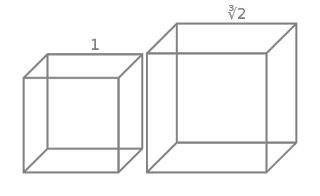
Thus the problem of doubling the cube was born. If we are given a cube of a certain volume, can we construct a cube whose volume is exactly double? We might as well start with the cube as a practice problem and worry about the more complicated shape of an altar once we've got the cube sorted out. Also, up to changing our choice of units, we can safely assume the cube has volume exactly 1. We've now got a simple geometry problem: given a cube with volume 1, how to construct a cube with volume 2? Like many of the best questions, this seemingly innocuous problem opens a Pandora's box of interesting things to ponder.
Plato warns us not to neglect our mathematics. As mathematically minded folks we know we should first decide on ground rules. If we don't bother to first agree on clear, unambiguous definitions and axioms, then we'll just end up talking past each other. This might play on cable tv, but it's not mathematics. Besides, like writing a sonnet or a haiku, half the fun in math is in the constraints. Like Robert Frost said, "I'd sooner write free verse as play tennis with the net down".
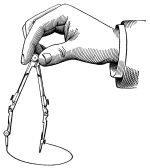
In the case of the doubled cube, the Greeks allow us to use a straightedge (that is, an unmarked ruler which allows us to make any straight line we like) and a compass (those devices from elementary school with a point on one end and a pencil on the other which allows us to make any circle we like). Nowadays you can instead play the addictive free game Euclidea.
Since a cube is completely determined by its side length and the volume is just the side length cubed, doubling the cube comes down to the problem of using a straightedge, compass and a line segment of length 1 and, by hook or by crook, construct a line segment whose length is the cubed root of 2.
After fiddling with your straightedge and compass for a millennium or two you might start to suspect that the god was putting one over on the Delians (after all the Greek gods weren't known for playing fair). But how in the world could you ever know for certain that it wasn't possible? After all, tomorrow you might find That One Weird Trick Which Doubles the Cube!
Math is nearly unique in that you can show things are never, ever possible. I was blown away when I first saw the proof that the real numbers cannot be put into an order list numbered by the counting numbers and that the square root of two cannot be written as a fraction of two counting numbers. In retrospect, it was the proofs of impossibility which first converted me to math.