
Stavroula Kousteni, is the Associate Professor of Medicine in Physiology and Cellular Biophysics at Columbia University Medical Center. The goal of her research is to understand the influence of the skeleton on various physiological processes, to uncover the pathogenesis of degenerative diseases and to suggest therapies for them. She is currently examining the role of osteoblasts in hematopoiesis with particular emphasis in myelodysplasia (MDS) and acute myeloid leukemia (AML). Her lab has discovered the skeletons role as an inducer of leukemogenesis, identifying a mutation in osteoblasts that disrupts hematopoiesis leading to leukemogenic transformation of hematopoietic stem cells (HSCs) and establishment of MDS progressing to AML. Additionally, she has helped establish the role of osteoblasts in the engraftment of leukemia blasts. She is currently characterizing the signaling pathway that mediates these actions to manipulate osteoblasts to make the hematopoietic niche hostile to residual leukemia cells.
Azra Raza, author of The First Cell: And the Human Costs of Pursuing Cancer to the Last, oncologist and professor of medicine at Columbia University, and 3QD editor, decided to speak to more than 20 leading cancer investigators and ask each of them the same five questions listed below. She videotaped the interviews and over the next months we will be posting them here one at a time each Monday. Please keep in mind that Azra and the rest of us at 3QD neither endorse nor oppose any of the answers given by the researchers as part of this project. Their views are their own. One can browse all previous interviews here.
1. We were treating acute myeloid leukemia (AML) with 7+3 (7 days of the drug cytosine arabinoside and 3 days of daunomycin) in 1977. We are still doing the same in 2019. What is the best way forward to change it by 2028?
2. There are 3.5 million papers on cancer, 135,000 in 2017 alone. There is a staggering disconnect between great scientific insights and translation to improved therapy. What are we doing wrong?
3. The fact that children respond to the same treatment better than adults seems to suggest that the cancer biology is different and also that the host is different. Since most cancers increase with age, even having good therapy may not matter as the host is decrepit. Solution?
4. You have great knowledge and experience in the field. If you were given limitless resources to plan a cure for cancer, what will you do?
5. Offering patients with advanced stage non-curable cancer, palliative but toxic treatments is a service or disservice in the current therapeutic landscape?



 We find ourselves always in the middle of an experience. But it’s what we do next – how we characterize the experience – that lays down a host of important and almost subterranean conditions. Am I sitting in a chair, gazing out the dusty window into a world of sunlight, trees, and snow? Am I meditating on the nature of experience? Am I praying? Am I simply spacing out? Depending on which way I parse whatever the hell I’m up to, my experience shifts from something ineffable (or at any rate, not currently effed) to something meaningful and determinate, festooned with many other conversational hooks and openings: “enjoying nature”, “introspecting”, “conversing with God”, “resting”, “procrastinating”, and so on. Putting the experience into words tells me what to do with it next.
 Forever is a long time.

 Lili Marleen is one of the best known songs of the twentieth century. A plaintive expression of a soldier’s desire to be with his girlfriend, it is indelibly associated with World War II, in part because it was popular with soldiers on both sides. It was
 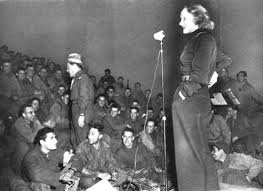 Marlene Dietrich, who worked tirelessly during world war two entertaining allied troops, also recorded both a
 While waiting, shivering and jetlagged, for a train home from the Paris airport this week, I alternately stared into space and checked the train timetables. My train was an hour late. I later learned, thanks to the friendliness of a fellow traingoer, that the train had hit a deer.
 Wine writers, especially those who write wine reviews, are often derided for the flowery, overly imaginative language they use to describe wines. Some of the complainants are consumers baffled by what descriptors such as “brooding” or “flamboyant” might mean. Other complainants are experts who wish wine language had the precision of scientific discourse. The Journal of Wine Economists
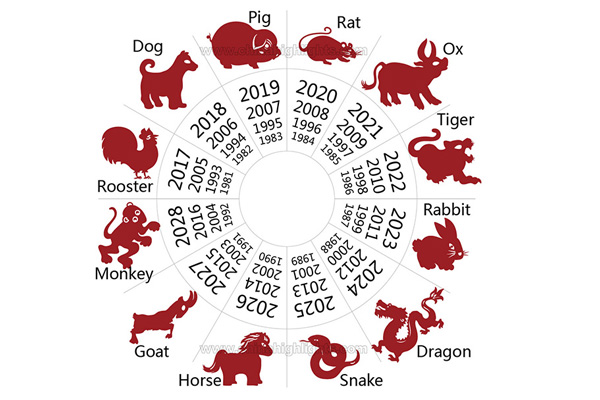 In the Chinese calendar, 2015 was the year of the sheep. I’m a sheep, and I briefly got into it. When you’re a sheep, you gotta own it.
 Schoolteachers across the grades are responsible for teaching their students how to write. Their essential pedagogical role is instrumental. With particular attention paid to format, grammar, spelling, and syntax, students ideally learn to write what they know, think, or have learned. It matters little if the student is in a class for “creative writing” or “composition,” writing is taught and practiced as a way to record thoughts, compose ideas in a coherent manner, and clearly communicate information. A student’s writing is then assessed for how well she adhered to these instrumental standards while the teacher is assessed for how well she adhered to the standards of instrumental teaching.