Maxim D. Shrayer talks to Cynthia L. Haven about her new book, The Man Who Brought Brodsky into English: Conversations with George L. Kline
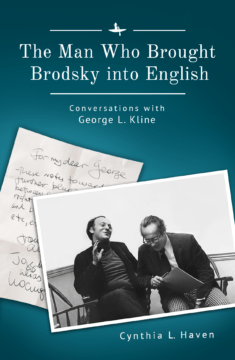 Cynthia, let me begin by asking you to describe your path to the book—a double path that led you to Joseph Brodsky and to George L. Kline.
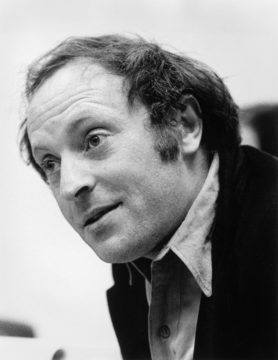
I studied with Joseph Brodsky at the University of Michigan—his first port of call in the U.S. It was psychological and aesthetic jolt, like sticking your finger into a light socket. And yes, we memorized hundreds of lines of poetry in his classes.
For many of us, Brodsky’s Selected Poems in 1973 was a radical reorganization of what poetry can be and mean in our times. However, I didn’t connect with the book’s translator, George Kline, until after I published Joseph Brodsky: Conversations in 2002. George and I stayed connected with Christmas cards and occasional phone calls. But we’d never actually met face to face—so I had no real sense of his age, until in late 2012, when he mentioned that he was almost 92.
George was a champion for Joseph Brodsky and his poetry—many people know that, but many don’t know that he was also a wise and kindly supporter of poets, Slavic scholars, and translators everywhere. He had never given a full account of his collaboration with the Russian-born Nobel poet, however, and I realized time was running out. So we began recording conversations.
His health was failing, and our talks became shorter and more infrequent. Towards the end, he urged me to augment our interviews with his articles, correspondence, and papers, reconstructing a portrait of his collaboration with Brodsky. George died in 2014. Read more »
 Philosophy of science, in its early days, dedicated itself to justifying the ways of Science to Man. One might think this was a strange task to set for itself, for it is not as if in the early and middle 20th century there was widespread doubt about the validity of science. True, science had become deeply weird, with Einstein’s relativity and quantum mechanics. And true, there was irrationalism aplenty, culminating in two world wars and the invention of TV dinners. But societies around the world generally did not hold science in ill repute. If anything, technologically advanced cultures celebrated better imaginary futures through the steady march of scientific progress.


 For some time, Sir Kazuo Ishiguro has been slyly replacing Dame Iris Murdoch as the author to whom I most regularly return. His enchanting and disturbing new novel, Klara and the Sun, his first since winning the 2017 Nobel Prize, is unlikely to diminish this trend. I wrote in a
  have instrumental value. That is, the value of given technology lies in the various ways in which we can use it, no more, and no less. For example, the value of a hammer lies in our ability to make use of it to hit nails into things. Cars are valuable insofar as we can use them to get from A to B with the bare minimum of physical exertion. This way of viewing technology has immense intuitive appeal, but I think it is ultimately unconvincing. More specifically, I want to argue that technological artifacts are capable of embodying value. Some argue that this value is to be accounted for in terms of the





 We think of AI as the stuff of science, but AIs are born artists. Those artistic talents are the key to their scientific power and their limitations.