by Mark Harvey

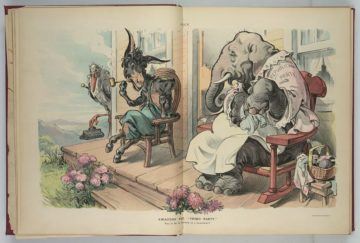
The trouble with theocracies is that they generally lead to crusades. And the trouble with crusades is that if you’re not of the right sect or denomination, you’ll end up crucified. Theocracies lead nowhere, bring great suffering on peoples, stifle creative thought, and have women covered or in the kitchen. They do anything but lead to paradise on earth. But they do give people a taste of hell.
Whether it’s the Taliban in Afghanistan, the Isis caliphate in Iraq and Syria, or The Islamic State of Iran, theocracies are inherently oppressive, and regressive. They subscribe to the idea that there is only one God, he is to be obeyed without question, and that those ruling in a theocratic government have some sort of manifest connection with that God.
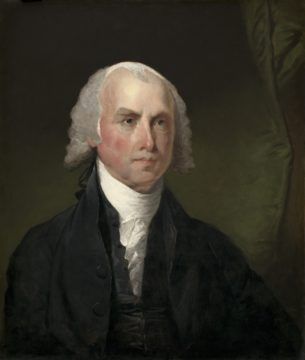
To some degree, Americans have been spared the ravages of theocracies. We are perhaps most indebted to James Madison for that. Madison, sometimes called the father of the Constitution, understood well in advance of 1789 when the framers met in Philadelphia, that the new nation being formed needed to be free and clear of the factionalism so often created by religious zealots. In letters to his close friend Thomas Jefferson, Madison wrote, “When Indeed Religion is kindled into enthusiasm, its force like that of other passions is increased by the sympathy of a multitude….Even in its coolest state, it has been much oftener a motive to oppression than a restraint from it.”
I have no issues with religion per se. I think it genuinely helps some people navigate their lives and having a faith strong enough to maintain an unswerving optimism in the face of life’s hardships is even enviable. For the truly dispossessed and bereaved, a belief in God may be the last thing to cling to. Ralph Waldo Emerson, one of our great writers and a transcendentalist, called the religious sentiment “mountain air” and “the embalmer of the world.”
“It makes the sky and the hills sublime, and the silent song of the hills is it,” he said. Read more »

 Being in Berkeley for more than four decades I have met and encountered many leftists and several of them are/were radical in their politics, though in recent years the radical fervor has been somewhat on the decline even in Berkeley. I remember some time back reading one east-coast journalist describing Berkeley, with a pinch of exaggeration, as moving from being the Left capital of the US to being its gourmet capital—this transition is, of course, most well-known in the case of Alice Waters who, a Berkeley activist in the 1960’s, started her iconic restaurant Chez Panisse in the next decade, though she herself considers the novel approach to food embodied in that restaurant—insistence on fresh ingredients and cooperative relations with local farmers– as growing out of the same counter-culture movement. (This transition was, of course, much more agreeable than some of the militant Black Panther leaders of 1960’s Oakland turning to Christian evangelism).



 Sughra Raza. Self Portrait in The November Sun, 2020.


 Going back and reading one’s favorite authors is like seeing an old friend after a long absence: things fall into place, you remember why it is you get along with and like the other person, and their idiosyncrasies and unique character reappear and interact with your own, making old patterns reemerge and lighting up parts of you that have long been dormant.