by Mike Bendzela
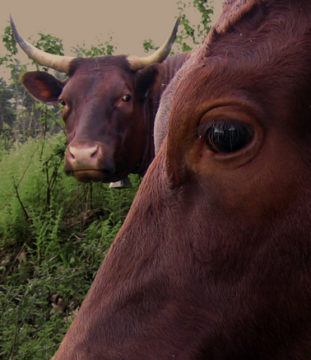
Hannah was a wide-horned, burgundy-red American Milking Devon heifer, with bug eyes and such a timid disposition you got the impression of a creature permanently bewildered. You could not approach her; she would just pace off to a corner of the barnyard pasture and stare at you from a distance. And she seemed never to blink: you swore she knew she was doomed.
Her adopted mother, Belle (full name: Colonial Williamsburg Belle), was just the opposite—outgoing, ornery, bright, also wide-horned and the burgundy red of the breed. We had had Belle a few years before we bought Hannah as a yearling from a Devon breeder. My husband, Don, had visions of hand-milking a small population of cows and selling the milk and the inevitable bull calves to neighbors and hobbyists. Such a prospect caused me to have visions, period.
But Hannah never calved.
We thought something was wrong with her from the time she was a young cow, when she attempted to nurse off Belle. Even though Belle already had her own calf to feed, she indulged the new yearling. Not even the spiked “weaner” that hung from Hannah’s nose like malevolent jewelry dissuaded her from Belle’s teat. She just learned to flip the weaning device up out of the way and twist her head in such fashion as to permit her access to Belle’s swollen bag.
The near-adult cow nursing off the adopted mother in the barnyard got to be something of a scandal. We even had to pen Belle up in the barn with her calf, Abe, to allow him an unmolested meal. Hannah literally had to grow out of it: After a time, she just could not fit her head and horns under the other cow anymore. Read more »
 The Fate of the Animals: On Horses, the Apocalypse, and Painting as Prophesy (Three Paintings Trilogy), by Morgan Meis, Slant
 Scheduled departure at Dulles came and went as we waited for the last passenger to board. Although the non-smoking section in the rear cabin was full, the smoking section where I sat was half empty. Death by asphyxiation on the flight to Paris was a distinct possibility but with three empty, adjacent seats in the centre nave there was some chance that my obituary might read, “She died peacefully, in recumbent sleep.”
 Indifference is an attitude first theorised as a philosophical stance by ancient Greek Stoic philosophers from the 3rd century BC. It was conceived as the right attitude to cultivate in reaction to indifferent things. What was surprising were the things the Stoics considered to be indifferent and hence require us to be indifferent to. Not your usual ‘whether the number of hairs on your head is odd or pair’, or the number of billions of stars in the galaxy, or even what colour underwear your boss wears – though in some circumstances, the latter can start becoming titillating. And titillation is of course what it’s all about. It’s the tickle that spurs the Stoic to resist it. Resisting what exactly? Feeling, uncontrolled gratification, heart-melting, giving in, touching, kiss-&-make-up-ing.
 Deborah Roberts. Shankia and Grace. 2021.
 According to the meta-charity



 There are certain words that seem to take on a life of their own, words that spread imperceptibly, like a virus, replicating below the level of consciousness, latent in our environment and culture, until suddenly the word is everywhere, and we are afflicted with it. We may even use these words ourselves: we struggle to find the right phrase, the true word to capture our intention, and these words come to us unbidden, floating into our minds from somewhere out there, and we speak the word without understanding what we really mean, but we see understanding and acknowledgement in the face of our interlocutor, and we know we have hit upon the correct utterance that will mark us as one who belongs.