
by Joseph Carter Milholland

Once, when I was asked who my favorite character in a Dostoevsky novel was, I replied Achilles. This is not as silly or as meaningless an answer as you might initially think; in fact, my response reflected one of my most deeply held beliefs about literature, a belief connected to what I think is a crucial feature of the entire literary canon.
Some years ago, the literary canon was almost always in my thoughts. Not just the books that are said to be in it, but the concept itself. Why should we read the canon, and what use was there in creating one? I knew almost instinctively that there was immense value in what Matthew Arnold called “the best that has been thought and said,” but I struggled to pinpoint what exactly would be the result of studying the canon for an individual. Despite all the claims made for it, the literary canon does not make you morally better, nor does it provide any special insight into non-literary academic fields, nor is it of any help in most practical matters.
At the time, literary journalism provided no convincing answers to my questions. This was during the great glut of “Defence of the Humanities” discourse, when dozens and dozens of articles in magazines and newspapers and professors’ blogs were dedicated to why university students should study the humanities, with none of the answers securing a consensus even among academics. Studying the humanities, some claimed, could produce better citizens, could cause us to become more empathetic with others, or could benefit workplaces in some hard to quantify way. In these debates, the canon was frequently a major subject, although here too there was no prevailing view of the matter. Should the canon be defended, revised, or abolished? I can recall some commentators who argued for all three positions at once. Read more »
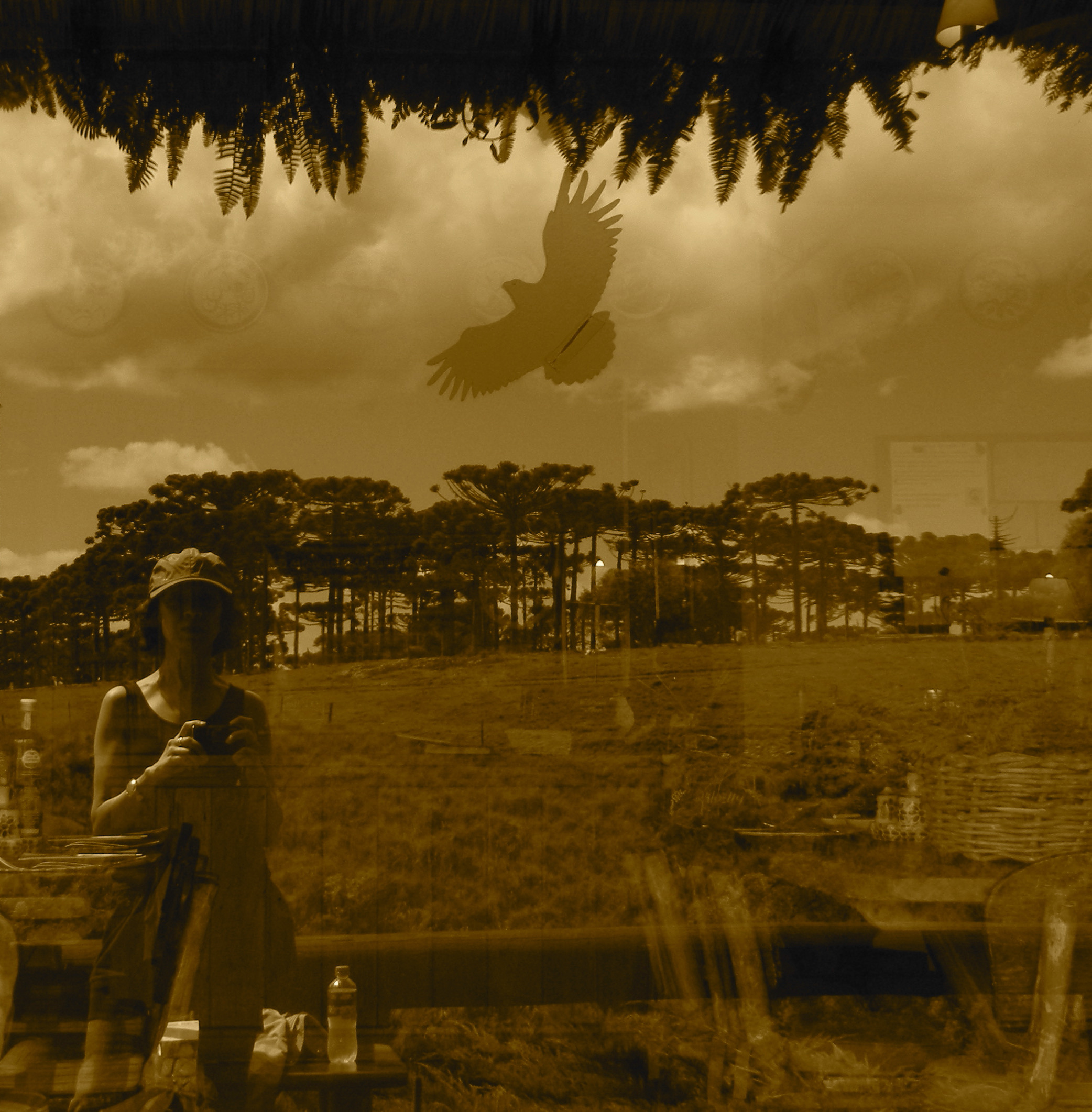 Sughra Raza. Self-portrait at Itaimbezinho Canyon, Brazil, March 2014.


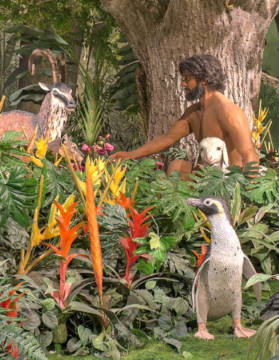 I picture the LORD God as a child psychologist—very much of a type, vaguely professorial, plucked from the ’50s. Picture him with me: shorn and horn-rimmed, his fingernails immaculate, he’s on his way to a morning appointment. As he kneels in the garden to tie his shoe, his starched white shirtfront strains against his gut.


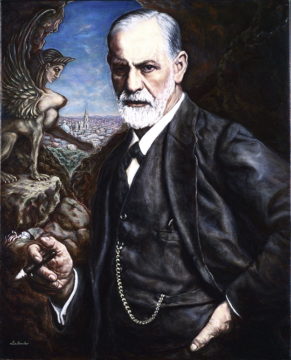
 The first



 Jeffrey Gibson. Chief Black Coyote, 2021.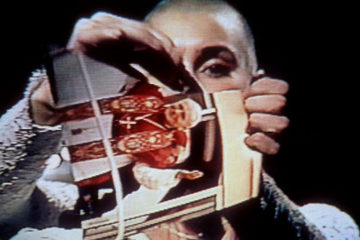
 Lucky you, reading this on a screen, in a warm and well-lit room, somewhere in the unparalleled comfort of the twenty-first century. But imagine instead that it’s 800 C.E., and you’re a monk at one of the great pre-modern monasteries — Clonard Abbey in Ireland, perhaps. There’s a silver lining: unlike most people, you can read. On the other hand, you’re looking at another long day in a bitterly cold scriptorium. Your cassock is a city of fleas. You’re reading this on parchment, which stinks because it’s a piece of crudely scraped animal skin, by the light of a candle, which stinks because it’s a fountain of burnt animal fat particles. And your morning mug of joe won’t appear at your elbow for a thousand years.
 Harry Frankfurt died on July 16, 2023. As a philosophy student I came to appreciate him for his work on freedom and responsibility, but as a high school word nerd, I came to know him the way other shoppers did: as the author of one of those small books near the bookstore checkout line. That book, On Bullshit, had exactly the right title for impulse-buying, which has to explain how Frankfurt became a bestselling author in a field not known for bestsellers.
 I had my first experience with Daylight Saving Time when I was 9 or 10 years old and living in Phoenix. Most of the country was on DST, but Arizona wasn’t. I knew DST as a mysterious thing that people in other places did with their clocks that made the times for television shows in Phoenix suddenly jump by one hour twice a year. In a way, that wasn’t a bad introduction to the concept. During DST, your body continues to follow its own time, as we in Phoenix followed ours. Your body follows solar time, and it can’t easily follow the clock when it suddenly jumps forward.