by Oliver Waters
 Part I of this series argued that transferring your personal identity to an artificial brain should be possible. It’s one thing however to preserve the informational content of your identity, and quite another for that content to be conscious. It would be a real shame if your new artificial self was getting about town as a zombified version of you: spending your wages, high fiving your friends – all with no inner subjective awareness.
In her book Artificial You (2019), the philosopher Susan Schneider entertains the possibility that entire alien civilisations may have taken the reckless gamble of transitioning to artificial brains and in the process inadvertently killed off their conscious minds. We would obviously prefer to avoid this nightmarish fate, and our best defence is a proper scientific theory of how consciousness works.
Many doubt that such a theory will arrive any time soon, with some claiming that consciousness is simply beyond our capacity to ever understand. There is also an intuitively compelling and popular notion that a scientific understanding of consciousness is impossible because we only have direct access to our own conscious minds. This view is largely motivated by a mistaken epistemology. Namely, an ‘empiricist’ view that the scientific process consists of building up a theoretical understanding of the world out of the components of raw, direct, sensory inputs. If you think of scientific knowledge as emerging this way, as a systematic reorganisation of what is available to your senses, then the realm of other conscious minds must forever remain out of reach.
But as the philosopher Karl Popper pointed out, ‘sensory inputs’ actually have no meaning unless they are part of a theoretical construct: observation is inextricably ‘theory-laden’. The theory doesn’t have to be a formal scientific theory, by the way. Your intuitive conception of what is going on in front of you (perceiving a sunset, for instance) counts perfectly well as ‘theorising’ in this context. Read more »

 Today marks eight years since I had my last drink. Or maybe yesterday marks that anniversary; I’m not sure. It was that kind of last drink. The kind of last drink that ends with the memory of concrete coming up to meet your head like a pillow, of red and blue lights reflected off the early morning pavement on the bridge near your house, the only sound cricket buzz in the dewy August hours before dawn. The kind of last drink that isn’t necessarily so different from the drink before it, but made only truly exemplary by the fact that there was never a drink after it (at least so far, God willing). My sobriety – as a choice, an identity, a life-raft – is something that those closest to me are aware of, and certainly any reader of my essays will note references to having quit drinking, especially if they’re similarly afflicted and are able to discern the liquor-soaked bread-crumbs that I sprinkle throughout my prose. But I’ve consciously avoided personalizing sobriety too much, out of fear of being a recovery writer, or of having to speak on behalf of a shockingly misunderstood group of people (there is cowardice in that position). Mostly, however, my relative silence is because we tribe of reformed dipsomaniacs are a superstitious lot, and if anything, that’s what keeps me from emphatically declaring my sobriety as such.



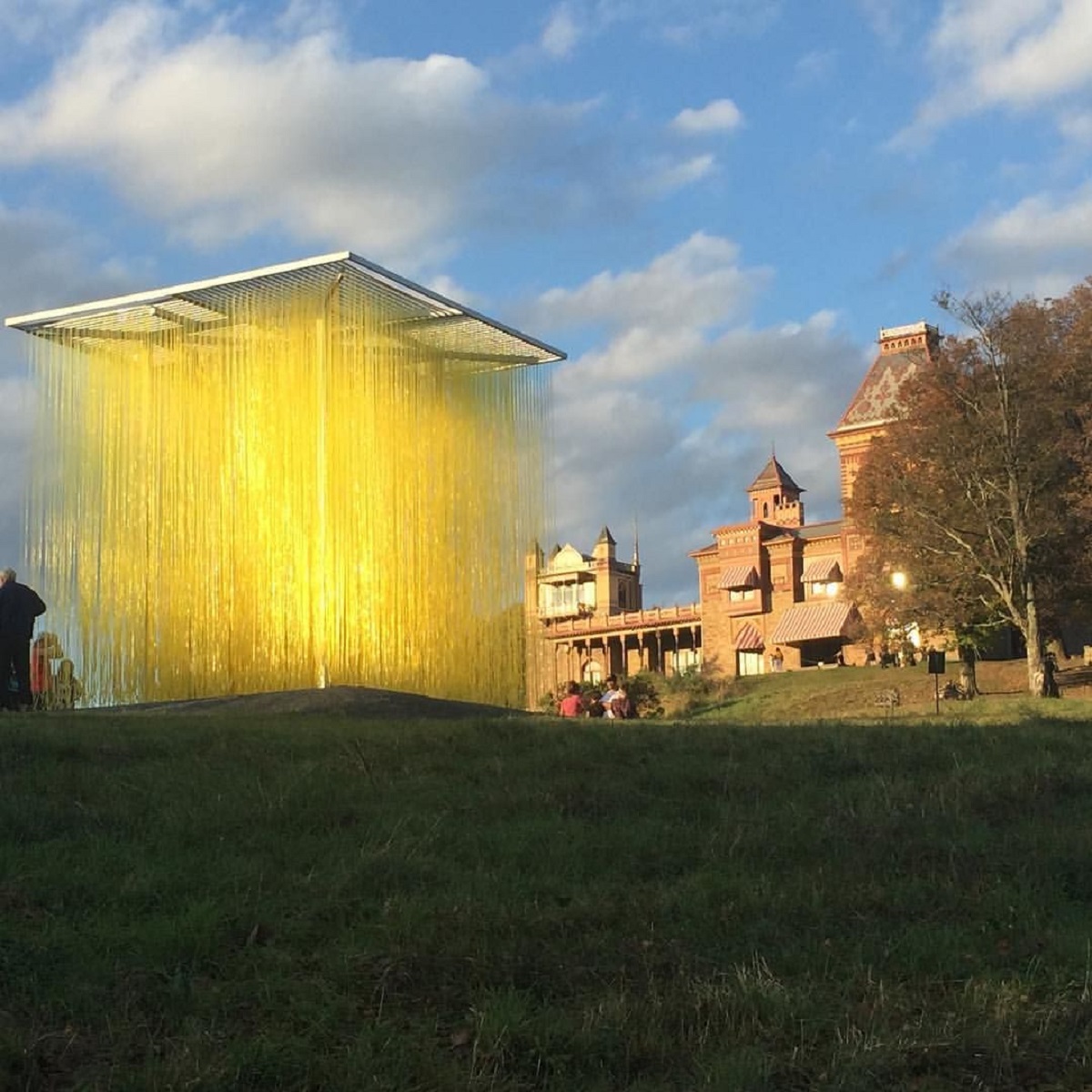 Jesus Rafael de Soto. Penetrable, at Olana State Historical Site, New York.