by Mary Hrovat

The other day I was looking up an anthropological discovery I’d seen mentioned online someplace. The discovery seemed a little dodgy upon closer inspection, but in my search I found the Wikipedia page List of places with columnar jointed volcanics. I wasn’t looking for information about volcanic rocks that have undergone columnar jointing, but I was happy that this wonderfully browsable list exists.
When I hear the word lists, I tend to think of the kind that are perhaps necessary but rarely enjoyable: the shopping list (often incomplete, seldom structured well with regard to the layout of the grocery store) or the to-do list (possibly a bad idea altogether). There are also lists that make me feel like I’m being forced down the neck of a narrow funnel with small benefit to myself: anything that begins “Your application must contain the following” or “You may be eligible for this tax credit if any two of the following are true (but see also the table on page 129).”
I’m also not fond of the lists encountered when seeking healthcare, although on rare occasions I’ve found them mildly entertaining. Once I was going down a list of symptoms to identify the ones I’ve experienced, and I asked my companion the difference between anxiety and nervousness. “If you have to ask…,” he said, smiling. “Oh yes, I’m going to check both boxes,” I said. “I was just curious.” A little further down the list, we puzzled over whether “dry mough” meant dry mouth or dry cough. In short, this list seemed a bit slapdash. Technical checklists should be the clearest and least ambiguous of all lists, but at least this one’s ambiguity was amusing. (Besides, it was an eye doctor’s office; if they really cared about my mough, they would have corrected that error long ago.) Read more »
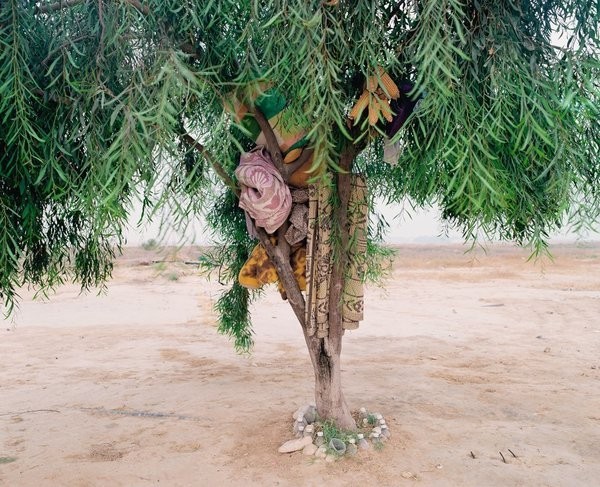 Ron Amir. Bisharah and Anwar’s Tree, 2015. From the exhibition titled Doing Time in Holot.

 You’ve always dreamed of foreign travel and you’re aware that there’s a long history of people doing it, and benefiting from it. But you live under a regime that closed the borders a couple of generations ago, at the same time criminalizing the act of researching potential destinations. (Many countries were dangerous, they said, and some tourists were coming home with tie-dyed shirts and peculiar ideas.) To protect the vulnerable, a War on Travel was announced. In the years since, you have grown up with little more than rumors of other cultures, climates, cuisines.
  Artificial intelligence – AI – is hot right now, and its hottest part may be fear of the risks it poses. Discussion of these risks has grown exponentially in recent months, much of it centered around the threat of existential risk, i.e., the risk that AI would, in the foreseeable future, supersede humanity, leading to the extinction or enslavement of humans. This apocalyptic, science fiction-like notion has had a committed constituency for a long time – epitomized in the work of researchers like


 The narrator of Alberto Moravia’s 1960 novel Boredom is constantly defining what it means to be bored. At one point, he says “Boredom is the lack of a relationship with external things” (16). He gives an example of this by explaining how boredom led to him surviving the Italian Civil War at the end of World War II. When he is called to return to his army position after the Armistice of Cassibile, he does not report to duty, as he is bored: “It was boredom, and boredom alone—that is, the impossibility of establishing contact of any kind between myself and the proclamation, between myself and my uniform, between myself and the Fascists…which saved me” (16).
 The only light in the second-class train compartment came from the moonlight, which filtered through the rusty iron grill of the window. The sun had set hours earlier, a fiery red ball swallowed whole by the famished Rajasthani countryside. I sat at the window on the bottom berth of my compartment of the Sainak Express, headed from Jaipur to Delhi.