
by Akim Reinhardt
 There are only four U.S. states where white people are at least 80% of the population in every county: West Virginia, Vermont, New Hampshire, and Maine. These four are also among the five whitest states as a percentage of total state population, with Wyoming coming in second, behind West Virginia (97%) and just ahead of Vermont and New Hampshire (both 92%). But not all of Wyoming’s counties are so very white because within its state boundaries are relatively populous Indian Reservations. None of the other four have reservations, except for Maine, but those have relatively small Native populations.
There are some other similarities among these four states. Three of them are in New England, and all four can be considered part of the broader Northeast, defined as north of the South and not west of the Appalachians. All four are also all substantially mountainous. And none of them have a major city.
However, there are also notable political and economic differences among these four states. West Virginia is one of the nation’s poorest states, and now one of the reddest. Vermont and New Hampshire have very strong state economies. But while Vermont is one of the nation’s most liberal states, to the point of sending Bernie Sanders to Congress for thirty-four years and counting, New Hampshire is a purple state with a strong libertarian, anti-tax tradition. Meanwhile, Maine is also purple and its economic standing varies from rather wealthy to quite poor
Comparing and contrasting these four states can remind us of the limits that both race and wealth offer in predicting U.S. political preferences. There are certainly patterns and trends to be found, some stronger than others, such as the strong propensity of African Americans, particularly women, to vote Democratic. But ultimately, the U.S. political equation is complex with many factors in play. Read more »

 Even after discussing Daniel Chandler’s inspiring

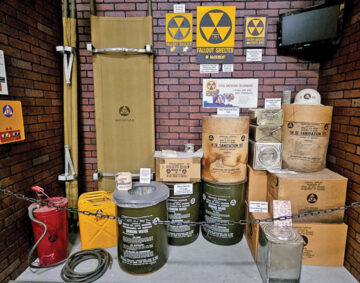
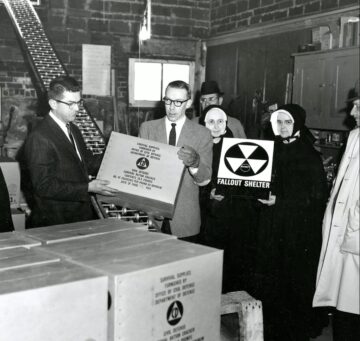 How did the survey come about? FDR had created an Office of Civil Defense in 1941, but it took the USSR’s first atomic bomb test to prompt Truman to reboot it in 1950 as the Federal Civil Defense Administration. In 1958 the FCDA begat Eisenhower’s Office of Civil and Defense Mobilization; in 1961 the OCDMA, moved by Kennedy from the executive into the Defense Department, became the Office of Civil Defense (tradition!), which soon launched its National Fallout Shelter Survey Program. Including those designated earlier, by 1963 the government had identified shelter spaces for 121 million people, and stocked enough of them for 24 million.

 For a couple of days, some things at 3QD may not work exactly as expected. We will be updating some of the pages at the site in the next few days. We appreciate your patience!
 .
.


 Some things in life are very hard to give up. For me, I hope in a most singular manner, it is bullshit. I have spent nearly twenty years reading whatever literature I can find on what bullshit might be. Since the publication of Professor Harry Frankfurt’s