There wasn't a damn thing I could do or say
Up in the skyway
~The Replacements
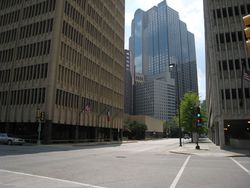
And yet, like any other urban form, skywalks are agnostic – what determines their success is not just their design and implementation, but also the problem that they seek to address. It is perhaps more accurate to say that skywalks, along with many other forms of intervention in the urban built environment, reveal the question that designers have posed themselves, believing that that question, whatever it might be, is in fact the correct and most pressing one. So, in the case of American cities, skywalks were employed to revive downtowns, and, generally speaking, failed. Other cities around the world have enlisted skywalks not because there is too little density, but because there is too much. Does this new context increase the possibility of success? In order to understand what a difference a difference makes, we first need to consider the forces that shaped cities in the West, and what the difference might be between this phenomenon and that of the global urban South.
The narrative describing the development of American cities can be retold as a narrative of excessive space. When energy and labour are cheap, economic logic drives growth outward; it is always easier to build on virgin ground rather than re-organize an existing built environment. This is especially true when urban areas are not bounded by geographic obstacles such as water or mountains – a condition true of most mid-Western cities and not a few coastal ones.