by Leanne Ogasawara
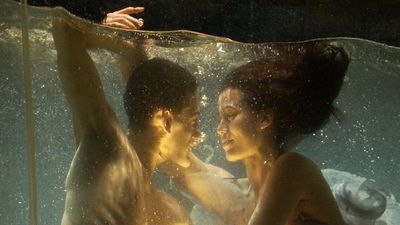
We find ourselves back in a time when heart and imagination took center stage–and love was thought to move the stars and the heavens above.
Not surprisingly, it was a time when lovesickness was the most common form of heart disease. A veiled glimpse ignites a fire causing two people to circle each other as Lover desires Beloved; each seeking to know the Other. This all being something which took place within the topography of the heart itself. It was something imagined– over weeks upon weeks; months upon months. Imagined as “'spirits take bodies and bodies become spirits' something so powerful that European physicians of the Middle Ages declared that, if one wasn’t careful, lovesickness could lead a person into madness (see Averroes' study of love as affliction, for example).
13th and 14th century scholars talked about something known to them as visual species. These were defined as “objects” (propogated through the air) that mediated between the physical and imaginal world by imprinting themselves on a person's imaginaton from a distance. It was the image as held in the body that caused the troublesome– and sometimes dangerous– overheating of the bood around the heart.
To pursue the logic of all this, because the “visual species” that caused desire and lovesickness were things originating outside the person, it followed that magic could also generate new species. And this is why love charms, amulets and the use of magical incantations in maters of love became fairly common. For romantic success, men were encouraged to write “pax + pix + abyra + syth + samasic” on a hazel stick and hit a woman with it three times on the head, then quicky kiss her; while Tristan and Iseult were undone by a love potion which they accidentally drank. People reported that like the other magical incantation– abbracadbra— that just whispering the words out loud “I-love-you” had the power to move mountains. It even had the power to cure gout–or maybe that was abbracadabra?
I told him that I wanted to employ a famous Medieval love charm at our wedding. Not surprising, the Eucharistic host played many different roles in various Medieval love potions. But my favorite was perhaps the simplest– a lady would slip the host under her tongue. Then, kissing her beloved with the host still in her mouth, she would ensure that he would love her forever.
He dismissed my plans, saying, he already knew he would love me forever so I didn't need to go through so much trouble.
I wonder, though, is the heart that knowable?