by Ryan Ruby
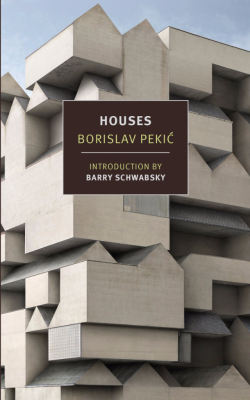
But before I read Borislav Pekic's Houses (translated by Bernard Johnson from the Serbo-Croatian in 1978 and re-released this month by NYRB Classics), I'd never come across a novel that had the chutzpah to draw its protagonist from the ranks of what is surely, as we're now reminded on a daily basis, the lowest of the low: the realtor.
The proud owner of Pekic's savage farce is Arsénie Negovan, scion of an old Belgrade family, Vice-President of its Chamber of Commerce, a Francophile and a recluse who surveys his properties with a pair of military binoculars from the living room of the house he shares with his wife, Katerina, and his maid, Mademoiselle Foucault. We meet him in 1968, shortly after his first foray into town since the Yugoslav coup of 1941, and shortly before his death, as he scribbles his last will and testament on the backs of old tax receipts and rental contracts, in what will be an unsuccessful attempt to dispose of his assets and to persuade his executors and readers that he is of sound mind and body.
Of course, precisely because he is the protagonist of a novel, Negovan does not buy and build to turn a profit. He is not motivated by anything so base as the desire for luxury, comfort, security, or status that property sometimes confers on its owners. Instead, like many of the monomaniacs in his literary ancestry and a few of his colleagues in the real world, Negovan bases his business practices on the hilariously uneven foundations of a specious, self-spun philosophy. Just as Raskolnikov has his essay on crime, Humbert Humbert his treatise on nymphets, and Donald Trump his art of the deal, Negovan elaborates a “philosophy of Possession” to justify his obsessive and often cruel behavior.