by Michael Liss
Are opera singers dumb?
As a child, dragged to the Metropolitan by opera-obsessive parents in order to practice sitting absolutely still for three hours, I sometimes wondered about this. Certainly, on stage, there was a lot of dumb going on. What intelligent person could possibly trust evil Baron Scarpia to keep his word, or would sing full-out when dying of tuberculosis, with only a delicate, tuneful cough to show the gravity of the situation?
Opera singers were like Rat Pack Era movie-stars—they dressed well, they smoked and drank, they seemed always to be alighting from planes surrounded by Rolleiflex-bearing photographers. I heard a great story about Franco Corelli, the “Prince of Tenors,” who, when irritated by a soprano lead, would have a pre-performance meal laced with garlic. Did wonders for the love scenes. To an eight-year old that sounded pretty darn smart.
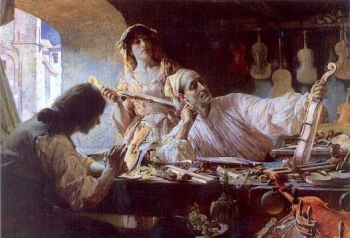
Yet, if you ask many musicians, they will tell you that the average opera singer just isn't that bright. I had a conversation a few months ago with a classically trained instrumentalist who is now a cantor. In his conservatory, the pure vocalists were looked down upon as lesser beings. He used the example of a Stradivarius. If he were suddenly to hand me this most cherished of instruments, I would scrape the bow across the strings and produce a sound similar to an alley cat. Without learning how to play, how to sight-read, without hours and hours of daily practice, I would never have the ability to make music. That was a musician's burden–endless efforts towards perfection, and the instrumentalists paid it. But the singer, through some completely random mixing of DNA, almost as God's afterthought on a busy day, got the Strad implanted, and all she needed to do was open her mouth and beauty would pour out.
This “Strad Complex” is not confined to instrumentalists and vocalists. There is the brilliant scene in Amadeus when the desperate Constanze brings Mozart's music to Salieri. Look at F. Murray Abraham's face as he leafs through page after page—it's just eating at him. In the space of a few moments you see incredulity, envy, opportunism, but, above all, an anguish that can only come from being talented enough to grasp that, on his best, most creative day, he can't even approach what this silly little man-child writes as a first (and only) draft.