by Genese Sodikoff
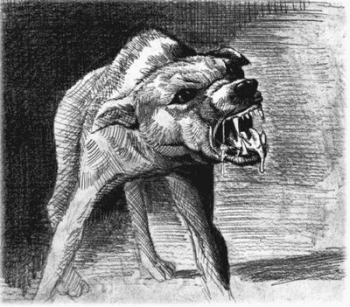
In Madagascar, where I do anthropological fieldwork, rabies has been around since at least 1896, when the French colonized the island. Historian Eric T. Jennings writes that by 1899, a Pasteur Institute was established to forcefully combat human rabies, known as hydrophobia, but the virus was never eradicated. Jennings writes that to French colonial scientists experienced in treating rabies, Madagascar appeared to have a particularly acute and fast-spreading strain, requiring “more frequent injections of more active virus.” Rabid dogs in Madagascar appeared more ferocious than elsewhere, aiming right for the face.
Given the prevalence and history of rabies in Madagascar, I was surprised to learn that many Malagasy people (including doctors and veterinarians) attribute the viral source to a wild species that has only recently appeared on the landscape: a creature they call “little big chest” (kelibetratra). I refer specifically to people in the region of Moramanga District, about a three-hour drive east of the capital, Antananarivo, but knowledge of the kelibetratra as the rabies source extends far beyond this district.
The creature was described to me as a furtive wild dog from the rain forest that only roams late at night. It is built like a pit bull, but with shorter legs and a bigger thorax. Because of deforestation, they said, the animal has been scared out of its natural habitat into villages and towns, where it attacks pet dogs and cats, infecting them with rabies.




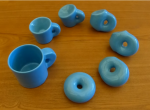 Maybe you've heard by now about last week's Nobel Prize in Physics, awarded to three physicists for their work on topological phase transitions. But if you didn't already know what a topological phase transition was, chances are you still don't. When a friend of mine read a few popular articles on the discovery, I asked him if he felt enlightened. “No, it felt like the authors were just free-associating: first they said ‘topological phase transitions,' then they said ‘topology,' and then ‘bagels.'” I sympathize with my friend, but also with anyone trying to explain this year's prize. It's true: you can't explain topological phase transitions without mentioning the underlying mathematics, a field called topology. And when you mention topology, you're tempted to talk about bagels. In fact, not long after the Nobel announcement, a Nobel committee member was waiving bagels and cinnamon buns on screen.