by Carl Pierer
I.
The old problem of induction raised the question of how we can justify inferences from singular observations to general statements. In the last century two newer problems were presented. The Ravens Paradox, which I will explain in section II, is due to Carl G. Hempel. The ‘grue problem' was put forth by Nelson Goodman and I shall present it in section III. In section IV I will first compare the two problems and then attempt to show that Hempel's paradox can be solved, whereas Goodman's ‘grue' points to a deeper problem.
II.
Carl Hempel focuses on the question of what counts as evidence for hypotheses. There are two principles of inductive reasoning that we seem to accept.
(i) If all Ps have been observed to be Qs, then this counts as evidence for "All Ps are Qs". Hempel writes: "(…) this hypothesis is confirmed by an object a if a is P and Q; and the hypothesis is disconfirmed by a if a is P, but not Q." (Hempel 1945, p. 18)
(ii) What counts as evidence for one statement, counts as evidence for all logically equivalent statements. So, if all non-B's have been observed to be non-A's, then this counts as evidence for the original statement. It seems plausible to accept the second principle. The statements are equivalent exactly because they are true under the same conditions.
Hempel thinks that this account entails a paradox, namely the Ravens Paradox. Say we start off with the hypothesis: "All ravens are black". We can then construct its logical equivalent: "All non-black things are non-ravens". By (i), everything that we can observe that is not a raven and not black will count as evidence for the second statement. By (ii) we are bound to accept these evidences as evidence for the initial hypothesis. But this seems absurd. We do not believe that my brown jumper does in any way affect the hypothesis that all ravens are black. This fact seems completely irrelevant.
III.
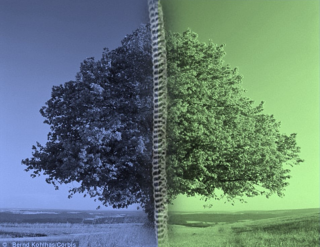
Nelson Goodman formulated a "new riddle of induction". In order to construe it, he needs to come up with a new predicate: the infamous "grue" (Goodman 1954, p 74). Objects are grue if they are observed before time t and are green, and if they are observed after t and they are blue. Now, t is some time in the future, say the 1st November 2020. So, if we have a green emerald before time t, then this certainly supports the hypothesis "All emeralds are green". However, we can also take it as evidence for "All emeralds are grue". The issue, then, is to determine whether we have any reasonable grounds to prefer thinking of emeralds as green over emeralds as grue.