NPC memes and the politics of solipsism

by Scott F. Aikin and Robert B. Talisse
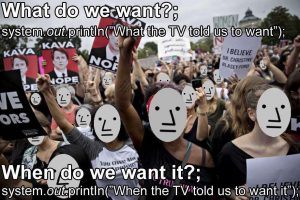
The advent of the NPC meme is curious. It’s used as a term of abuse in comment-exchanges, it has occasioned some deep hermeneutics from the cultural Left, and it’s been a cause for escalation particularly by the extreme Right. The political meme of the NPC comes from the world of gaming. It is an abbreviation of non-player character.  The point of non-player characters is that they are part of a story being told for the point of the game – a person in need of help, a bartender with some information, or an opponent with a challenge.  In tabletop gaming, such as Dungeons and Dragons, the NPCs are played by the Dungeon Master. In that case, there was still an interested human driving the actions of the NPCs. But with electronic games, the NPCs are directed by the computer. They have no inner life nor are they avatars for those who have them. They are merely furniture in the world of the game. Their purpose is to be there to be soaked for information, helped so that they may confer some boon, or vanquished for some treasure, as the case may be. But they have no value or purpose beyond being a foil with which players may tell their own stories.

The application of the term NPC in contemporary internet culture is predicated on the divide between player character and non-player characters. Player characters develop, and they are reasons for which the game world exists. Non-player characters are static, predictable, and mindless; again, they are mere instruments within that world. The division, then, is between those characters who, on the one hand, are conscious, have minds, and can deliberate about what they wish to do, and on the other hand, those characters who are mindless, unconscious, and do not (and perhaps cannot) deliberate about their purposes. NPCs are, then, tools, and players are those who may use them as they see fit.

It is a familiar distinction, in a sense. The old division between those who are asleep and those who are awake is one ancestor. Further, the old term of abuse ‘sheeple’ invokes the idea that there is a less-than-aware group who is systematically misled because of their incapacities or credulity. In fact, the rhetorical force of most consciousness-raising programs requires some such contrast. Enlightenment, for example, contrasts with those who labor in darkness. Being woke contrasts, again, with the slumbering.  Those who have been raised up are brought out of a lower consciousness. That’s what consciousness raising is and must be. These metaphors all entail that a change has occurred, one between two contrary states of mind. Read more »
Noah’s Floods

by Paul Braterman

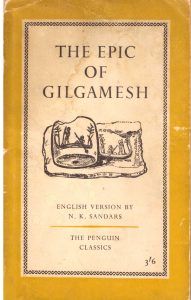
By chance, I chose as holiday reading (awaiting my attention since student days) The Epic of Gilgamesh, a Penguin Classics bestseller, part of the great library of Ashur-bani-pal that was buried in the wreckage of Nineveh when that city was sacked by the Babylonians and their allies in 612 BCE. Gilgamesh is a surprisingly modern hero. As King, he accomplishes mighty deeds, including gaining access to the timber required for his building plans by overcoming the guardian of the forest. But this victory comes at a cost; his beloved friend Enkidu opens by hand the gate to the forest when he should have smashed his way in with his axe. This seemingly minor lapse, like Moses’ minor lapse in striking the rock when he should have spoken to it, proves fatal. Enkidu dies, and Gilgamesh, unable to accept this fact, sets out in search of the secret of immortality, only to learn that there is no such thing. He does bring back from his journey a youth-restoring herb, but at the last moment even this is stolen from him by a snake when he turns aside to bathe. In due course, he dies, mourned by his subjects and surrounded by a grieving family, but despite his many successes, what remains with us is his deep disappointment. He has not managed to accomplish what he set out to do.
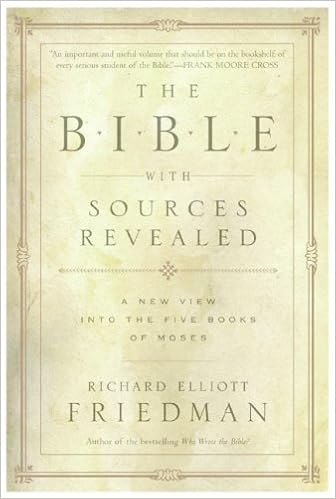
On his journey, Gilgamesh meets the one man who has achieved immortality, Utnapishtim, survivor of a flood remarkably similar, even in its details, to the Flood in the Bible. Reading of this sent me back to Genesis, and hence to two other books, The Bible [actually, just the Pentateuch] with Sources Revealed,   by Friedman, and The Ark Before Noah,  by Finkel. Friedman is Ann and Jay Davis Professor of Jewish Studies at the University of Georgia, while Finkel is curator of the British Museum’s collection of cuneiform tablets. Most of what follows derives from these two sources.
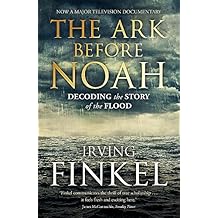
The Ark Before Noah: Decoding the Story of the FloodComparing Hebrew with Cuneiform may seem like a suitable gentlemanly occupation for students of ancient literature, but of no practical importance. On the contrary, I maintain that what emerges is of major contemporary relevance.
As Lakatos pointed out, scientists will not abandon a position, despite difficulties, absurdities, and anomalies, until a more satisfactory one is offered. Why should the creationist be any different? He is led to embrace the absurdities of Young Earth “Flood Geology” because he regards the text of Genesis as the direct revealed word of God. If you want to change his mind, you must offer an alternative that is better on his terms, emotionally and spiritually. Such an alternative, I argue, is what emerges from textual and historical analysis. And in the Americas both North and South today, weaning the Evangelical voting bloc away from reality-denying simplicities is a matter of the greatest urgency. Read more »

Framing nature

by Brooks Riley

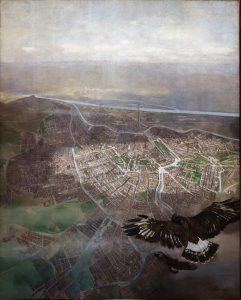
When architect Otto Wagner commissioned this large painting by Carl Moll for the Kaiser’s personal railroad station in Vienna in 1899, he might not have seen the irony of an eagle’s view of the city. View of Vienna from a Balloon envisions a future beyond rails in which a bird shows the way to a whole new way of looking at landscape, one that would renew the way we view nature itself, hardly more than a 100 years later. If that painting were done today, the eagle would be replaced by a small four-cornered device with a camera and four rotary blades to keep it aloft: the drone.
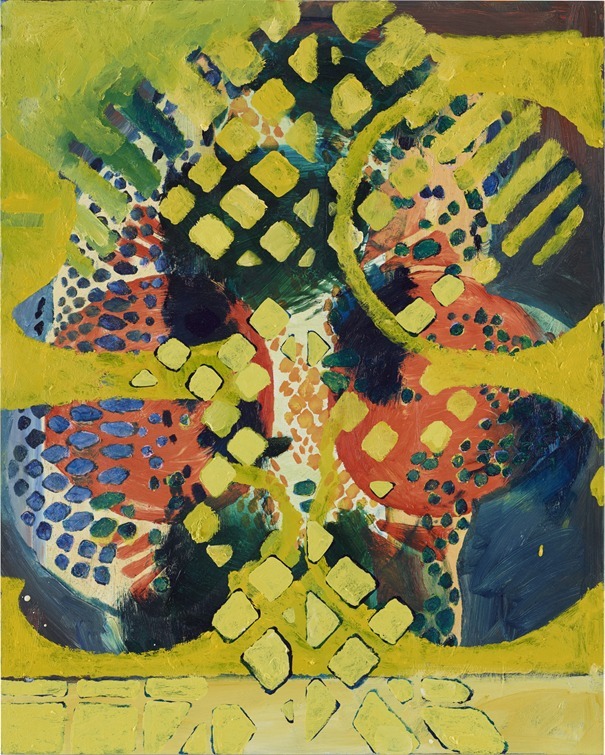
The relationship between human beings and nature has always been tense. While we acknowledge our debt to nature—our existence, our food, building materials, environment, panoramic views, flora and fauna, chromatic infinity, physical and biological laws—there is always some corner of our thinking that cries out, ‘Anything you can do I can do better,’ to quote an Irving Berlin song. When it comes to art, we set ourselves on a collision course with nature, touting our museum landscapes over the real ones and the painter’s vision as the one true aesthetic version of beauty. Now that we’ve left nature behind (in more ways than one), nature has left the building and moved into the brand new Instagram showroom where it can show itself off with impunity from interpretation.

The recognition of nature as a generator of beauty is universal. Representational art and photography are often tributes to that beauty—pyrrhic undertakings when the original is so compelling. And yet careers have been made from the depiction of nature—Caspar David Friedrich, Ansel Adams, and countless others. If our art differs from nature, it is in the selectivity and execution of the image as much as it is the subject matter. Art is our way of saying to nature, we can do better than you. Read more »

On “Math with Bad Drawings” by Ben Orlin

by Jonathan Kujawa

Dark Days

With the end of daylight savings time, the long, dark nights of winter slump over the land. It is the season for cold nights, warm blankets, and reading good books with a nice cup of tea (or a dram of scotch, if you prefer). Unless, of course, you live in Hawaii or the southern hemisphere, in which case you’ll have to content yourself with reading in a convenient hammock.

Popular math books are a sub-sub-sub-genre of nonfiction, found at a local bookstore in the Nonfiction-Science-Math-“Math? For fun? Really? Ok, if you say so.” section. Even within that narrow span of the bookshelf, you’ll find there are a wide variety of popular math books. Some ambitiously try to give you a sense of deep, modern topics of research like the geometric Langlands program or statistical mechanics. Although I suspect those mainly succeed in giving Hawking’s “A Brief History of Time” and Piketty’s “Capital” a run in the category of many sold but few actually read. Other authors lean towards biography. While interesting and enjoyable reads, they are not often about math, per se. I’m looking forward to someday getting to Siobhan Roberts’ well-reviewed biographies of Coxeter and Conway. Both sound great! But such books necessarily can only hint at the amazing math their subjects have done.

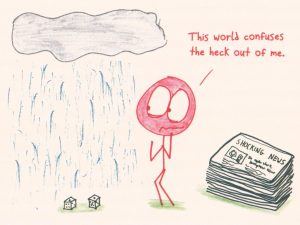
Perhaps unavoidably, too many popular math books end up missing the mark. Trying to talk math without the technicalities, the authors are left leaning on old standbys like the irrationality of √ 2, Hilbert’s Hotel and the marvels of infinity, and picture friendly topics like fractals. It’s a bit like eating a big bowl of oatmeal: a whole lot of familiar filling with the occasional pleasant surprise mixed in. Not that I’m throwing stones! My house here at 3QD is built from its share of tired metaphors, mathematical and otherwise. Every person who writes about math knows the truism: every equation you include cuts your readership in half. But talking about math without, you know, writing down any math is darn hard. It’s like writing about music or poetry in strict essay form. Read more »

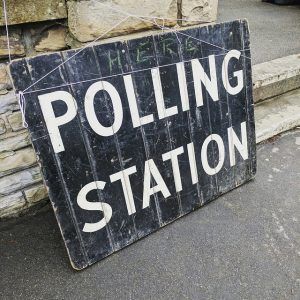
Help Citizens with Disabilities Participate in the Political Process

by Jalees Rehman

The World Health Organization (WHO) estimates that over a billion people live with some form of disability, expressed as impairments, activity limitations and participation restrictions.  Disabilities are often manifestations of health conditions and as such, people suffering from disabilities not only require general medical care such as immunizations and preventive screenings but also need additional care to address the underlying health conditions. According to the WHO, people with disabilities are far more likely to suffer catastrophic health expenditures and receive inadequate medical care than people without disabilities. In addition to the medical and financial challenges, people with disabilities are often isolated and marginalized in society. The lack of political participation by people with disabilities in politics is especially concerning because it sets in motion a vicious cycle of marginalization. If the voices of people with disabilities are not adequately represented in the political arena, then it becomes less likely that governmental measures are taken to ensure adequate medical care and social integration of people with disabilities.

The researchers Lisa Schur and Meera Adya recently studied the political participation of people with disabilities in the United States in their article Sidelined or Mainstreamed? Political Participation and Attitudes of People with Disabilities in the United States. They used data from four US surveys: the 2008 and 2010 Current Population Surveys (CPS), the 2006 General Social Survey (GSS), and the 2007 Maxwell Poll on Citizenship and Inequality. The surveys ask respondents whether they suffer from distinct forms of impairment such as visual, hearing, mental-cognitive or mobility. There were 12,027 people in the 2008 CPS and 12,064 people in the 2010 who answered yes to at least one of the disability questions. The large sample size of CPS and the inclusion of a “voting supplement” in the CPS during even-numbered years allowed the researchers to study the extent of political participation by people with disabilities. Read more »

What’s With All The Zombies?

by Tim Sommers

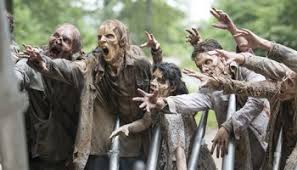
This year – 2018 – marks something truly auspicious. This is the semi-centennial of the invention of the Zombie. In these fifty years, let’s face it, we have been completely overrun. Zombies are everywhere. They are in our movies, tv shows, books, and comic books, plus, out here in the real world where the Center for Disease Control has a comprehensive Zombie preparedness and education plan and there are Zombie-walks, Zombie-conventions, and, anyway, didn’t you see them this Halloween? The most popular Zombie tv show, “The Walking Dead”, has been streaming for almost ten years – and the comic book it is based on is still going strong. At least one Pulitzer Prize and National Book Award winning author has written a straight-up zombie novel – Colson Whitehead’s “Zone One”. So, what’s with all the Zombies?
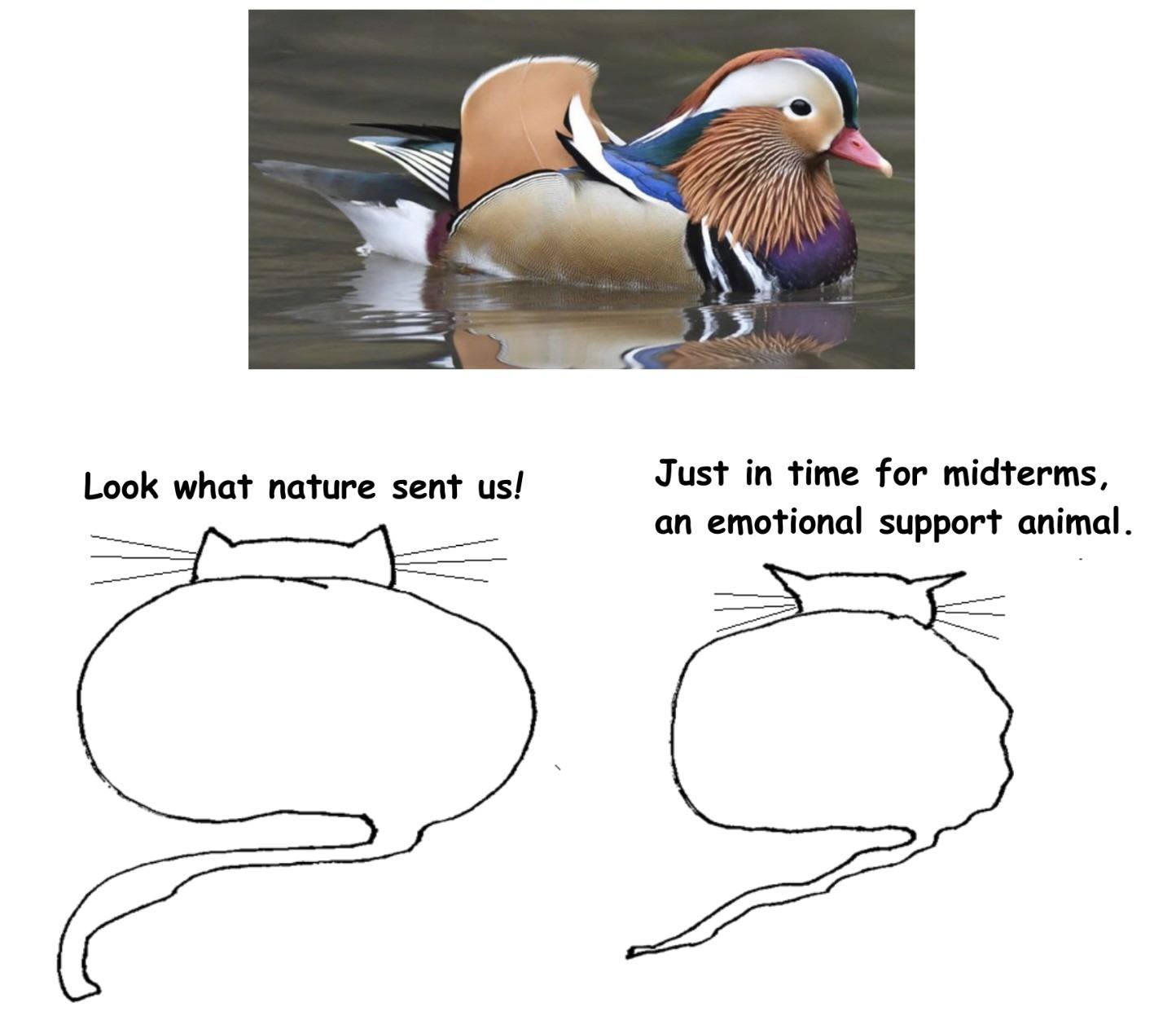
I should just ask my mom. She’s 73 and she loves Zombies. I did ask my brother. He said, “Zombie movies are the new westerns.” I think he meant that they are about how people survive and cope, especially with each other, against a backdrop of lawlessness. And they both involve plenty of gun-play and violence. That seems basically right to me. But, still, if that’s the appeal of the genre, what is the appeal of the Zombies themselves? Let me come back to that. Let’s start with how the Zombie invasion started fifty-years ago. Read more »

A Young Person Investigating the End

by Lexi Lerner

“They all go the same way. Look up, then down and to the left,” the EMT said. “Always.”
Why?

“I don’t know,” he said. “Well – I think they know. When they look up, they’re just… waiting.”

And the next part – why to the left? Because of the heart?

“I don’t know. Maybe something with blood pressure differences. Maybe something else. I really don’t know.”


I’m not living, I’m just killing time.[1]

It’s absurdly easy to take this life for granted. It’s so easy that I want to, so badly, all the time. The pitfall was built into its coding. So was the challenge: if I let life matter more, I choke.


What’s the worth of sitting in the grass, watching geese, or perhaps fireflies, for days or decades on end? Is it worthy of a lifetime? Where were the geese in my college classrooms? Where were the fireflies at my jobs? What’s the role of ambition? Ambition to do what?

We sat on a bench in Soho, watching a pickup kickball game.

“Is this fragile?” I asked her.

She looked through the chain link fence. The rubber ball sailed across the field; all heads followed its enormous arc. Both teams cheered heartily.

“Yes,” she said.

“Is it sacred?” I asked.

The bruised shadows of trees, the emperor sun behind them, the pigeons.

“Yes,” she said.


On a sun-spotted afternoon in a forest, I asked my dad if he missed his dad, who passed a few years ago.

Sometimes, it doesn’t really feel like he’s gone. More like, I haven’t seen him in a while, and we haven’t spoken in a while, but he’s just a phone call away. I find myself thinking, where’s Pa? Where is he? Read more »

Free-For-All

by Nickolas Calabrese

Is art “a right or a privilege”? This question was addressed by a who’s who of artworld elites in a New York Times feature earlier this year with regards to the Metropolitan Museum of Art’s revised policy to charge out-of-towners the full $25.00 admission fee rather than their standard pay-what-you-wish policy. Predictably, this group (many of them known for their overt political or moral activism, like Ai Weiwei) overwhelmingly endorsed its status as a right (there was one dissenter, but even that came with caveats). Perhaps one of the most prominent defenders of this view, because of her station and her institutional influence, is Aggie Gund, President Emerita of the Museum of Modern Art in New York. She frequently states that “art is a right, not a privilege” (as she discusses in the beginning of this interview).

As framed here, it is unclear precisely what their statement is declaring. I understand it to mean one of two things: (1) Access to art is a moral right; that is, the belief that our ability to freely appreciate and produce art objects is, generally speaking, good and ought to be defended. This looks prima facie true to me. One would be hard-pressed to deny the moral good of the freedom to produce and appreciate art, barring extreme cases like hateful art, or propaganda attributed to and distributed by despotic regimes, such as the arts that Hitler or Mussolini championed in their lifetimes. This account would also be protective of art as a facet of free speech, which also seems like a mostly good thing. There is a more rigid account of art as a right, one which makes a more serious claim: (2) Access to art ought to be a legal right; that free access to museums and other institutions housing cultural artifacts should be legally guaranteed to citizens. I believe that this second usage is what is being suggested by Gund and the respondents in the NYT article, because the first claim is nearly unanimous, and anyone who would disagree with it is probably some kind of monster. But it is this second account that I am going to dispute. Read more »

Song of the Silk Road: A Photo Essay

by Shadab Zeest Hashmi

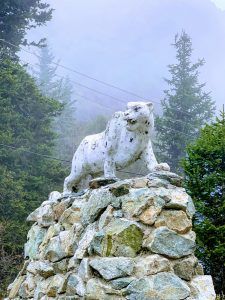
In Tian Shan mountains of the legendary snow leopard, errant wisps of mist float with the speed of scurrying ghosts, there is a climbers’ cemetery, Himalayan Griffin vultures and golden eagles are often sighted, though my attention is completely arrested by a Blue whistling thrush alighting on a rock— its plumage, its slender, seemingly weightless frame, and its long drawn, ventriloquist song remind me of the fairies of Alif Laila that were turned to birds by demons inhabiting barren mountains.
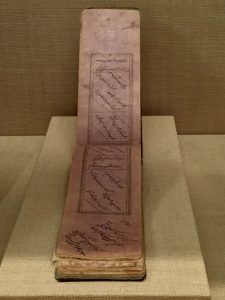
Images of the winged creature “Pari” enlivens a delicately stenciled page of this oblong framed Persian Ghazal anthology from the 14th century.

The sense of enchantment is powerful and not entirely unexpected. “Ay Pari” (Oh Fairy!), sung by the Badakhsan Ensemble, I imagine as a song sung in a human language in response to the eloquent whistle of the thrush, really a fairy under a spell. The word “fairy” in English may have been derived from the ancient Zoroastrian Persian “pari:” the first mythic creature I remember from lores and lullabyes and the television show Alif Laila (Arabian Nights) in Urdu. The song, in an eastern Persian dialect, comes from the heart of the Pamir mountains— the range that not only joins the Tian Shan in Kyrgystan to the north, and to the south, borders the Hindukush the mountains of my childhood in Pakistan, but the source of the famed river Oxus or Amu Darya—the drainage area of which was once the space between the empire of Genghis Khan, and over a thousand years earlier, of Alexander the Great. Read more »

The migrants in the caravan are not coming to invade, they are seeking relief of their suffering

by Craig Blinderman

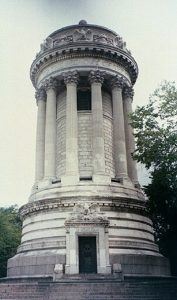
On a recent windy morning, walking past the Soldiers’ and Sailors’ Monument on West 89th Street in New York City, seeing the flag at half mast, just days before the midterm elections, and a week after the deadly shootings at the Tree of Life Synagogue in Pittsburgh, on my way to take my daughter to her dance class at Ballet Hispánico, I couldn’t help but reflect on the offensive and false rhetoric about the caravan of men, women, and children fleeing Honduras and other Central American countries, and the horrific outcomes when one takes such ideas seriously.

As a palliative care physician who also teaches in medicine, I have been trained—and train others—to understand pain and suffering, to understand its taxonomy, its causes, and how to reduce it when it occurs in individuals with chronic pain, a serious illness, or at the end of life.

I have also spent the past five years volunteering with Columbia Physicians and Surgeons’ Asylum Clinic, a student-run human rights initiative, working with Columbia medical faculty, to offer free medical and psychiatric evaluations to individuals seeking asylum in the United States.

My palliative care skills of listening to and understanding how individuals suffer with a serious or life-threatening illness has helped me to identify and document the ways in which individuals seeking asylum have suffered in their home countries; the impact their physical, emotional, psychological, and sexual traumas continue to have on their lives; and the risk to their physical and mental well-being should they be forced to return.

Aside from the physical and emotional pain, the suffering that asylum seekers, as well as seriously ill patients, are most tormented by is existential in nature. It is the fear of their own deaths. As Søren Kierkegaard famously wrote, “The most painful state of being is remembering the future, particularly the one you’ll never have.” Unlike the patient with a terminal illness, the existential threat can be attenuated (at least temporarily) for the individual seeking asylum by simply not being sent back to their home country. Read more »

Monday, October 29, 2018

The Season of Savagery and Hope

by Ali Minai

April 2018: ‘Tis the Season of Giddiness in Democratlandia. Republicans are saddled with a widely despised President and riven by internal dissension. The Republican leadership in Congress is lurching from fiasco to fiasco – interrupted briefly by one great “success” on tax cuts. The zombie candidates of the Tea Party are still stalking establishment Republicans across the land. And, somewhere in his formidable fastness, the Great Dragon Mueller is winding up for the fiery breath that will consume the world of Trumpism like a paper lantern. And a Blue Wave – nay, a Tsunami – is headed towards the Republicans in Congress, looking to engulf them in November.
Time passes, and it is October. Anguish is all around. After snatching children from their parents and imprisoning them in cages, after giving a wet kiss to Kim Jong Un and worse to Putin, after having his former campaign manager convicted of crimes and his fixer plead guilty, after a virtual torrent of lies, after reports of a still devastated Puerto Rico and newly devastated Carolinas and Florida – after all this and more, Trump is more popular than ever in his presidency, Brett Kavanaugh is on the Supreme Court, and the Blue Wave is beginning to look more like an eddy. To be sure, Trump is still spectacularly unpopular compared to past presidents, with disapproval numbers at 50% of higher, but he seems to be rising. Rising! The very word is like a knell of doom. As Trump himself might say, “What the hell is going on?”

First of all, probably an over-reaction. A large part of US electoral outcomes can be ascribed to structural factors, such as the fact that 26 of the 50 states have conservative majority populations. Yes, these 26 states may add up to only 47% of the US population, but they elect 54% of the US Senate, and that cannot change. The number of reliably liberal states is much smaller – only 16 – and, though they account for 42% of the population, they only elect 32% of the Senate. The remaining 8 states – comprising 11% of the population – swing with the season, but supply 16% of the Senate. Thus, Democrats start off with a huge disadvantage in the Senate even in the best of times. Demographic forces will gradually change this situation, but slowly. Meanwhile, Democrats, as the liberal party, will always be facing the bitter choice of either accepting conservative senators in their own ranks or remaining a permanent minority in the Senate. Four decades of asymmetric political warfare has also left Republicans in control of most state houses, which they have used to gerrymander districts and pass laws to disenfranchise Democratic voters. That too is hard to change because these factors are custom-designed to perpetuate Republican majorities. But all is not lost for Democrats here. Read more »

Victor Weisskopf and the joy of scientific insight

by Ashutosh Jogalekar

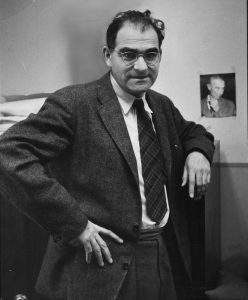
Victor Weisskopf (Viki to his friends) emigrated to the United States in the 1930s as part of the windfall of Jewish European emigre physicists which the country inherited thanks to Adolf Hitler. In many ways Weisskopf’s story was typical of his generation’s: born to well-to-do parents in Vienna at the turn of the century, educated in the best centers of theoretical physics – Göttingen, Zurich and Copenhagen – where he learnt quantum mechanics from masters like Wolfgang Pauli, Werner Heisenberg and Niels Bohr, and finally escaping the growing tentacles of fascism to make a home for himself in the United States where he flourished, first at Rochester and then at MIT. He worked at Los Alamos on the bomb, then campaigned against it as well as against the growing tide of red-baiting in the United States. A beloved teacher and researcher, he was also the first director-general of CERN, a laboratory which continues to work at the forefront of particle physics and rack up honors.
But Weisskopf also had qualities that set him apart from many of his fellow physicists; among them were an acute sense of human tragedy and triumph and a keen interest in music and the humanities that allowed him to appreciate human problems and connect ideas from various disciplines. He was also renowned for being a wonderfully warm teacher. Many of these qualities are on full display in his wonderful, underappreciated memoir titled “The Joy of Insight: Passions of a Physicist”.

The memoir starts by describing Weisskopf’s upbringing in early twentieth century Vienna, which was then a hotbed of revolutions in science, art, psychology and music. The scientifically inclined Weisskopf came of age at the right time, when quantum mechanics was being developed in Europe. He was fortunate to study first at Göttingen which was the epicenter of the new developments, and then in Zurich under the tutelage of the brilliant and famously acerbic Wolfgang Pauli. It was Göttingen where Max Born and Heisenberg had invented quantum mechanics; by the time Weisskopf came along, in the early 1930s, physicists were in a frenzy to apply quantum mechanics to a range of well known, outstanding problems in nuclear physics, solid state physics and other frontier branches of physics. Weisskopf made important contributions to quantum electrodynamics which underlies much of modern physics. Read more »

Monday Poem

Desert

I wake sometimes at night, mouth
dry as the bottom of a cast iron skillet
in equatorial sun thinking, water!
imagining its absolute absence

yesterday on the iron bridge
I stopped dead center, leaned
and watched the slow river wrap itself
around a rock as rivers do, embracing 
the stubborn thing with eddies and waves
as it fell, pulled forward by its own weight
caressing, kissing, never stopping, touching 
with its passing, keeping, staying
for a moment in a backwash, in a pool—

letting go

I wake at night mouth dry
as the bottom of a cast iron skillet
in equatorial sun thinking,
water/you!
..
Jim Culleny
9/28/17

On Not Knowing: An Introduction

by Emily Ogden

Unfitness to pursue our research in the unfathomable waters. —Herman Melville, Moby-Dick

What are the forms of unknowing? Ambivalence. Diffidence. The open mind. The broken mind. The mind faced with the sacred. Deprivation of an education. Naiveté—or is it just youth? Objectivity. Credulity. Amateurism. Anti-intellectualism. Forgetting. Willful forgetting. Receipt of mercy, as when we say, it’s better if she doesn’t know.

Neither good nor bad, neither innocent nor strategic, unknowing in itself belongs neither to the right, nor to the left, nor even to the clueless, privileged middle. Yet forces conspire of late to make unknowing, both posture and reality, look like the exclusive territory of the reactionary guard. I do not think progressives should cede their claim to this common property of ours. For a little while, then—never mind how long; I’m not sure yet—this column will concern unknowing: when and why one might value it.

I am aware of how untimely such a project may seem, may even be. The Trump administration’s aggressive, racialized ignorance has reached literally world-destroying proportions. Seemingly the one kind of expertise toward which the US president does not maintain open hostility is criminal defense litigation, and that’s of necessity. Republican voters take pride in their know-nothingism—see “I’m a Deplorable” bumper stickers—and their critics agree, calling them uneducated, in denial about their white supremacist sympathies, or both.

While campaigns like #bluelivesmatter and climate-change denial weaponize obtuseness, the left assumes a defensive crouch and draws tight the mantle of its enlightenment. What other choice is there? To enter certain conversations—as for example about abortion or rape—unsure of what you think is often to be judged conservative. Only slightly less often, it is actually to be so. And thus knowingness becomes at times an affected signal, and at other times a reliable sign, of progressive politics.

But—but. Aren’t there forms of unknowing one might want to protect, even prize? Read more »

Anglo-Saxon vs. French Vying for Control of English

by Gabrielle C. Durham

When you consume a meal, do you eat cow or beef? Yes, these are the same, especially considering where they end up, but we tend to think of the cow as the beginning of this particular process, and the beef as the product. More of these pairings include calf/veal, swine or pig/pork, sheep/mutton, hen or chicken/poultry, deer/venison, snail/escargot.
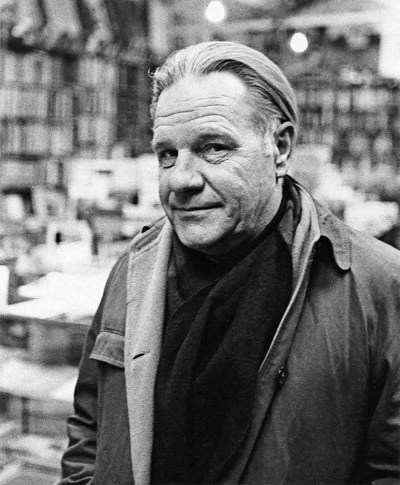

The question: Why are the “baser” elements of Anglo-Saxon origin, similar to our curse words, whereas the results typically have French roots? As you rush to beat me to the answer with your pupil’s sycophancy, it’s all about the Battle of Hastings in 1066. When the Normans, aka the French, beat the snot out of the English, or Anglo-Saxons, French words started creeping into the language. The Norman words were considered more sophisticated (as in, poultry is fancier than hen).

This applies to other, more vegan-friendly options as well, such as beverages. In this case, sophistication may not be the goal, but pretension is the indubitable result.

Many of my kindred (editors) try to replace the Latinate or Romantic words with Anglo-Saxon words. Is it a linguistic form of nationalism? Not really, although I don’t read alt-right writing, so I could be wrong. The goal is to simplify text, reducing gratuitous verbiage where possible. Or cutting spare words. See how that works? Read more »

Spirits of elsewhere

by Thomas O’Dwyer

Lawrence Durrell
Lawrence Durrell

When a plane lands at Larnaca in Cyprus, as it rolls past the control tower one can glimpse on a misty horizon the lone pyramid of Stavrovouni mountain. The ugly airport tower then obscures the steep mountain and the ancient monastery on its summit. It could be a metaphor for modernity obliterating the spirit of places that once seemed mysterious and eternal.

It’s an hour’s drive from the airport to the sprawling concrete capital Nicosia and up and over the green passes of the Kyrenia mountain range. Then it’s a right turn east along the northern Mediterranean coast to the hillside village of Bellapais. A remarkable 12th-century Gothic abbey dominates the village and a couple of Crusader castles brood on the mountain ridge high above it. Even the names carry a whiff of ancient Gothic Europe – Buffavento, Hilarion, Bellapais. Carob, mulberry and cypress trees crowd around the ruins as they did when knights roamed the hills.

A few hundred metres up a steep path from the abbey is a small house, once traditional, now modernised. The abbey and the cottage are responsible for the tawdry trinket shops and banal tourist cafes that have all but wiped out the old village tavernas. The splendid abbey is an obvious attraction, but the unremarkable cottage? For the literary-minded, it has an equal fascination. In it was written one of the great portraits of a city in 20th-century English literature. Here in the early 1950s Lawrence Durrell reimagined and immortalised Alexandria of Egypt. It joined the Dublin of James Joyce and the Paris of Marcel Proust in literary legend. Read more »

The Pull of the Now

by Joshua Wilbur 

Repetition, in itself, is neither good nor bad. Everything repeats. “Nature is an endless combination and repetition of very few laws,” said Emerson. Seasons come, and seasons go.

But what’s true for seasons isn’t true for people. We tend to prefer some forms of repetition to others. At its best, repetition is a great source of comfort and a precondition for mastering any task. The familiar rhythms of the Sunday church service are a balm to many, and it takes years of practice to throw a 98 mile-per-hour fastball that cuts in on a hitter’s hands at just the right moment.

At its worst, repetition means monotony and aimless toil: Sisyphus pushing his boulder up the hill for all eternity. Freud wrote of our “compulsion to repeat” the past, sensing that reenactment lies at the heart of everyday neuroticism, psychological trauma, and the most unnerving displays of madness—“All work and no play makes Jack a dull boy,” writes Jack Torrance, a thousand times over, in The Shining.

In between these two extremes—between the master and the madman—repetition provides the unglamorous but necessary foundation of daily life. It’s the soundtrack of childhood: brush your teeth, tie your shoes, finish your homework, eat your dinner, and so on. By the time a person reaches adulthood, she has internalized an incalculable number of habits: some good, some bad, but most avoiding the sureness of a positive or negative judgement. Thanks to our neurological adaptiveness, we are constantly slipping into patterns without realizing it, and the unrelenting expansion of consumer tech has only opened more avenues for our habitual instincts. Read more »