
by Ashutosh Jogalekar
 The fall turned colors faster than ever before. The streets never saw any activity. The whole gambit of Prometheus hinged on a mere coin flip. Richard Albrook gingerly closed his book and took a look around.
The café was almost deserted, college students and startup founders struggling to meet last minute deadlines, their faces a picture of desperate concentration. The baristas and their blues, the coffee with its vitriolic flavors. It seemed like the uneasy middle of time. Had not the soothsayer spoken with gusto and evident admiration for the march of destiny, he might have almost been forgiven for having a sense of whimsy.
Albrook had been languishing in this carved out area of spacetime until his visceral emotions had gotten the better of him. His friends had warned him that too much time with a speakeasy kind of permissive feeling would mark his doom. Not that feelings of doom had never crossed his mind, but this time it seemed all too real. Lost love, the convolutions of Clifford algebras and dandy details of daffodil pollination had always been seemingly on the verge of materializing in a cloud of abject reality, but the effect had been subtle at best.
It was this rather susceptible mix of preternaturally wholesome unification that Albrook was mulling over when the wizard walked in. Read more »

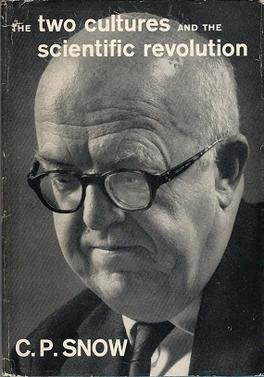 It is a commonplace to say that a divide has occurred in modern academia between the sciences and the humanities. In the anglophone world, this diagnosis is often traced back to a lecture by the British scientist-novelist Charles Snow, who pointed out in 1959 what he saw as a lamentable gap between ‘two cultures’: the literary and the scientific culture. Snow’s Rede lecture has become the main





 “Beware of literature!” This warning occurs in Jean-Paul Sartre’s 1938 novel Nausea as an entry in the diary of the narrator, Antoine Roquentin. In context, it concerns the way that literary narratives falsify our experience of events by investing them with an organization and structure that our experiences in themselves, as we live them, do not have. When Bilbo Baggins finds the ring in The Hobbit, Tolkein tells us that although Bilbo didn’t realize it at the time, this would turn out to be a turning point in his life. When married couples recall their first meeting, their account inevitably packages the event as a “beginning,” even though they may have had no inkling of this at the time.
 Do you find this prospect upsetting? Perhaps you think it is unfair for someone to get a job without a good reason for why they deserve it rather than anyone else. Perhaps you think such a system would decrease your chances of getting the job you want. If so then you may be under the influence of the cult of excellence.

 In the 70s our church caught bus fever as an effort to bring in the sheaves with greater volume (we pass the salvation savings on to you!). We began deploying a fleet of ancient school buses, painted Baptist blue, out into the neighborhoods of town to bring anyone that so wished to church. Heathen parents gleefully signed up their kids so they could read the paper and drink coffee in peace. Today such an effort would be like inviting people to sue you and then providing a free ride to the courthouse. Come for the mass transit; stay for the litigation.
 When the father of your child is in jail, pray even if you don’t believe in God. Pray even though in your head of heads you know it won’t do shit. Stop staring at the walls, at the clock, at the phone. At your baby, now eight, sleeping next to you, his sneakers, caked with mud, still tied to his feet. Pray because it will distract you from what’s coming, from a conversation millions of mothers have already had with their sons. You are not different, not an exception to some rule. Start praying instead of feeling sorry for yourself. Buck the fuck up because he will need you.
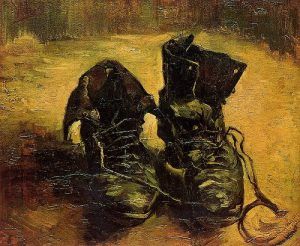 Despite the continued influence of formalism in the 20th Century there were currents of dissent that took an opposing position. Thinkers as diverse as Heidegger, Whitehead and Deleuze were arguing that genuine aesthetic appreciation is not about form but the unraveling of form. Despite their considerable differences, each was arguing that the most important kinds of aesthetic experiences are those in which the dominant foreground and design elements of a work are haunted by a background of contrasting effects that provide depth. It’s the conflict between foreground and background, surface and depth, between what is known and what is mysterious that give art its allure. The uncanny is the key to art worthy of the name. For example, for Heidegger in his famous study of Van Gogh’s A Pair of Shoes, it’s the seemingly insignificant brushstrokes in the background of the painting that allow amorphous figures to emerge and begin to take to shape as we view it. The background figures preserve ambiguity and allow the concealing and unconcealing of multiple interpretations to take place, which Heidegger argues, are at the heart of a work of art.