
by Ashutosh Jogalekar
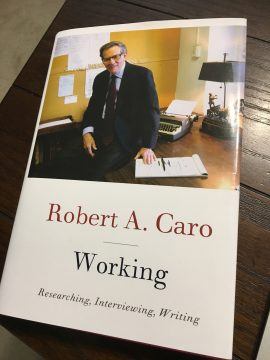 Robert Caro might well go down in history as the greatest American biographer of all time. Through two monumental biographies, one of Robert Moses – perhaps the most powerful man in New York City’s history – and the other an epic multivolume treatment of the life and times of Lyndon Johnson – perhaps the president who wielded the greatest political power of any in American history – Caro has illuminated what power and especially political power is all about, and the lengths men will go to acquire and hold on to it. Part deep psychological profiles, part grand portraits of their times, Caro has made the men and the places and times indelible. His treatment of individuals, while as complete as any that can be found, is in some sense only a lens through which one understands the world at large, but because he is such an uncontested master of his trade, he makes the man indistinguishable from the time and place, so that understanding Robert Moses through “The Power Broker” effectively means understanding New York City in the first half of the 20th century, and understanding Lyndon Johnson through “The Years of Lyndon Johnson” effectively means understanding America in the mid 20th century.
By drawing up this grand landscape, Caro has become one of the most obsessive and exhaustive non-fiction writers of all time, going to great lengths to acquire the most minute details about his subject, whether it’s tracking down every individual connected with a specific topic or interviewing them or spending six days a week in the archives. He worked for seven years on the Moses biography, and has worked an incredible forty-five years on the years of Lyndon Johnson. At 83 his fans are worried, and they are imploring him to finish the fifth and last volume as soon as possible. But Caro shows no sign of slowing down.
In “Working”, Caro takes the reader behind the scenes of some of his most important research, but this is not an autobiography – he helpfully informs us that that long book is coming soon (and anyone who has read Caro would know just how long it will be). He describes being overwhelmed by the 45 million documents in the LBJ library and the almost equal number in the New York Public Library, and obsessively combing through them every day from 9 AM to 6 PM cross-referencing memos, letters, government reports, phone call transcripts, the dreariest and most exciting written material and every kind of formal and informal piece of papers with individuals who he would then call or visit to interview. Read more »




 The spring ephemeral wildflowers of the Midwest are generally not large or showy. In a relatively short time during one of the less promising parts of the year, these perennial plants must put out leaves and flowers and reproduce, all before disappearing until the next spring. Still, they light up the woods for me every year despite their relatively modest circumstances.
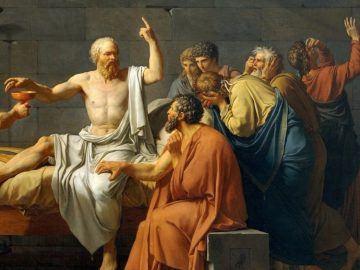 When Socrates’ students enter his cell, in subdued spirits, their mentor has just been released from his shackles. After having his wife and baby sent away, Socrates spends some time sitting up on the bed, rubbing his leg, cheerfully remarking on how it feels much better now, after the pain.

 I’ve always liked stories that depended on mistaken identity, a very old theme in general. Having a degree in mathematical logic, I was also drawn to the subject on a more theoretical level, on which lies Gettier’s Paradox.

 Movies, music and novels portray a particular ideal of romantic love almost relentlessly. Love is something that happens to you, something you fall into even against your will or better judgement. It is something to be experienced as good in itself and joyfully submitted to, not something that should be questioned.

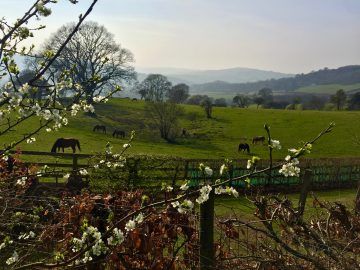 Just as Anteus in Greek mythology renewed his strength by touching the earth, so emigrés who live abroad often draw some sort of cultural or spiritual nourishment from returning to their roots. In my case this means returning to Britain, and specifically to the countryside that remains, for the most part, green and pleasant. Usually I do this in the summer, so it made a nice change this year to be in Britain at the beginning of Spring. The trees not yet being in leaf left more of the landscape open and visible. There were fewer flowers, of course, but there were also fewer holiday makers clogging up the roads and the honey pot tourist sites.