by Dave Maier
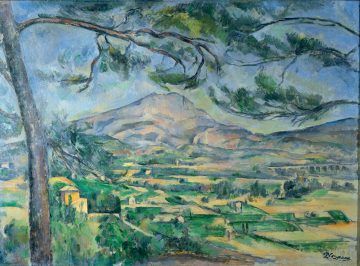 Philosophers have spilled a great deal of ink attempting to nail down once and for all the necessary and sufficient conditions for a thing’s being a work of art. Many theories have been proposed, which can seem in retrospect to have been motivated by particular works or movements in the history of art: if you’re into Cézanne, you might think art is “significant form,” but if you’re impressed by Andy Warhol, you might that arthood is not inherent in a work’s perceptible attributes, but is instead something conferred upon it by members of the artworld.
Nothing has really seemed to fit everything, and for whatever reason, essentialism in the philosophy of art, or at least arguing about it in public anyway, has drifted in and out of fashion. Yet that question, or something like it, won’t simply go away. Unless everything is art, some things are art and some are not. What’s the difference?
When you get stuck like this, one way to get back on track is to ask a different question. There are plenty of worthwhile candidates, but one which keeps coming up for me is: what’s the difference between something that’s not art because it’s not good enough, and something that’s not art because it’s the wrong sort of thing? Let’s start there. Read more »
 logician of modern times, at Einstein’s urging, brought his two magnificent proofs to Princeton. There he would remain for almost forty years, never mentoring a graduate student, rarely lecturing, adding only one substantial but incomplete proof to the cannon of math.
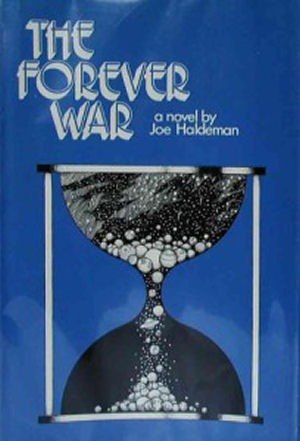 In 1974, noted science fiction author Joe Haldeman published a novel called The Forever War, which won several awards and spawned sequels, a comic version, and even a board game. The Forever War tells the story of William Mandella, a young physics student drafted into a war that humans are waging against an alien race called the Taurans. The Taurans are thousands of light years away, and traveling there and back at light speed leads Mandella and other soldiers to experience time differently. During two years of battle, decades pass by on Earth. Consequently, the world Mandella returns to each time is increasingly different and foreign to him. He eventually finds his home planet’s culture unrecognizable; even English has changed to the point that he can no longer understand it.


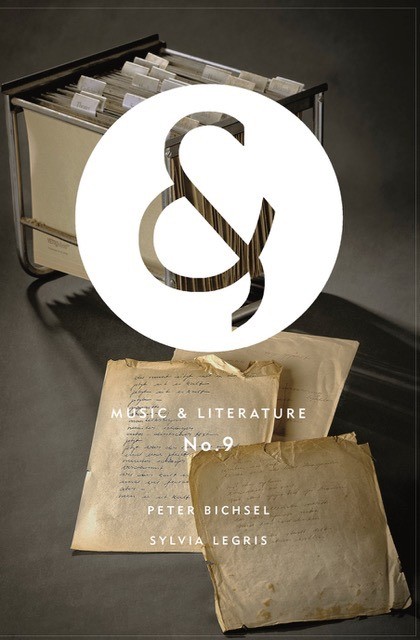 Madeleine LaRue: It did turn out to be pretty mammoth! How about I tell you, by way of introduction, about the first time I met Bichsel in person. He’d come to read at the Literarisches Colloquium in Berlin, the center of the grand old West Berlin literary establishment. It was November, it was dark and cold, and when he emerged at the back of the room and started walking up toward the stage, wearing the same black leather vest he’s been wearing for the past forty years, I think we were all a little worried about him. He was eighty-two then, and he looked exhausted. It had been a while since he’d been on such an extensive reading tour outside of Switzerland. He got to the stage and settled into his chair. The moderator welcomed him and asked how it felt to be back in Berlin—a simple question, a nice, easy opener. Bichsel still seemed tired, but as he leaned back and said, very slowly, in his lilting Swiss accent, “Ja, ja, Berlin,” his eyes lit up and he launched into a story about his first time in the city, in the early 1960s, and how he got caught in the middle of a bar fight with some people! Who turned out to be Swiss! And they all got thrown out onto the street together, and he’ll never forget it! And ja, ja, Berlin—and from his very first word, we all became like delighted children at Grandfather’s feet, totally enraptured, utterly unwilling to go to bed until we’d heard just one more story, pleeeease? And he himself became younger, full of life, charming and hilarious and genuine and profound.
 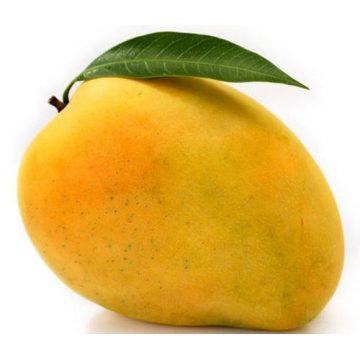 Having before you an iced mango