
by Mary Hrovat
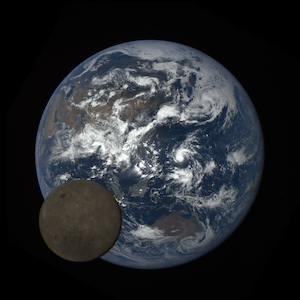
I think it was in the 1980s that I first saw t-shirts showing a drawing of a spiral galaxy with an arrow indicating “You are here.” They were amusing, and the image provides a bit of cosmic context. You may be here, looking at this screen, with your to-do list and personal problems and worries about the world, but you’re also here in the Orion arm of the Milky Way, about 25,000 light years from the center, in this solar system, on this planet.
One way to capture the most local part of your cosmic context is the 3D solar simulator at The Sky Live, which shows a simulated snapshot of the locations of all the planets relative to the sun at this moment. You can zoom in and out and add asteroids, near-Earth objects, and comets. You can also animate the simulation. At one week per second, you get a pretty good view of the tight circling of the inner planets, but the outer planets move at a very sedate pace. At one year per second, the inner planets move too quickly to follow easily, but the outer planets sweep along briskly.
Of course, you can also observe the solar system from the inside. One great way to broaden your horizons is to go out in the evening to see what other planets in the solar system are visible and to watch them moving along in their orbits over the weeks and months. There are a number of guides to what you can see on a clear night. Sky & Telescope provides a weekly update that tells you which planets will be visible, what phase the moon is in, and whether there will be any events such as eclipses or meteor showers. Space.com offers a monthly summary that covers a somewhat broader range of things to look for in the night sky, and EarthSky describes what you can see in the sky tonight.
In addition, space is not an unchanging backdrop but a place with its own weather (sort of) and events. Spaceweather.com posts news stories about solar activity, aurorae, meteor showers, fireball observations, and more. The sidebar on the left shows current data and images. Read more »
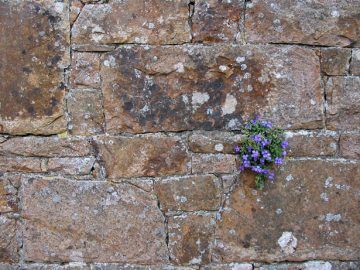 We find ourselves always in the middle of an experience. But it’s what we do next – how we characterize the experience – that lays down a host of important and almost subterranean conditions. Am I sitting in a chair, gazing out the dusty window into a world of sunlight, trees, and snow? Am I meditating on the nature of experience? Am I praying? Am I simply spacing out? Depending on which way I parse whatever the hell I’m up to, my experience shifts from something ineffable (or at any rate, not currently effed) to something meaningful and determinate, festooned with many other conversational hooks and openings: “enjoying nature”, “introspecting”, “conversing with God”, “resting”, “procrastinating”, and so on. Putting the experience into words tells me what to do with it next.
 Forever is a long time.
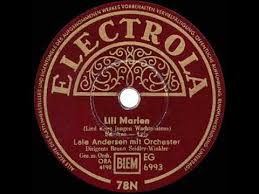 Lili Marleen is one of the best known songs of the twentieth century. A plaintive expression of a soldier’s desire to be with his girlfriend, it is indelibly associated with World War II, in part because it was popular with soldiers on both sides. It was
 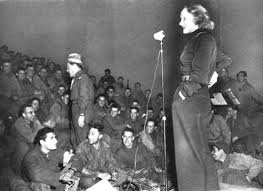 Marlene Dietrich, who worked tirelessly during world war two entertaining allied troops, also recorded both a
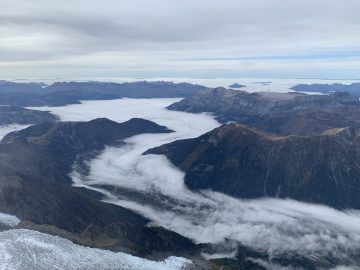 While waiting, shivering and jetlagged, for a train home from the Paris airport this week, I alternately stared into space and checked the train timetables. My train was an hour late. I later learned, thanks to the friendliness of a fellow traingoer, that the train had hit a deer.
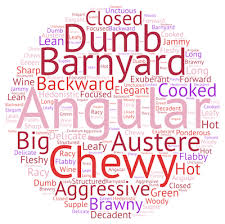 Wine writers, especially those who write wine reviews, are often derided for the flowery, overly imaginative language they use to describe wines. Some of the complainants are consumers baffled by what descriptors such as “brooding” or “flamboyant” might mean. Other complainants are experts who wish wine language had the precision of scientific discourse. The Journal of Wine Economists
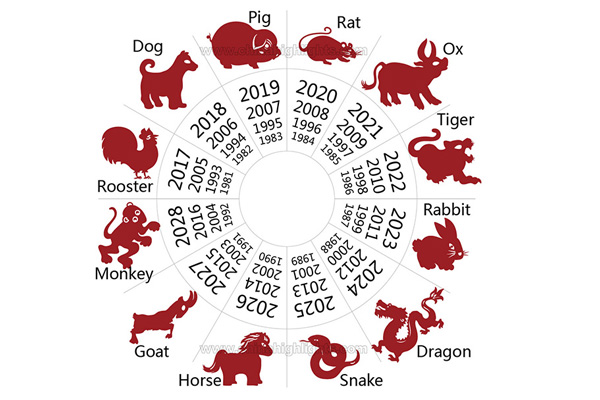 In the Chinese calendar, 2015 was the year of the sheep. I’m a sheep, and I briefly got into it. When you’re a sheep, you gotta own it.
 Schoolteachers across the grades are responsible for teaching their students how to write. Their essential pedagogical role is instrumental. With particular attention paid to format, grammar, spelling, and syntax, students ideally learn to write what they know, think, or have learned. It matters little if the student is in a class for “creative writing” or “composition,” writing is taught and practiced as a way to record thoughts, compose ideas in a coherent manner, and clearly communicate information. A student’s writing is then assessed for how well she adhered to these instrumental standards while the teacher is assessed for how well she adhered to the standards of instrumental teaching.
 1.
1.