
by Tamuira Reid
It is almost midnight here in New York City, and I’ve been sitting at my dining room table for the past eight hours with my finger on the “send” button. Each time, I freeze, regroup, take another sip of coffee, sneak a cigarette out on the fire escape where my son won’t see me. Because I know I have to scrap the essay I wrote for this week. The one I wrote before Thursday. The one that I can’t stand to look at now. “Dating During Covid”.
Every single thing I do feels like a betrayal. A privilege. Everything I do feels white.
Writing about anything other than the Capitol feels wrong. Writing about the Capitol as the events process and take shape in my white mind feels wrong. Writing is a kind of performance, here, in this intellectualized virtual space. What gives me access to this stage? What the hell do I know? What makes my voice so special?
I cannot write my way out of this.
There are voices that need to be heard right now, listened to, learned from. I am not one of them. Not now. Not yet. I have not done the work. I know I am full of feelings; big ones, shameful ones, stupid ones. Feelings that have ignited after a long, slow burn. But feelings, my feelings, are not relevant here. I am a white woman holding space for no one but myself.
I don’t want to hear my voice. I don’t want to hear any white voices. Just for five minutes, an hour, a day, a week. I want us to stop filling the pages that do not belong to us and give them back to their rightful owners. To stop acting like dutiful interpreters of a language we aren’t fluent in. To shut-up and bear witness. To take responsibility. To realize that being a nice white liberal with black and brown friends does not make you an anti-racist. Read more »
 The violent, insurrectionist attack on the US Capitol on January 6, 2021 was due, in part, to the success of the Nation’s system of public education, not its failure. Since Ronald Reagan announced in 1981 that “government is not the solution to our problem, government IS the problem,” federal authorities have worked to dismantle and erase any vestiges of democratic education from our system of public education. Free-market values replaced democratic ones. Public education slowly but consistently was transformed by neoliberal ideologues on both sides of the aisle into an institution both in crisis and the cause of the Nation’s perceived economic slip on the global stage. Following Reagan’s lead, all federally sponsored school reform efforts hollowed out public education’s essential role in a democracy and focused instead on its role within a free-market economy. In terms of both a fix and focus, neoliberalism was and remains the ideological engine that drives the evolution of public education in the United States. These reform efforts have been incredibly successful in reducing public education to a general system of job training, higher education prep, and ideological indoctrination (i.e., American Exceptionalism). As a consequence of this success, many of the Nation’s citizens have little to no knowledge or skills relating to the essential demands of democratic life. The culmination of the neoliberal assault on democratic education over the last forty-years helped create the conditions that led to the rise of Trump, the development of Trumpism, and the murderous, failed attempt at a coup d’etat in Washington, DC. From what I have read, I am not confident that your plans for public education will address these issues.
 Philosophy has been an ongoing enterprise for at least 2500 years in what we now call the West and has even more ancient roots in Asia. But until the mid-2000’s you would never have encountered something called “the philosophy of wine.” Over the past 15 years there have been several monographs and a few anthologies devoted to the topic, although it is hardly a central topic in philosophy. About such a discourse, one might legitimately ask why philosophers should be discussing wine at all, and why anyone interested in wine should pay heed to what philosophers have to say.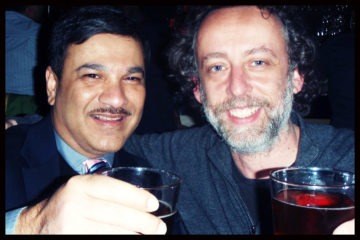
 Every Democrat, and many independent voters, breathed an enormous sigh of relief when Joe Biden defeated Donald Trump in the November election. Now they are all nervously counting down the days (16) until the last of Trump’s frivolous lawsuits is dismissed, his minions’ stones bounce of the machinery of our electoral system, and Trump is finally evicted from the White House. Only then can we set about repairing the very significant damage that Trump and Trumpism have wrought upon our republican (small r) and democratic (small d) institutions.
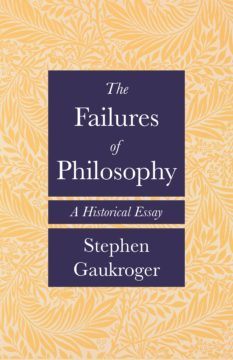 Three times have we started doing philosophy, and three times has the enterprise come to a somewhat embarrassing end, being supplanted by other activities while failing anyway to deliver whatever goods it had promised. Each of those three times corresponds to a part of Stephen Gaukroger’s recent book The Failures of Philosophy, which I will be discussing here. In each of these three times, philosophy’s program was different: in Antiquity, it tied itself to the pursuit of the good life; after its revival in the European middle ages it obtained a status as the guardian of a fundamental science in the form of metaphysics; and when this metaphysical project disintegrated, it reinvented itself as the author of a meta-scientific theory of everything, eventually latching on to science in a last attempt at relevance.
 For the past few years, I’ve been taking a fairly deep dive into attempting to understand the physical and ecological changes occurring on our planet and how these will affect human lives and civilization. As I’ve immersed myself in the science and the massive societal hurdles that stand in the way of an adequate response, I’m becoming aware that this exercise is changing me, too. I feel it inside my body, like a grey mass coalescing in my chest, sticking to everything, tugging against my heart and occluding my lungs. A couple of months ago, I decided to stop writing on this subject, to step away from these thoughts and concerns, because of their discomfiting darkness.
 If one enters the name “Ellen Page” into the search box at
 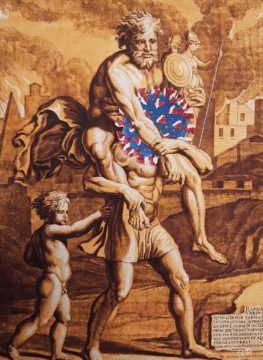 Arma virusque cano: Sing,
 This Christmas, I stayed in a Marriott in the town where my kids live. Like most people, my business and personal travel has mostly ground to a halt in the last 9 months. So I was pleasantly surprised by the check-in experience the hotel provided me to allow for social distancing. I’m a long-time Marriot member and have their app on my phone. Using it, I was able to check-in ahead of time, and when my room was ready, they sent me a mobile key.
 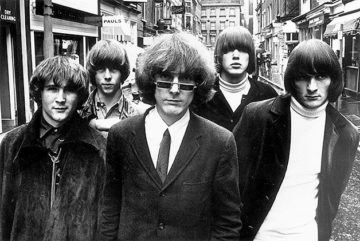 In the early months of 1966, whenever a familiar look of boredom settled in my mother’s eyes at the thought of cooking, I’d suggest, “Why don’t we go out for pizza?”
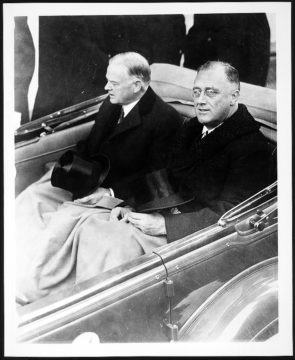 Adlai Stevenson, in the concession speech he gave after being thoroughly routed by Ike in the 1952 Election, referenced a possibly apocryphal quote by Abraham Lincoln: “He felt like a little boy who had stubbed his toe in the dark. He said that he was too old to cry, but it hurt too much to laugh.”