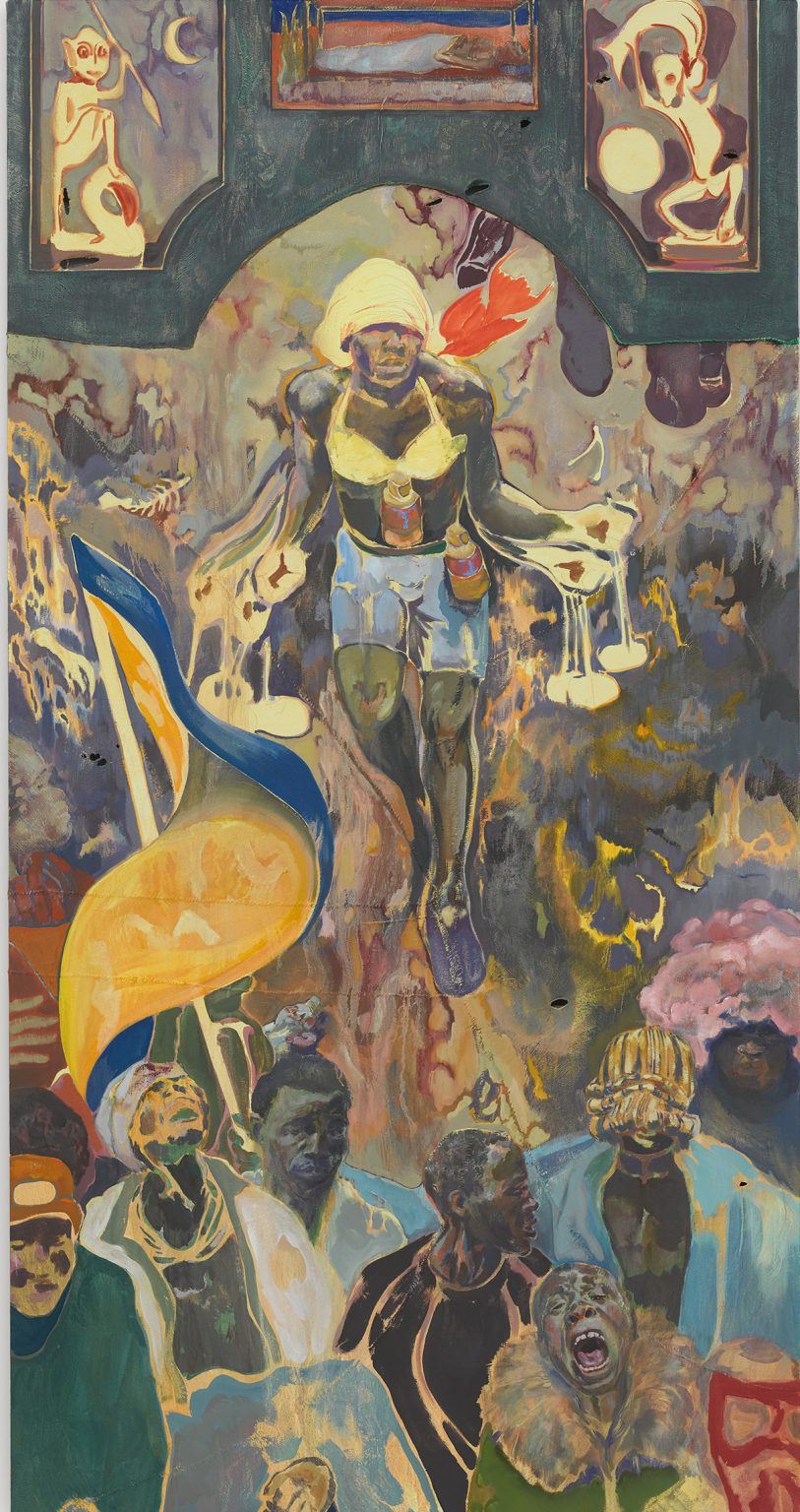
by Brooks Riley
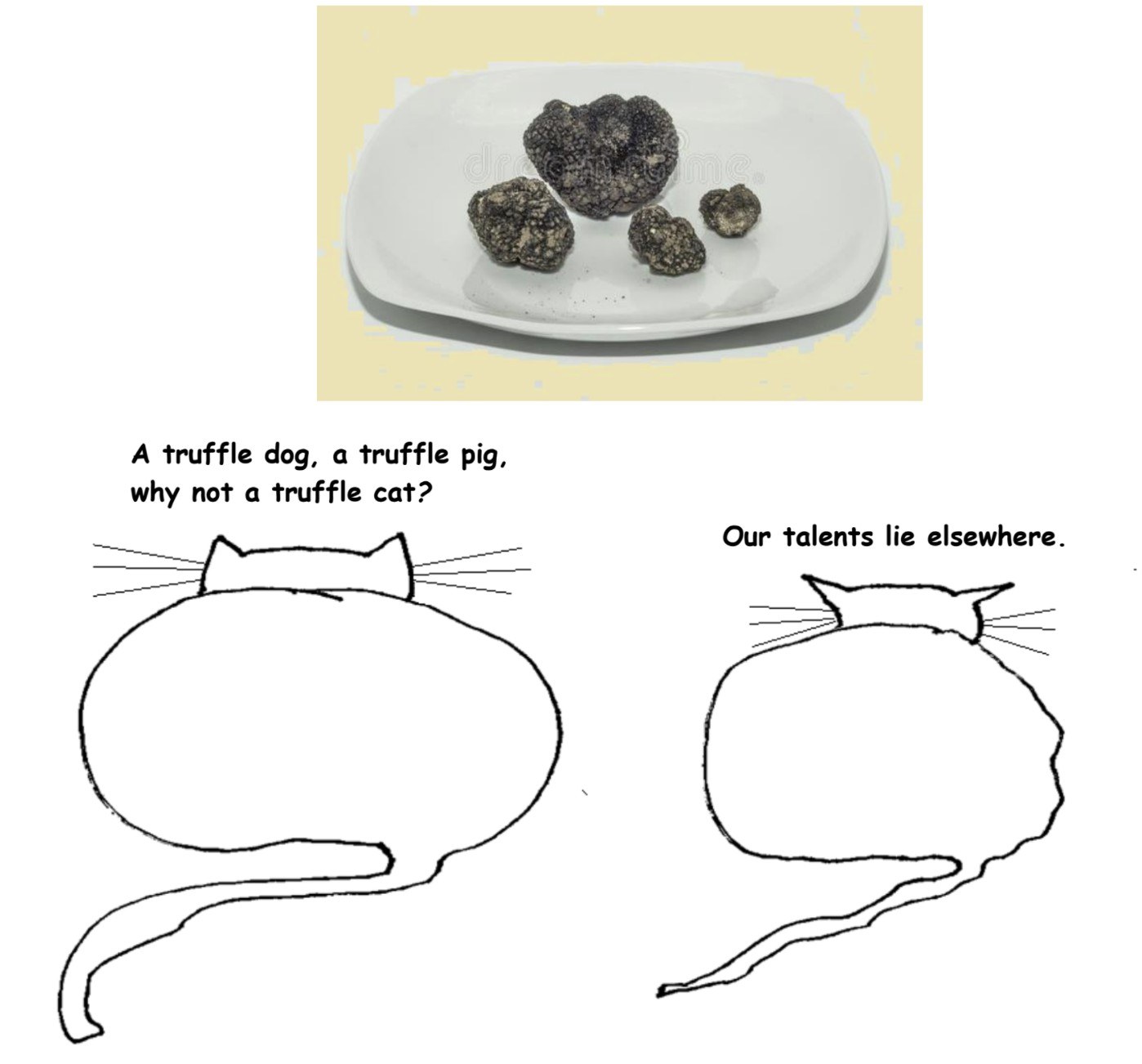

by Brooks Riley
by R. Passov
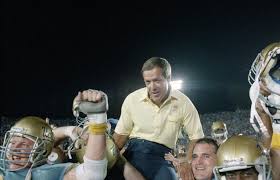
I learned from reading Terry Donahue’s obituary in the Los Angeles Times he became head coach of UCLA’s football team in the same year I became a Bruin freshman. And we spent our formative years as neighbors but since we were 14 years apart, we never met.
Back then 14 years was a big difference. Reading he passed at 77, after having stepped away from coaching at fifty-two, surprises me. Seventy-seven is no longer a ripe old age. And, in ego-driven enterprises where success tends to breed personality cults, it’s rare to see a leader know when to go.
His many obituaries lionize his winning ways at UCLA where he led the football team in its last glory years (1976-1995), providing a salve against the pain of watching UCLA’s basketball program, once the winningest in all of college sports, fracture in the post John Wooden era. (From 1948 to 1975, Wooden coached UCLA’s men’s basketball to 10 NCAA titles. It’s been a struggle ever since.)
One of Donahue’s keys to winning can be found in his NYT obituary: “You need money, access to an aircraft if possible,” Donahue is quoted as saying before he goes on to describe the faraway places he went in search of players.
One of those faraway places was Sherman Texas where, in 1977, he found an oversized teenager who, under Friday Night Lights, was tearing up the gridiron.
Billy Don Jackson was a phenom.
by Rafaël Newman
History is the one true fatality: you can re-read it as much as you like, but you can’t re-write it. —Laurent Binet
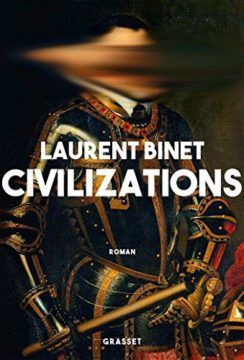 One of my oldest friends, an economic historian who serves as the Academic Director of a museum of Jewish life in northern Germany, is, like me, a child of May; and, during our recent birthday month, as is our custom, we exchanged gifts by post. Since we also share a love of books and history and a taste for grand, occasionally outlandish theory, as well as an abhorrence for futuristic science fiction, the novels we sent each other were in equal measures fantastical and backward-looking: examples of counterfactual historical fiction, what has come to be known as uchronia, the imaginative remaking of a bygone era that is the temporal counterpart to utopian geography.
The birthday book I received from my friend, Der Komet (2013), by Hannes Stein, a German foreign correspondent in the US, re-imagines the 20th century without the colossal conflicts that grew out of the assassination of Archduke Franz Ferdinand in 1914. “One billiard ball clicks against the next,” Stein writes, in an appendix detailing the events elided (or avoided) by his alternative history: “The shots fired in Sarajevo >> the First World War >> the Second World War >> the end of the colonial empires, since imperialism had become too costly for the colonial powers.” Stein’s intricate, multi-character novel is set in an Austro-Hungarian Empire still in existence in the year 2000, one in which the Polish and Ukrainian questions have been settled in a series of minor skirmishes and peaceful negotiations, and assimilated Jews pursue their careers unmolested by a fringe party of anti-Semites. Stein mingles nostalgia for the Habsburgs with an implicit and rueful recognition of the progress that was in fact born of war in the actual 20th century: not only the waning of colonial domination, which in Stein’s world is still carried out only by the “barbarian” Japanese in China, but also the spread of pan-European female suffrage, which in Der Komet has only come, with veritably Swiss tardiness, following the revolts of 1968.
Der Komet’s resuscitation of vanished empires is reminiscent of the encomia for imperial cohabitation that appeared in some otherwise liberal quarters when the USSR was disintegrating, and Yugoslavia was going up in smoke, in the 1990s. The Ottomans and the Habsburgs may have been bigoted and repressive, the argument ran, but at least they (and, in their image, the regimes of Gorbachev and Tito) had kept the inter-ethnic peace. And indeed, Stein, a naturalized American and right-of-center moderate who switched his party affiliation from Republican to Democrat only with Trump’s rise, has one of his novel’s more sympathetic characters preemptively eulogize the Austro-Hungarian Empire (spoiler alert!) as “reactionary, progressive, and humane”. Read more »
by Alexander C. Kafka
During the pandemic, my family binge-watched the National Geographic Genius miniseries about Albert Einstein, Pablo Picasso, and Aretha Franklin. We imagined ourselves the producers for such a project and considered whom we would select as geniuses to feature.
On my short list would surely be the choreographer, dancer, and entrepreneur Alvin Ailey, whose dance company has become a lasting juggernaut of artistry, entertainment, and pride.
The entertainment aspect has sometimes bred jealousy and resentment. Some critics have focused on the company’s beautiful, athletic bodies they see as stereotyped, idealized symbols of the Black experience. Ailey scoffed at that critique. If his astonishingly skilled and conditioned dancers raised the physical bar for American concert dance, so be it. And if audiences could understand and relate to his work, all the better.
“The Black pieces we do that come from blues, spirituals, and gospels are part of what I am,” he shot back. “They are as honest and truthful as we can make them. I’m interested in putting something on stage that will have a very wide appeal without being condescending, that will reach an audience and make it part of the dance, that will get everybody into the theater. If it’s art and entertainment, thank God, that’s what I want to be.”
The pride component is complex. Ailey’s work celebrates Black American pride, of course, but audiences around the world relate and respond to his themes of oppression, struggle, and transcendence. Ailey’s multiracial company became an international craze, through State Department touring, before it became an American one. Read more »

Shadow self-portrait of my wife and me on the red clay tennis courts in Vahrn, South Tyrol, in mid-June of this year.

The succinct, topical, and obvious choice is Review: Tom Lutz’s Aimlessness. It works just fine. But I am not taken with it. I shall come back to this.
*
by Akim Reinhardt
*
I don’t know how well Abbas knows me. Of course one can never really know how well someone else knows them. It’s a second degree of mystical confusion flowing the first: how well can you really know anyone else? [here]
How well do I know Abbas? Kinda. But more. Or less. I’m not sure. Over the last decade there have been email exchanges and the roughly biennial meet up for drinks. Our mutual friends have described him to me, and likely me to him.
How well does Abbas know me? Not at all in some ways. Very well in others. As 3QD editor he’s been reading my essays for over a decade. Is that what led him to suggest I review Lutz’s book on aimlessness? Certainly some of my own work here has broached the topic in various ways without ever using the word. There was the three-part essay from 2014 that chronicled my rambling 7,500 mile drive around the United States. And there was the book manuscript that I serialized at 3QD in 2019–2020. Ostensibly about songs that got stuck in my head, it was really about whatever mental and emotional meanderings those songs led my head to follow.
Is this why Abbas, who may or may not really know me, asked if I would like to review Tom Lutz’s new book about aimlessness? Read more »
by Bill Benzon
When I was growing up in the 1950s and 1960s Westerns were pervasive on television and at the movies. Where they the dominant genre of the era? Perhaps, I don’t really know. But whatever the numbers say, the were very important. Correlatively, science fiction was a relatively minor genre, both on television and on the big screen. Now the situation is reversed. Science fiction is pervasive while Westerns, if not as scarce as hens teeth, certainly do not command the broad attention they once did.
What are we to make of this? Westerns look to the past, to the founding of America. How the West Was Won (1962) was the story of America, and it won three Academy Awards. The bespeak and confident America. Star Trek is a bit different. It, the entire franchise (from 1966 through to the present), is set in the future while America has only a tenuous presence in it, a step back in time every now and then. America is in transit. Similarly, Star Wars, the whole throng of stories, is set in a universe long ago and far away. America has disappeared.

Why? Tastes change, no? Yes, but why? For one thing, America has changed as well. That’s what interests me, the relationship between changes in America and changes on the Big Screen. I want to examine that by focusing on two films, The Forbidden Planet (1956), a science fiction classic from the era when science fiction was a minor genre, and The Terminator (1984), another classic science fiction film, one in a franchise in an era of franchises, and an era when science fiction was becoming pervasive.
The argument I am going to make, a loose argument, a speculative argument, and therefore the most interesting kind of argument we can make about the stories we tell ourselves, is that these are, at the core, the same story. If they are, on the surface, so very different – which they are – that is because they speak to radically different psycho-cultural circumstances. The America of 1956 was confident of itself and of the future. The America of 1982 was badly shaken and searching for itself. Exactly between those two dates, 26 years apart, we have the Apollo moon landing in 1969. Read more »
by Bill Murray
 It wasn’t effortless but we managed to mollify, sidestep and defy enough authorities to be legally resident in Finland for the month of July. Never mind shoes and belts off and toothpaste in a plastic bag. No, do mind; do that too. But add PCR test results, Covid vaccination cards and popup, improvised airport queues. And a novel Coronavirus variant: marriage certificates on demand.
The pandemic shines stark light down into the engine room, onto the unoiled grinding of international gears. A year and a half in, the lack of coordination between countries is everywhere on woeful display.
The Finnish parliament, unambiguously and unanimously, declared that “Anyone who has proof of being fully vaccinated or having recovered from Covid within the previous six months will be able to travel to Finland without having to undergo a Covid test.”
But then a Delta Airlines official peered into her screen and told us, “it says here no one is allowed to go to Finland, period.” Whereupon the haggling began, and it turns out production of a Finnish passport and our marriage license was sufficient qualification for access to our seats, payment for which was happily accepted with no questions long ago. Read more »
by Ashutosh Jogalekar
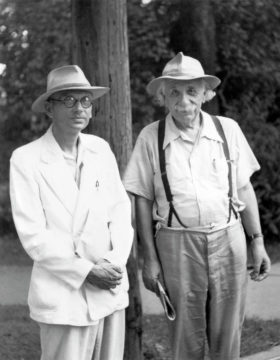
Two men walking in Princeton, New Jersey on a stuffy day. One shaggy-looking with unkempt hair, avuncular, wearing a hat and suspenders, looking like an old farmer. The other an elfin man, trim, owl-like, also wearing a fedora and a slim white suit, looking like a banker. The elfin man and the shaggy man used to make their way home from work every day. Passersby and motorists would strain their heads to look. Everyone knew who the shaggy man was; almost nobody knew who his elfin companion was. And yet when asked, the shaggy man would say that his own work no longer meant much to him, and the only reason he came to work was to have the privilege of walking home with the elfin man. The shaggy man was Albert Einstein. His walking companion was Kurt Gödel.
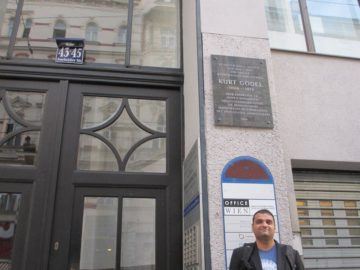
What made Gödel, a figure unknown to the public, so revered among his colleagues? The superlatives kept coming. Einstein called him the greatest logician since Aristotle. The legendary mathematician John von Neumann who was his colleague argued for his extraction from fascism-riddled Europe, writing a letter to the director of his institute saying that “Gödel is absolutely irreplaceable; he is the only mathematician about whom I dare make this assertion.” And when I made a pilgrimage to Gödel’s house during a trip to his native Vienna a few years ago, the plaque in front of the house made his claim to posterity clear: “In this house lived from 1930-1937, the great mathematician and logician Kurt Gödel. Here he discovered his famous incompleteness theorem, the most significant mathematical discovery of the twentieth century.”
The reason Gödel drew gasps of awe from colleagues as brilliant as Einstein and von Neumann was because he revealed a seismic fissure in the foundations of that most perfect, rational and crystal-clear of all creations – mathematics. Of all the fields of human inquiry, mathematics is considered the most exact. Unlike politics or economics, or even the more quantifiable disciplines of chemistry and physics, every question in mathematics has a definite yes or no answer. The answer to a question such as whether there is an infinitude of prime numbers leaves absolutely no room for ambiguity or error – it’s a simple yes or no (yes in this case). Not surprisingly, mathematicians around the beginning of the 20th century started thinking that every mathematical question that can be posed should have a definite yes or no answer. In addition, no mathematical question should have both answers. The first requirement was called completeness, the second one was called consistency. Read more »
by Azra Raza
All of the articles in this series can be found here.
 Cancer has occupied my intellectual and professional life for half a century now. Despite all the heartfelt investments in trying to find better solutions, I am still treating acute myeloid leukemia patients with the same two drugs I was using in 1977. It is a devastating, demoralizing reality I must live with on a daily basis as my entire clinical practice consists of leukemia patients or leukemia’s precursor state, pre-leukemia. My colleagues, treating other and more common cancers, are no better off. I obsess over what I have done wrong and what the field is doing wrong collectively.
Cognitive Biases in Cancer Research
The Nobel Laureate Daniel Kahneman was speaking to Krista Tippet on NPR about the faulty hardwiring of our brains and the cognitive biases that provide ongoing confirmation for the erroneous assumptions we regularly and naturally make (May 9, 2021). To illustrate his point, Kahneman recounted a sweet personal story. Some years ago, he and his wife returned from dinner with friends and were casually talking about the couple they had been with when his wife declared, “He is sexy.” As Kahneman pondered this possibility, trying to decide if he agreed or not, she then said something quite shocking, “He does not undress the maid himself.” Kahneman stared at his wife in disbelief. What could she possibly mean by this bizarre statement? What he should have done next was to ask himself, “But this is so uncharacteristic of her that there must be an error on my part”. Instead, he demanded to know what on earth she meant. And of course, what she had actually said was, “He does not under-estimate himself.”
There are some 180+ entries listed by Wikipedia as examples of these cognitive biases. Among these, the confirmation biases are particularly problematic where scientists are concerned. Science is a discipline devoted to the strictures of methodology based on formulating a hypothesis, designing experiments to test the hypothesis, and modifying the original proposal as needed through precise measurements and observations. Critical evaluation is the backbone of the scientific method. Yet, given the tendency toward cognitive biases, we become less critical, more readily accepting of emerging information that confirms our existing hypothesis, and we ignore the parts that don’t quite fit in. With time, this type of “confirmation bias” in support of a half-baked hypothesis builds up and an entire field is hijacked by its loud and powerful proponents.
I have regularly witnessed this during a four-decade long career in oncology research. Read more »
by Scott F. Aikin and Robert B. Talisse
1.
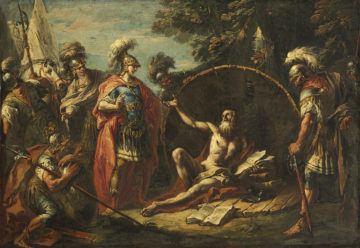
Diogenes met Kikermos, the Olympic pankration champion, on the road. Kikermos was followed by a cheering crowd. Diogenes asked Kikermos why these people were so enamored with him.
“I beat everyone at the pankration,” Kikermos replied.
“Oh! So you beat everyone at the pankration, even Zeus?” Diogenes asked.
“No! I beat all those who entered the pankration”
“Hm. So you beat the little boys who entered the junior division?”
“No! I bet all the men who entered the pankration, in the men’s division.”
“Oh, so you beat them all in one giant brawl?
“No! I beat all the men in one-on-one contests.”
“Oh, so since you beat all the men, that’s how you beat yourself?”
“No! I only beat all the others.”
“Oh, so were they stronger than you?”
“No! I was stronger than them!”
“Hm. So why is it such a great feat for you to defeat all these others that are weaker than you?”
2.
Diogenes watched the Olympic races, hoping to see examples of excellence. Upon seeing a heat of runners finish, he crept up to the winner’s stand and stole all the prizes for first place. He hustled to the woods nearby and deposited them there.
He returned and announced what he had done, because he had determined that though there are runners at the games that are faster than others, none are faster than the deer that live in the wilds. So none here should be allowed to claim the prize for ‘the fastest.’ Read more »
by Claire Chambers
 Covid-19 has led to various reactions akin to the various phases in the process of grieving. Davide Bertorelli observes in his chapter for The World Before and After Covid that ‘people have experienced differing degrees of anxiety, panic and disruption in every aspect of their lives’. Given what Bertorelli calls our current ‘mild collective psychosis’, it behoves us to learn from the previous global pandemic, the HIV/AIDS crisis.
HIV is a virus that contains single-stranded ribonucleic acid (RNA), as does SARS-CoV-2. Transmission is by blood-borne infection through bodily fluids: blood, semen, and saliva. Typical routes are via sex, needles for intravenous drugs or blood transfusions, or vertical transmission from mother to baby. Like all viruses, HIV (human immunodeficiency virus) gets taken up into the host’s cells, mostly the white CD4 T cells. The virus then uses the host’s equipment to reproduce its own RNA. After killing off the helper T cells, HIV bequeaths the host an immunodeficiency.
HIV infections have three different phases. First is the primary infection stage, known as seroconversion, when the disease is caught. It usually takes seven to 21 days for patients to show the illness in flu symptoms and a rash. Then they get better and the virus lies dormant, possibly for years. The second phase is persistent generalized lymphadenopathy: carriers manifest swollen glands for quite some time but are otherwise healthy. The third phase is acquired immune deficiency syndrome itself, where patients develop an AIDS-defining illness. Opportunistic infections such as aspergillosis, cryptococcosis, candidiasis, toxoplasma, and cryptosporidium have famously been devastating for people with AIDS. Their immune systems cannot cope, whereas healthy people can easily fight off such infections. In addition to the AIDS-defining illness, the other characteristic of AIDS is that sufferers have a low CD4 count. Read more »
by Ethan Seavey
The end of the pandemic is far from near. The end of the American epidemic is far from near, too, but for those of us who made the decision to get one of three miracle vaccines, our COVID story is slowly wrapping up.
The COVID world was lonely, hidden, distrustful, terrifying, and endless. The COVID world was online, which excited me because then, I would’ve happily spent all day online. That changed.
Until there was a completed, ready-to-eat vaccine I believed we would be stuck in this digital alternate universe for five years. When every news channel boasted the efficacies of the new vaccines, I believed it’d be years before I got one, years before I’d have to worry about returning to the old world, the one so foreign to me now.
And now: it’s here. It’s knocking on the door, hard. I’m vaccinated and I’m supposed to jump back out into that real world, and that fills me with anxiety. I should’ve seen dozens of friends I promised to see, but now that I’m able, I can’t find the energy. I should’ve been a miserable unpaid intern four times by now, but I can’t get an e-mail back. I should be moving forward, and I can hope that I’m looking at that glorious summit by now, but I’m more comfortable thinking it’s just another false peak.
My future is made up of several fantasies. There’s one where I see myself a successful writer—that is: meeting my basic needs—and raising a happy family with the man I love. Read more »
by Brooks Riley
by Adele A Wilby
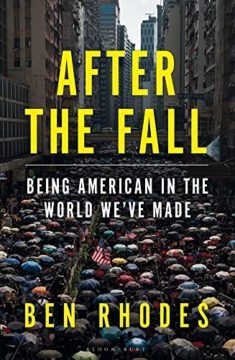 Many of us read with interest Ben Rhodes’ insider account of his time as a speech writer and advisor to Barack Obama during that historic presidency in his book The World as It Is: Inside the Obama White House. There were suggestions of his displeasure at some aspects of US politics in that publication, as for example the racism he thought Obama was subjected to while in office. His new book After the Fall: Being American in the World We’ve Made, goes further and is a clearer articulation of his concern about US and international politics. The conclusions he draws could be viewed as a personal coming of age in his understanding of the impact of American foreign policy on the world, and indeed experiencing and confronting more realistically, the ‘darker’ angels in US domestic politics.
The phrase ‘after the fall’ in the title of the book hints at what is to come and suggests any one of two things, or indeed both. It could be seen as a metaphor to his personal experience after the transfer of power to Trump’s administration in 2016. Power, as many know, has its own intoxication and it would not be surprising if, on a personal level, Rhodes experienced the loss of his high-powered job and access to the highest office in the land as a ‘fall’. The personal reflections of this period in the book are certainly laced with indications of what was indeed an extra-ordinary career experience for Rhodes: it is the rare individual who gets to write ‘thousands’ of speeches for a president, let alone an historic president such as Obama, that Rhodes makes clear in this book that he did. Only time will tell however whether such a revelation about the extent of his involvement in shaping Obama’s thought will have an impact on Obama’s legacy, but such a revelation, we can assume, has Obama’s concurrence. Still, these personal accounts and reflections are worth a read in themselves. Read more »
by Thomas Larson
 In 1994, Chauvet cave was discovered near the township of Vallon-Pont-d’Arc in southern France. The cave is a spectacular venue for the earliest known rock art made by our ancestors and in no way “primitive.” Deep inside the limestone cavern are hundreds of highly animated wall paintings of bison, bear, ibex, lion, rhinoceros, hyena, wooly mammoth, and horse, “signed” by the red-ochre handprints of the artists. The darkly etched charcoal drawings were sketched in the cave’s smoothed chambers, their walls rounded and pocked from water’s eonic hollowing. In the space are also pudding-like towers of calcium drips, whose conical shapes record the geologic heaping of age. The images, now protected as a World Heritage Site, were done between thirty-thousand and thirty-three thousand years ago.
In the first ten minutes of Werner Herzog’s Cave of Forgotten Dreams (2011), the film director and his crew hike up a rock face and squeeze through crawls spaces into the cave. Inside, the artists, paleontologists, and filmmakers don hardhats, test flashlights, and review the rules they must follow. The group’s one-hour descent, guarded viewing, and exit are filmed; afterwards, Herzog edits the footage by using two sound guides: the eerie, improvised evocations of cellist-composer Ernst Reijseger, to accompany the images, and Herzog’s voiceover commentary. Like a choirmaster, his soft, German-inflected, baronial English accompanies us through this sonic and architectural marvel. His voice warms and mystifies the claustrophobic space like a nurse talking us through an MRI. Read more »
by Chris Horner
 One day, I used to say to myself and anyone else who’d listen, I’m going to write a book called ‘everything you know about these people is wrong’. I have given up on the idea, and I expect anyway that someone else has already done it. What prompted the repeated thought was the way in which so little of what well known thinkers and artists did or said is actually reflected in public consciousness, assuming it makes a showing at all. This can lead people to reject the idea of engaging with them before they’ve even had time to discover the ideas or experiences they might have learned from or enjoyed. Clearly, not everything will be to everyone’s taste, but you can’t know until you give it, or them, a try.
What makes this problematic is that it is the least credible – and creditable – things that they have supposedly said or did that hang round them like a bad smell: Nietzsche the proto facist, Freud the sex mad coke addict, Marx the totalitarian etc. Popular beliefs about many of the key figures of modernity are often seriously askew, and sometimes at 180′ from the truth: Nietzsche was neither anti Semitic, nor a nationalist; Freud didn’t say it was ‘all about sex’; Marx wasn’t a proponent of a one party state, etc. It is almost as if whatever the popular view is of these figures, the truth lies in the opposite direction. So my instinct is to try to put the record straight. But what to do when the popular idea of an artist or thinker actually does correspond to something real – something true and bad?
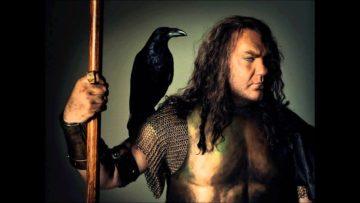
Take Richard Wagner as a classic example. Read more »
Helicopter and mountain in Franzensfeste, South Tyrol. Photo taken in May of 2021.
by David Oates

In the plague year I walked every day, just about. It added up to a long journey of surprising homeliness. A solidarity of strangers. A neighborhood of distance and vista. A journey far and yet without the lie of the exotic.
It began in March over a year ago now. Since I was about to turn seventy, I had been planning a Big Do: hired a violinist from our Portland orchestra, plus a pianist who was a splendid performer (and also my teacher on alternate weeks). They would play for my birthday guests: I hoped for part of Beethoven’s Spring Sonata, and something from Mozart; and to celebrate my wonderful piano, a couple of Goldberg Variations and some Chopin. Who wouldn’t love such an evening?! I sent out invitations weeks ahead. The musicians rehearsed at my home.
But with one week to go, the picture clouded. Do you remember how our collective predicament came on? Each day, we wondered – how bad is this, really? On Monday I sent a placating email to my guests: “We’ll all be masked, but follow your conscience. . .” On Wednesday another: “If you can’t make it, I’ll understand. . .” The situation ripened sourly, direly. Almost hour by hour came new reports: infection, contagion, danger. With one day to go, I cancelled it.
And went for a walk. Read more »