by Thomas Larson
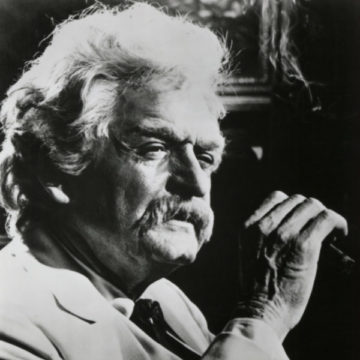
Samuel Langhorne Clemens, among the greatest and most widely read authors in history, is known everywhere by his pen name, Mark Twain. This was the nom de plume Clemens adopted in 1863 as a frontier columnist for The Virginian, a Nevada newspaper. There, he wrote satires and caricatures, bald hoaxes (fake news) and ironic stories of the wild pioneers he met and whose tales he embellished even further. His writerly persona came alive when he began lecturing and yarn spinning from a podium. Over time, his lowkey delivery, his deft timing, coupled with the wizened bumptiousness of a country orator in a white linen suit, captivated audiences in America and Europe, and on world tours. No one has embodied America, in its feral enthusiasms and its institutional hypocrisies, better than Clemens. Dying at 74 in 1910, he played Twain—rather, he became him—for 47 years.
In the early 1950s, a young actor from Cleveland, Ohio, Hal Holbrook, adopted the Twain persona for a stage act, aping the man’s appearance and cornpone speech and dipping into the goldmine of material—raucous tales to tell and witty saws to quip. Examples of the latter: “Dying man couldn’t make up his mind which place to go to—both had their advantages: Heaven for climate, Hell for company.” “Faith is believin’ what you know ain’t so.”
Holbrook developed the act before psychiatric patients, school kids, and Rotarians in the Midwest, then launched a polished performance in 1954 as “Mark Twain Tonight!” The stage: Lock Haven State Teachers College in Pennsylvania. Within a few years, he was on “The Ed Sullivan Show” and “The Tonight Show.” He debuted Off-Broadway in 1959, the show hitting Broadway in 1966 when Holbrook won a Tony. He went on to play Clemens’s Twain more than 2000 times from 1954 to 2017 when he retired the act. A record, no doubt, for a single role: 63 years, a decade and a half longer than Clemens himself played Twain. Read more »

 Over recent times, many books have been published with the aim of writing women into history and crediting them for the achievements they have made to the benefit of humanity more broadly. Janice P. Nimura’s The Doctors Blackwell is in that genre of women’s history and she effectively narrates the biographies of the first two remarkable women to study and practice medicine in the United States: Elizabeth Blackwell and her younger sister, Emily.
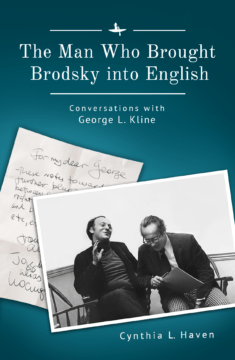 Cynthia, let me begin by asking you to describe your path to the book—a double path that led you to Joseph Brodsky and to George L. Kline.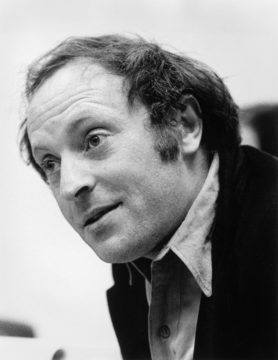
 Philosophy of science, in its early days, dedicated itself to justifying the ways of Science to Man. One might think this was a strange task to set for itself, for it is not as if in the early and middle 20th century there was widespread doubt about the validity of science. True, science had become deeply weird, with Einstein’s relativity and quantum mechanics. And true, there was irrationalism aplenty, culminating in two world wars and the invention of TV dinners. But societies around the world generally did not hold science in ill repute. If anything, technologically advanced cultures celebrated better imaginary futures through the steady march of scientific progress.


 For some time, Sir Kazuo Ishiguro has been slyly replacing Dame Iris Murdoch as the author to whom I most regularly return. His enchanting and disturbing new novel, Klara and the Sun, his first since winning the 2017 Nobel Prize, is unlikely to diminish this trend. I wrote in a
  have instrumental value. That is, the value of given technology lies in the various ways in which we can use it, no more, and no less. For example, the value of a hammer lies in our ability to make use of it to hit nails into things. Cars are valuable insofar as we can use them to get from A to B with the bare minimum of physical exertion. This way of viewing technology has immense intuitive appeal, but I think it is ultimately unconvincing. More specifically, I want to argue that technological artifacts are capable of embodying value. Some argue that this value is to be accounted for in terms of the