by Ashutosh Jogalekar
Grace Lindsay is a computational neuroscientist at University College London. She has just published a new book titled “Models of the Mind: How Physics, Engineering and Mathematics Have Shaped Our Understanding of the Brain“.
Most books about the brain take either a biological or philosophical approach, but Grace’s book is rather unique in exploring the brain through the physical sciences and really delving deeply into how well or poorly mathematical models of the brain can provide insights into its complex functions. The book is not only wide-ranging in its choice of topics but is also a lively journey through the history of these efforts and traces the lives of the eccentric and fascinating scientists who were instrumental in figuring out the brain’s working by using tools ranging from information theory and graph theory to Bayesian modeling and neural networks.
Below I chat with Grace about “Models of the Mind”, a clearly written and highly recommended journey through the intricacies of an organ that is the essence of what makes us human.
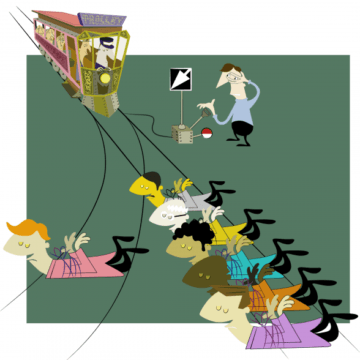 The first part of the original trolley problem goes like this. A runaway trolley is careening towards five people tied to the tracks. There’s a lever in front of you that could divert it onto a second set of tracks. Unfortunately, there is also a person tied to those tracks. You can either do nothing and let five people die or throw the switch and kill one person – but save the five. What do you do?



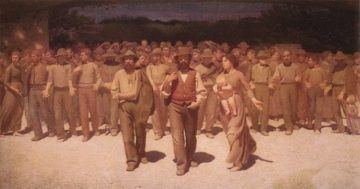 How should people on the ‘progressive’ side of politics view patriotism? That question continues to vex those who would connect with what they suppose are the feelings of the bulk of the population. The answer will vary a good deal according to which country we are considering – the French left, for instance, has a very different relationship to la patrie to that of the US or the UK. In the case of the former, the side cast as traitors has historically been seen as the right. In the USA, at least in the second half of the 20th century it has been very different: those who protested against the Vietnam war were cast as the anti patriots. And today, we still hear that the left ‘hates our country’. The accusation is a damaging one, and has been wielded with glee by conservatives whenever they have the chance. So there is a tricky task for the left, it seems: to be seen as with and not against the mass of people in their identification with the nation and its history, without abandoning an internationalist perspective that rises above the narrow nationalism of the conservative.
 Talking about “The Enlightenment”, when understood as something like “an intellectual and philosophical movement that dominated the world of ideas in Europe during the 17th and 18th centuries” (thanks,
 Sughra Raza. Untitled, April 2021.


 car when driving alone. Yet my momentary career as a musical performer—exceedingly brief as it may have been—enjoyed a spotlight rarely offered to others.