
by Michael Liss
My idea of an agreeable person is a person who agrees with me. —Benjamin Disraeli
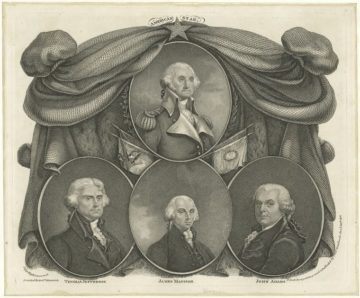 John Adams was not the kind of man who easily agreed, and it showed. Nor was he the kind of man who found others agreeable. Few have accomplished so much in life while gaining so little satisfaction from it. When you think about the Four Horsemen of Independence, it’s Washington in the lead, Benjamin Franklin, Thomas Jefferson and, last in the hearts of his countrymen, John Adams. You could add to that mix James Madison and even the intensely controversial Alexander Hamilton, and, once again, if you were counting fervent supporters, Adams would still bring up the rear.
He was an exceptionally talented man, willing to take up unpopular causes, to assume enormous personal risks. He was also dedicated, patriotic, and just a royal (in the “democratic” sense of the word) pain. Of Adams, Franklin once said, “I am persuaded however that he means well for his Country, is always an honest Man, often a Wise One, but sometimes and in some things, absolutely out of his Senses.”
Adams knew it as well. He understood both his flaws and his place in the firmament. He wrote to his friend Benjamin Rush: “The Essence of the whole will be that Dr Franklins electrical Rod, Smote the Earth and out Spring General Washington. That Franklin electrified him with his Rod—and thence forward these two conducted all the Policy Negotiations Legislation and War.”
Nevertheless, after eight years of being George Washington’s loyal (but largely unheeded) Vice President, he had just enough support to be elected to succeed him in 1796. As much as he wrestled with his own ego and even his insecurities, he (and Abigail) thought he had earned it, and he had. Read more »

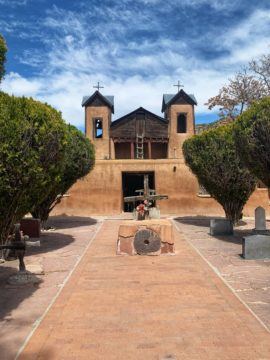
 Shada Safadi. Promises. 2014.
 The overwhelming majority of pre-service and in-service teachers I have worked with over the past two decades believe that they should, first and foremost, love, care, and nurture their students. Everything else associated with what is euphemistically called “best practice,” they believe, will follow. When pushed to describe what loving, caring and nurturing their students actually looks like within and beyond the classroom and school—in theory and practice—many of them have trouble getting beyond superficial appeals to “multiple intelligences,” “diversity,” “safe spaces,” and “culturally responsive pedagogy.” Focused primarily on making their students feel safe and emotionally supported, they’ve reduced their pedagogical responsibilities to a metaphorical big hug. Stir in a tablespoon of standardized ideological content, blend with a half cup of research-based strategies, add a pinch of job training/college prep, stir in a few high-stakes tests and, voilà, the neoliberal agenda for public education is rationalized and set.
 3QD editor Abbas was desperate. After more than a year of pandemic life, much of it spent in a state of semi-lockdown, he and his partner had run out of shows to watch. So he did what any abject and forlorn person in his situation would do: he solicited recommendations via social media. I then did what any person who has spent the last year watching far too much TV and thinks far too much of his own opinion would do: I emailed him scores of streaming titles, replete with very brief descriptions.
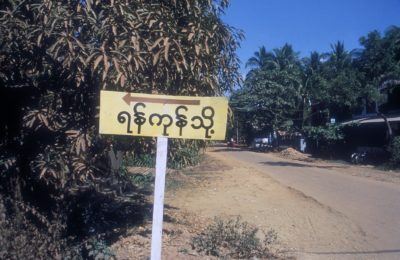 Aye Chan Zin, a 22 year old competitive cyclist, once raced from Yangon to Mandalay and back. He fell and lost both incisors to gold teeth.

 For the past year or so there have been a considerable number of cases of teachers or authors or journalists who have been threatened with sanctions, had sanctions imposed, or lost their positions, because of articles they wrote or statements they made as part of their occupations. Many of these cases involved the appearance of the N-word in their speech or written work. Here are some of them.
 Please, See My Innocence
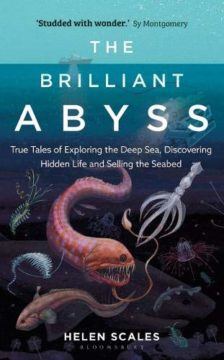 Marine biologist Helen Scales’ book, The Brilliant Abyss: True Tales of Exploring the Deep Sea, Discovering Hidden Life and Selling the Seabed is a triumph. The four major sections in the book, ‘Explore’, ‘Depend’, ‘Exploit’ and ‘Preserve’ are indicators of the breadth of issues addressed in the book: the variety of life forms in the different levels of the oceans; the significance of the oceans to life on the planet; the various ways in which human activity exploits the oceans resources, and concludes with her ideas about how to prevent the ocean from becoming just another area of resources of the planet for exploitation by human beings.
 Sughra Raza. River Magic. May, 2021.
 Small poetry presses are the gold dust of the publishing world, glittering yet easy to miss. And of enduring cumulative value.
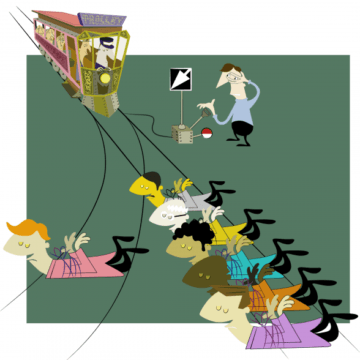 The first part of the original trolley problem goes like this. A runaway trolley is careening towards five people tied to the tracks. There’s a lever in front of you that could divert it onto a second set of tracks. Unfortunately, there is also a person tied to those tracks. You can either do nothing and let five people die or throw the switch and kill one person – but save the five. What do you do?