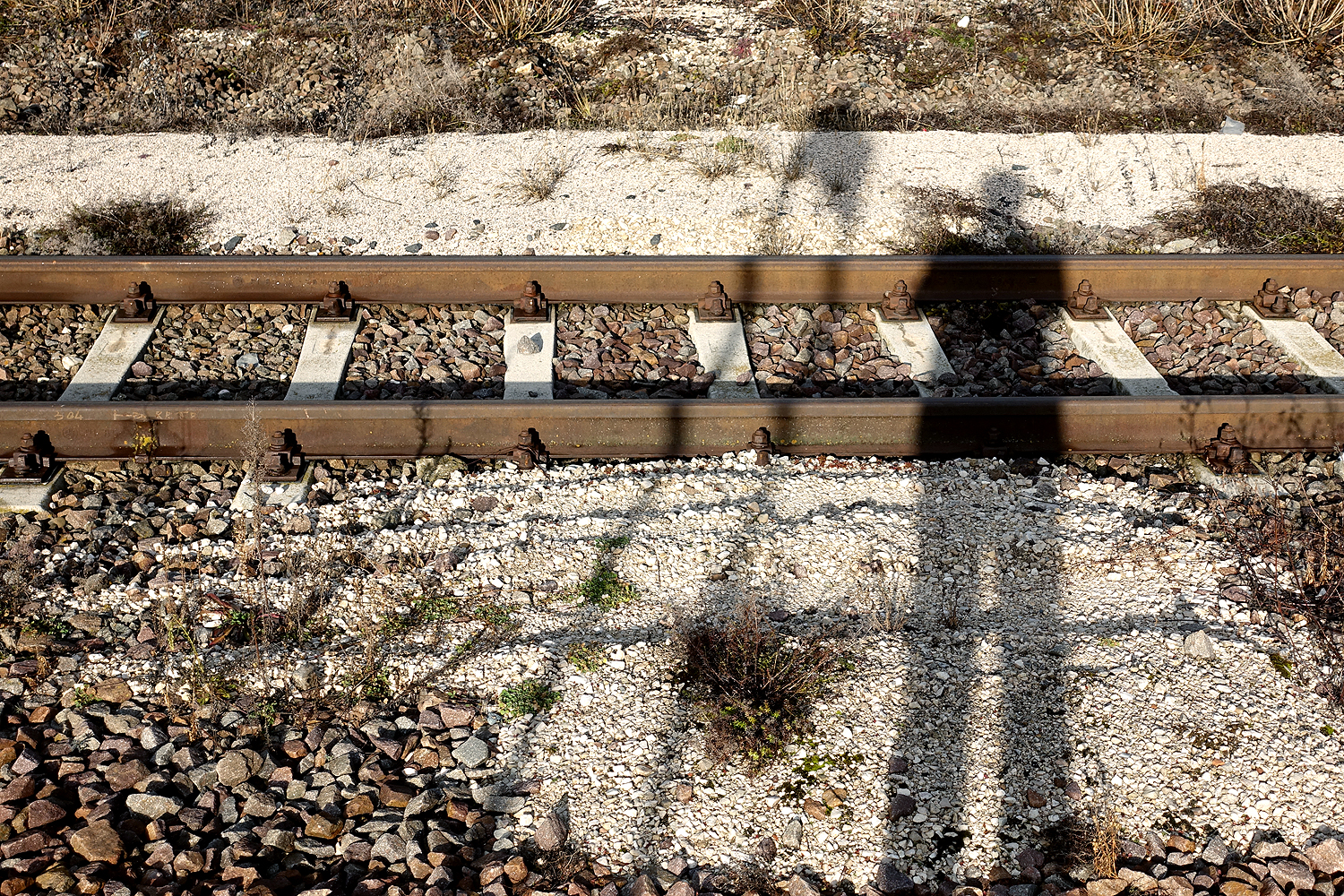
Shadow self-portrait at the train station in Bruneck, South Tyrol.

Shadow self-portrait at the train station in Bruneck, South Tyrol.
by David Greer

My property on Pender Island is just a postage stamp of a lot by rural standards, but the immensity of the surrounding stillness of the Pacific rainforest feels more precious to me than the numbers representing its square footage. With no other human dwellings within sight or hearing, the stillness is the silence of a cathedral in these weeks before Christmas, with the murmurs of devoted parishioners replaced by the soft chatter of Pacific wrens among the sword ferns, the nasal queries of a red-breasted nuthatch marching down a fir trunk, the gravelly chuckle of a raven passing overhead, and the slow creaking of an antique carriage clock being rewound deep in a cedar—the winder being a Pacific chorus frog perilously close to dormancy on a day threatening a hard frost. Much less audible, high in the canopy, are the whisperings of the tiny insect-hunters and seed-eaters that depend on the treetops for food: chestnut-backed chickadees, golden-crowned kinglets, pine siskins.
In this part of the world, on this island in the Salish Sea, the trees grow very large indeed. The aptly named grand firs may reach 250 feet and Douglas-firs are frequently taller, over 300 feet in some cases. In height though not in majesty they overshadow the western red cedars and bigleaf maples that dominate the glade in which my cabin stands, a quarter mile from the Canadian edge of Haro Strait and within hearing of the largest of the massive container ships struggling against the incoming tide.
Every tree has its own character. Outside the cabin stands a massive bigleaf maple (Acer macrophyllum) that has been through the wars but has risen again to defy the next winter storm. From time to time she drops branches as big as smaller trees (I have watched them fall) yet still carries on like some old limbless veteran, surviving by sheer will despite gaping holes in her trunk that delight children with supple imaginations. Read more »
by Mike Bendzela
Sleepless one Christmas Eve . . . monkey brain, coffee at 3 a.m. . . . then back to bed to stare at purple and green fireworks on the insides of my eyelids.
Meanwhile, my husband, the retired carpenter, saws wood loudly beside me. He is recovering from both cancer and stroke.
A chorus of human voices fills the room, no comprehension—it’s Latin—the words so swaddled in harmonic echoes they lift and disperse in the bedroom like smoke from a censer. The choir floats me to the edge of transcendence, sets me down like a feather. What is this?
From the radio turned down low, the announcer says: “This is what the season is all about—‘O Magnum Mysterium.’” No surprise here, the day before Christmas.
I think: This is what I should have heard at the Smithsonian a couple of years ago, at the Museum of Natural History, in the big, quiet room darkened but for spot-lit, black stone slabs, the Burgess Shale fossils, found a century ago in British Columbia by Charles D. Walcott, with his horses and pickaxes. These stones reveal life from half a billion years before present, give or take a few million.
This is my pilgrimage. But it’s sad to find myself alone in this exhibit, with this magnificent find. One must study the black slabs up close and judiciously, like the brush strokes of Old Masters, to appreciate the wonders there. Read more »
by Thomas R. Wells
 When people take to the street to protest this is often supposed to be a sign of democracy in action. People who believe that their concerns about the climate change, Covid lockdowns, racism and so on are not being adequately addressed by the political system make a public display of how many of them care a lot about it so that we are all forced to hear about their complaint and our government is put under pressure to address it.
But what about this is democratic?
In a democracy we are supposed to accept the outcome of the democratic process, involving reasoned public debate and free electoral competition for positions of public power. The fact that people protest when they don’t accept the outcome of the democratic process is a rather clear sign that protests are a non-democratic activity at best, and at worst an attempt to override and undermine democracy itself. I have in mind particularly the recent climate change related protests in the UK which seem to be spreading and becoming increasingly aggressive, but also recent events like the farmers blocking roads in the Netherlands, the truck drivers blockading Canadian cities and borders, and so on.
At best public protest is non-democratic. It aims to get attention (primarily from the news media) and thus to get the protestors’ complaint higher up in the political agenda – the things the government is expected to have an answer to. Success depends on the quantity of attention the protestors can attract, and this is proportionate to the amount of drama they can cause rather than the quality of their complaint (i.e. its reasonableness). It is thus a kind of democracy hack, like the search engine optimisation companies engage in to get higher on Google’s search results and so get more attention from potential customers. Read more »
If you talk about it, it’s not Tao
If you name it, it’s something else
……………. —Lao Tzu, the Tao Te Ching
At first I think, I’ve got it!
then I think, oh no, that’s not it,
I think, it’s more like a flaming arrow
shot into the marrow
of the bony part of everything
…. ah, but some summer nights
…. it’s hanging overhead so bright
then right there I lose it,
let geometry and time confuse it,
then it’s silent and won’t sing a thing,
…. but some summer nights
…. it’s croaking from a pond so right
then again, I lose it,
let theology and time confuse it
then it’s silent and won’t sing a thing
…….. I’m thinking I’ve been here before
…….. feet two inches off the floor,
…….. thinking, is this something true?
and sometimes I think, I’ve lost it!
though I never could exhaust it,
because it’s lower than low is
… and wider than wide is
……….and it deeper than deep is
…………….and higher than high is,
…. ah, but some fresh spring days
…. it’s cutting through the fog and the haze
…….. I’m thinking I’ve been here before
…….. feet two inches off the floor
…….. thinking, is this something true?
by Jim Culleny
© 2015
Rendering in song: Here
by Paul Braterman

In 1954, at the height of the McCarthyite Red Scare, the anti-evolution preacher John R. Rice asked his audience to whom Marx had dedicated The Communist Manifesto. The answer, he shouted out, was Charles Darwin. It is doubtful whether Marx had even heard of Darwin when he and Engels wrote the Manifesto in 1848, but that is the least of Rice’s errors.
 Carl Weinberg, in his excellent Red Dynamite, an overview of the deep links between evolution denial and right-wing politics in America, points out that Rice had the wrong book; he should have been referring to Das Kapital. But as we now know, even if he had been he would still have been wrong. Wrong book, wrong date, wrong author, wrong about Darwin’s response to the request to dedicate.
The matter is well summarised by Richard Carter, reporting in The Friends of Charles Darwin on a paper by Margaret Fay in The Journal of the History of Ideas. The same conclusions had been reached, independently, by Lewis Feuer, and Fay’s paper has a long discussion regarding their relative priority, and describing differences of interpretation between them. As for the belief that Marx had wished to dedicate Das Kapital to Darwin, Fay traces this to Isaiah Berlin, probably misunderstanding what Darwin actually did say in a letter to Marx. Read more »
by Derek Neal

I write this essay as much for myself as for the reader. It is my conviction that one writes to find out what one thinks, not to put down fully formed thoughts that are floating inside one’s head.
Some sort of alchemy occurs when I put pen to paper, or in this case, pen to screen, as I set down the stuff knocking about my brain and give it a more solid, permanent form. But why do I insist that what I write comes from within me? To say that my words flow from my own head, down my arm, and into the writing instrument is simply the representation of a process I don’t fully understand. The bards who sang epic poems in ancient Greece did not view their creations in this way, as coming from within, but as being inspired from without, inspire in this case taking on its original meaning: to breathe into. The poets began their stories by invoking the gods, or muses, in the hope that the spirit might be blown into them, filling them up and allowing them to translate that spirit into words and music for the benefit of an audience. It may be that we could also think of writing in this way. Since I’m writing an essay, I might invoke the spirit of Montaigne, call upon him to breathe life into my pen and help shape my words, but it may also be that literacy itself precludes this, that literacy and the written mode of thought are fundamentally interior activities, a conversation with oneself, and that something about the written word lends itself to being thought of as coming from inside of oneself, whereas the spoken word seems to come from “out there,” with the speaker being a vessel giving form to something of which they are not the origin. Read more »
by Ada Bronowski

Why celebrate first times? If, admittedly, from the first time you have sex to the first time you taste escargots à la bourguignonne, hear Allegri’s Miserere or read Dostoevsky’s Demons, you, personally, undergo internal cataclysms which change you permanently, are not these moments blatant gulfs of ignorance and inexperience that you thankfully succeed in filling and should feel shame and embarrassment, if anything, about not having gotten done before? There always is a before, and the first time for you is the last for everyone else. So why do we nevertheless persist in sacralising first times both for ourselves and others?
One answer is that it is easier. It gives a fast-track meaning to our individual lives. First times map out each of our individual paths in life, fixes down memories and, with hindsight, provides us with explanations for our actions and more often than not, for our failings. But such doting smacks ultimately of self-indulgence, turning into meaningful exploits, essential steps required of us in order to realise our humanity – a task set upon all of us whether we like or not.
When Aristotle suggested that the way living beings are immortal is through the perpetuation of the species, he spelt out a hope and a burden. The hope that what individuals achieve in their short lives, lives on after them through the generations to come, like Archimedes’ eureka moment when he discovered the equal weight displacement in water of a solid body – no one after him can claim eureka about that: once discovered forever treasured. But it is also a burden: for every generation of the species has to catch up with everything that was done before, if it is to claim its right to the name of that species. And that is why the immortality of man is set apart from that of all other living species. For all other animals, the hope and the burden of immortality are one and the same: to survive, from sea turtles to sloths or canaries, animals must, but also cannot but, live up to all the promise of their species. Read more »
by Rebecca Baumgartner
While watching a Christmas movie recently and hearing a character describe something as a “Christmas miracle,” my 8-year-old son scornfully exclaimed, “That’s not a Christmas miracle, that’s a Christmas coincidence!” He was right, of course, but despite that outburst, he’s not the kind of kid who would tell the other third-graders that Santa’s not real or ask uncomfortably pointed questions about baby Jesus. He’s the kind of kid who works on a project about Diwali and shows genuine curiosity and appreciation for the beauty of the ceremony. And he’s absolutely right about that, too. He has already learned to straddle the line that all secular people must learn to navigate: declining to accept extraordinary claims without extraordinary evidence and honestly pointing out falsehoods, while respecting the social contract and generally being a well-adjusted and likable human being.
This time of year is just as heartwarming for secular folks as it is for religious ones, even if there are a fair number of eye-roll-inducing “Christmas coincidence” moments. I have fond memories of singing in the choir during my college’s Christmas candlelight service, harmonizing in the darkened, musty-smelling, flame-flickered chapel and awkwardly turning sheet music while trying not to spill hot wax on myself. There is no requirement to believe in virgin births in order to feel the closeness and vastness of a moment like that, and it would be small-minded to insist that there is.
Whether you believe in Christmas miracles, Christmas coincidences, or don’t celebrate Christmas at all, it’s the time of year when we naturally want to nestle in blankets and compile lists, so that is exactly what I’m going to do. Here are a few secular comforts and joys that have lent their magic to the end of 2022 for me. Read more »
by Brooks Riley
by Joseph Shieber

Credit: Wellcome Library, London.
Famously, the philosopher and mathematician Alfred North Whitehead referred to all of philosophy as “footnotes to Plato.” Actually, he wrote that, “The safest general characterization of the European philosophical tradition is that it consists of a series of footnotes to Plato. I do not mean the systematic scheme of thought which scholars have doubtfully extracted from his writings. I allude to the wealth of general ideas scattered through them.” (Whitehead, Process and Reality)
Now, Whitehead intended this statement as a tribute to “the wealth of general ideas” that we can find in Plato. There is, however, another way to read the statement, a way that is not flattering at all to philosophy itself.
According to this other, less flattering reading, all of the major ideas that are still discussed by philosophers were already there in Plato, thousands of years ago. There are at least two ways in which this reading is unflattering for philosophy.
First, and most obviously, the statement suggests that there have been no significant new ideas in philosophy for over 2000 years. The big ideas, so the statement would have it, were already there in Plato; all the philosophers since Plato have only been able to add contributions worthy of nothing more than footnotes – that is, commentary or minor improvements.
Second, the statement paints an unflattering picture even when you consider the – plausible – point that not all philosophers after Plato have agreed with his positions. Here are a few reasons why. Read more »
by Jochen Szangolies
Picture the internet circa late 2000s, during the heyday of New Atheism: virtually everywhere, it seemed, people were embroiled in a grand crusade for truth, a final showdown of faith versus reason, religion versus science, revelation versus empiricism. On both sides, fallacy was the weapon of choice: demonstrate the logical error at the heart of your opponent’s argument—burn down their straw men, chase the true Scotsmen from their hiding spots, poison the cherries they pick—and add a notch to your belt.
These were simpler times, where truth was a monolithical concept, not the many-fingered, complex thing it has become, where universal principles reigned superior over context and individual perspective, where all of the crummy details of human life seemed just so much detritus to abstract away to find the common truth below—a truth that, you were sure, everybody would be compelled to accept, could they just manage to see past their various biases and prejudices. This vision has receded into the mist—and, one might say, good riddance: how much richer is the world in all its variety, where different perspectives cannot all be resolved into a grand, but bland homogeneity, but must find a means of peaceful coexistence, where the individual is no longer neglected in favor of the supposedly universal, where we each might have a chance to live our truth. But let’s not get ahead of ourselves. Read more »

The river Eisack flowing through Franzensfeste, South Tyrol, a couple of days ago.
by Bill Murray
 It’s 6:15 on the Erakor Lagoon in Vanuatu. Women in bright print skirts paddle canoes from villages into town. Yellow-billed birds call from the grass by the water’s edge, roosters crow from somewhere, and the low rumble of the surf hurling itself against the reef is felt as much as heard.
Every morning the sky is grayer than blue. Clouds hang close to the hills and the water is green glass, reflecting jungle. We’re staying on a tiny island near the capital city, Port Vila. Last night the heavens inflicted a pounding rain just as we arrived at the ferry dock.
We rise to gasp at the wages of yesterday’s folly – snorkeling from an outrigger in the midday sun. Good bet we’ll stay out of the sun today; we could plausibly be served up as steak tartare, and anyway there’s the thunder, the no fooling rumble you feel through your bare, pink feet in the grass, through the earth.
Vanuatu’s colonial name was New Hebrides. It’s about 80 islands a thousand miles east of Australia. When colonial hands came off, Port Vila was left more British than French. The two countries governed the New Hebrides in an arrangement they called a condominium from 1906 until independence in 1980. Read more »
by Michael Abraham
It has all gotten too technicolor for Dorothy Gale. The trees and the grass are too green—not to mention the Emerald City (she had to take the glasses off several times to rub her eyes)—and the slippers are much too silver, or were they ruby? There are so many colors she is getting confused. The eyes of her friends, these queer little friends she has made, they are much too luminous for her, glittering, glittering, their eyes—it is driving her crazy. Yes, crazy: Dorothy is going crazy in Oz. She stares at the basket of the Wizard’s balloon, and she prays for wind, prays ardently. See, Dorothy has killed a witch, befriended a witch, killed another witch. Dorothy has done all the work of a messiah. She is tired, but, more than tired, her mind is starting to come a little undone at its edges. She loves these odd friends of hers, and she loves the feeling of being on an adventure, but, all along, she has been yearning for quite the opposite of adventure, for home. Not because home is all that special. Home is sepia and boring and full of responsibility. She’s yearning for home because there is something sinister beneath all the brightness of Oz, something dead sent against her flourishing. Kansas is safer. There are no witches to vanquish in Kansas. See, Dorothy never set out to be any kind of hero. She was just in the wrong cyclone at the wrong time. But she feels herself to be so much herself, so overmuch, when in Oz that it is starting to drive her mad. This grandiosity of being a slayer of witches. Dorothy Gale has become much too much of herself, and she is coming undone. So she stares at the balloon, and she prays for wind. And the wind comes, but it comes too soon. It carries off the Wizard. Read more »
Editor’s Note: Frans de Waal’s new book, Different: Gender Through the Eyes of a Primatologist, has generated some controversy and misunderstanding. He will address these issues in a series of short essays which will be published at 3QD and can all be seen in one place here. More comments on these essays can also be seen at Frans de Waal’s Facebook page.
by Frans de Waal
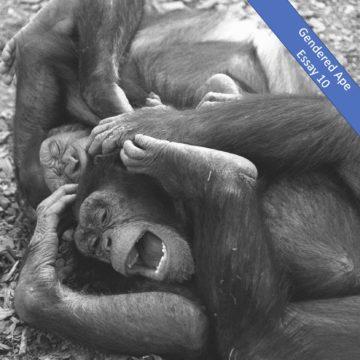
No one can deny the traditional (and ongoing) gender inequality in human society, which disadvantages girls and women. It’s a huge injustice that we need to fight.
But who says that elimination of gender differences is the solution? Or that we need to promote gender-neutrality?
Of the two words in “gender inequality,” only one is a problem, and it isn’t “gender.”
A fully gender-neutral upbringing of children may not even be feasible. Human biology isn’t blind to sex. The breastmilk of mothers, for example, varies dependent on whether she’s nursing a boy or a girl. Milk for male babies has a greater energy content. Milk of monkey mothers shows the same difference.
Young male primates are more energetic and rambunctious than same-aged females. When hundreds of children in different nations were outfitted with accelerometers to measure body movements, boys showed far more bursts of vigorous locomotion than girls. That boys are also three times more likely than girls to be diagnosed with attention-deficit/hyperactivity disorder (ADHD) reflects the same difference. Read more »
by Rafaël Newman
Because I work part time developing a terminology database at a large econometric institute; and because it is important that, in this capacity, I remain abreast not only of raw vocabulary but also of the substance of recent developments in financial technology, known by its Orwellian moniker “FinTech”; and because the owl of Minerva flies at dusk—for all these reasons I recently dusted off my book-bag, packed my reading glasses and a roll of antacid, and registered for a course on blockchain, crypto, and digital currencies.
The three-month program I attended, leading to a so-called Certificate of Advanced Studies (CAS), was offered at the University of Zurich’s Blockchain Center, an interdisciplinary institute ranked fourth for university teaching of distributed ledger technology worldwide. And indeed, my fellow students had come from as far afield as Australia, India, and Brazil, as well as from various corners of Switzerland and Europe, presumably in the hopes of profiting from cutting-edge technical expertise in their work back home as computer programmers, bankers, and jurists.
Instruction was provided by a changing roster of professors in three modules of several full days each, devoted respectively to the IT, economic, and legal dimensions of the new(ish) technology. Each module was punctuated by an assignment, to permit evaluation of the participants: the IT module closed with an online multiple-choice test; the economic component was rounded out with a series of group-work exercises; and the legal section, and thus the course as a whole, concluded with a written essay, on a topic chosen from among suggestions made by the various professors, one of whom, depending on the student’s choice of topic, would then serve as supervisor. Read more »
“Shu” is the single teaching of Confucius and “jen”
it’s counterpart. Shu means reciprocity; jen is love,
kindness and goodness. T’ien is heaven.
–Confucius and the Teaching of Goodness
Goodness came as two hearts and sat beside me.
“My name is Shu,” they said. At that moment
two birds flew through an open window generously wide
and, pointing, Shu said, “Jen.”
The two hearts of Shu, in duet, said,
“What can we do for you?”
The two birds of Jen sang,
“Looks like you need a friend.”
“The world is split in two, and so are you,” said Shu
“See the birds of Jen, she said? They feed each other and
so are free in T’ien.”
“Think of me,” said Shu
and you may be free too.”
Jim Culleny, 6/18/11
by David Kordahl
I’ve been thinking again about the relationship of scientists to the history of science. Lorraine Daston, the historian and philosopher of science, was recently interviewed for Marginalia, where her interviewer asked a strongly worded question. “Scientists are—I don’t want to put it too provocatively—but frankly they’re afraid of the history of their own discipline. What do you think that means?”
Daston was not quite willing to put all the blame at the feet of scientists. Historians of science, she remarked, have become more specialized, making their work less useful to scientists. Likewise, philosophers have failed to “remake of the concept of truth that does justice to the historical dynamism of science.” But then there’s the scientists themselves, who “consider almost anything which is not within their discipline, including other sciences, to be blather. So, there’s quite enough blame to go around in terms of explaining […] this impasse of mutual incomprehension.”
When this interview was released, it prompted some online chatter. Some scientists reading the interview did not see themselves in Daston’s characterization, since scientists do not, in general, consider themselves uninterested in the history of science—quite the opposite. The problem, for such history-interested scientists, was of approach rather than content.
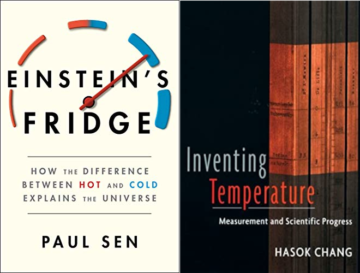
To explore the basic distinction between “science history for scientists” and “science history for historians-and-philosophers-of-science,” I’ll use two complimentary books. Einstein’s Fridge: How the Difference Between Hot and Cold Explains the Universe, out last year from the science writer Paul Sen, exemplifies the former approach, where history provides a narrative scaffold to lead us gently toward our modern scientific theories. Inventing Temperature: Measurement and Scientific Progress, the 2004 work by the historian and philosopher of science Hasok Chang, is a classic example of the latter, where history is used as a proving ground to show that science and its history is more complicated than most scientists care to admit. Read more »
 Loriel Beltran. P.S.W. 2007-2017