
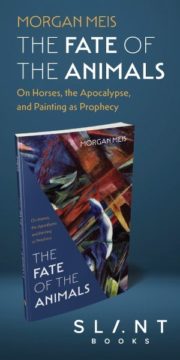
 The Fate of the Animals: On Horses, the Apocalypse, and Painting as Prophesy (Three Paintings Trilogy), by Morgan Meis, Slant
Review by Leanne Ogasawara
- The discovery of a book of letters written by a soldier and artist to his wife during World War I, and the recognition of this book of letters drives us into a consideration of the Great War, which was a kind of Apocalypse.
In 2011, philosopher and art critic Morgan Meis is wandering the halls of the Museum of Modern Art in New York City. A show on German Expressionism is on, and Meis finds himself transfixed by a certain picture. It is Franz Marc’s 1913 oil, The World Cow. The languid rust-colored creature in the painting calls to mind a cow seen in real life. Recognizing those eyes, Meis recalls its patient stare. Wasn’t there perhaps a hint of rebuke in the cow’s eyes?
This cow becomes the moment of possession. Or perhaps it was more like the first beckoning; for a year or so later Meis stumbles on a book of collected letters that the German painter wrote to his wife whilst a soldier in the Great War. It would be in the war where Franz Marc would lose his life, his skull shattered by a bullet.
Meis is hooked.
Meis’s next stop is Switzerland, where he and his dear friend Abbas Raza—to whom the book is dedicated– stand before Franz Marc’s monumental 1913 The Fate of the Animals, in the Kunstmuseum, Basel. At first glance, he thinks it is a work of early abstract art. With its strong slashes of primary colors, the immediate impression is one of violence. Looking closer, however, the animals come into focus. There is a bluish deer in the lower center, appearing in grave distress. Is the deer being sacrificed? And if so, to what purpose, he wonders. Other animals—including boars and horses—can be just made out among the shafts of color. Is this the end of the world? Read more »
 Scheduled departure at Dulles came and went as we waited for the last passenger to board. Although the non-smoking section in the rear cabin was full, the smoking section where I sat was half empty. Death by asphyxiation on the flight to Paris was a distinct possibility but with three empty, adjacent seats in the centre nave there was some chance that my obituary might read, “She died peacefully, in recumbent sleep.”
 Indifference is an attitude first theorised as a philosophical stance by ancient Greek Stoic philosophers from the 3rd century BC. It was conceived as the right attitude to cultivate in reaction to indifferent things. What was surprising were the things the Stoics considered to be indifferent and hence require us to be indifferent to. Not your usual ‘whether the number of hairs on your head is odd or pair’, or the number of billions of stars in the galaxy, or even what colour underwear your boss wears – though in some circumstances, the latter can start becoming titillating. And titillation is of course what it’s all about. It’s the tickle that spurs the Stoic to resist it. Resisting what exactly? Feeling, uncontrolled gratification, heart-melting, giving in, touching, kiss-&-make-up-ing.
 Deborah Roberts. Shankia and Grace. 2021.
 According to the meta-charity


 There are certain words that seem to take on a life of their own, words that spread imperceptibly, like a virus, replicating below the level of consciousness, latent in our environment and culture, until suddenly the word is everywhere, and we are afflicted with it. We may even use these words ourselves: we struggle to find the right phrase, the true word to capture our intention, and these words come to us unbidden, floating into our minds from somewhere out there, and we speak the word without understanding what we really mean, but we see understanding and acknowledgement in the face of our interlocutor, and we know we have hit upon the correct utterance that will mark us as one who belongs.
 Naomi Lawrence. Tierra Frágil, 2022.
 Come die with me.